Commercial & Hospitality
The Coastal Resort Common-Area Custodial Specialist Career Pathway: Technical Floor-Safety Auditing, Sand-Slurry Mitigation, and Hospitality Compensation Models in Myrtle Beach
Discover the technical skills, professional certifications, and competitive compensation structures required to build a high-performing resort custodial team on the Grand Strand.
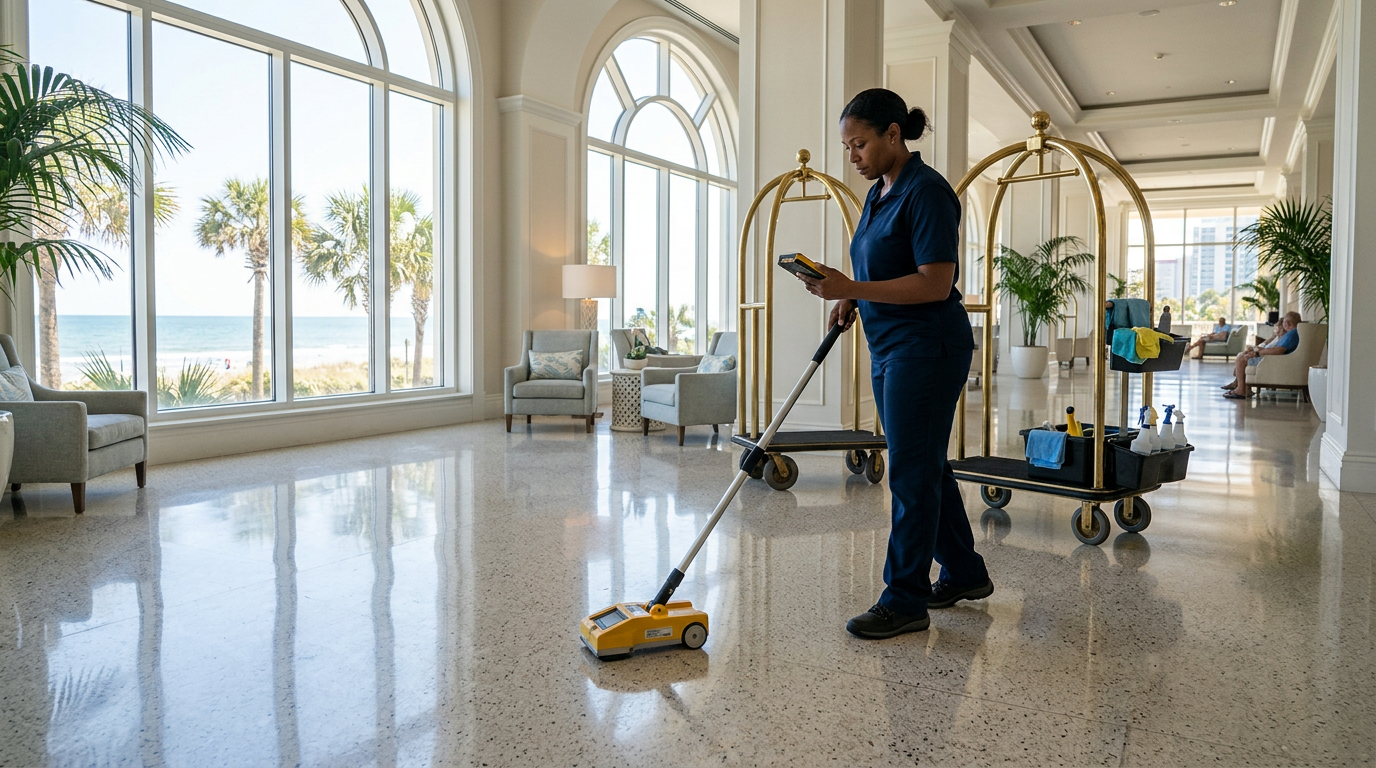
Managing the common areas of a busy Grand Strand resort requires a specialized skill set far beyond basic commercial cleaning. High-traffic oceanfront lobbies, wet elevator vestibules, and pool-to-lobby transitions face a continuous onslaught of abrasive sand, salt-laden moisture, and heavy foot traffic. To protect valuable property assets and ensure guest safety, property managers must transition from hiring general cleaners to recruiting and training certified Coastal Resort Common-Area Custodial Specialists. This guide outlines the professional career pathway, technical competencies, and local hiring frameworks necessary to build a world-class hospitality custodial team in Myrtle Beach.
The Environmental Demands of Grand Strand Oceanfront Common Areas
Grand Strand resort common areas present a unique set of challenges that standard commercial janitorial services rarely encounter. An oceanfront lobby acts as a high-velocity transition zone where thousands of guests drag abrasive beach sand, salt-laden moisture, and chlorinated pool water across delicate surfaces. A professional custodial specialist must understand that these elements chemically degrade stone, luxury vinyl tile, and carpets if left unmanaged. Mitigating this constant environmental wear requires a strategic, proactive approach to surface care rather than simple reactive mopping.
The presence of salt-air humidity further complicates common-area maintenance by preventing moisture from evaporating naturally from hard surfaces. When combined with fine silica sand, this lingering dampness forms an abrasive grey slurry that acts like sandpaper under the feet of busy vacationers. Left unchecked, this slurry strips away protective floor sealers, dulls natural stone, and embeds deep into textile fibers. Understanding the chemical nature of this coastal soil is what elevates a basic cleaner to a specialized resort custodian.
Transition zones, such as elevator vestibules and pool-to-lobby entryways, require continuous monitoring and tactical intervention throughout the day. A specialized custodian designs and executes an hourly rotation plan that targets these high-risk areas before moisture and grit can migrate deeper into the building's interior. This zoning strategy preserves the building's capital assets, reduces the frequency of expensive deep restorations, and maintains a clean, professional environment that aligns with guest expectations.
- Continuous monitoring of high-velocity transition zones to intercept sand and water at the building envelope.
- Proactive management of salt-air humidity on hard surfaces to prevent the formation of abrasive grit slurry.
- Hourly rotational cleaning schedules focused on elevator vestibules, main corridors, and public restrooms.
- Preservation of costly resort floor finishes through targeted, chemical-specific soil neutralization.
Technical Floor-Safety Auditing and Slip-Fall Mitigation
The primary responsibility of a resort custodial specialist is mitigating slip-and-fall risks on wet, high-traffic flooring. Coastal moisture, condensation, pool runoff, and sudden summer rainstorms can turn a polished tile lobby into a liability hazard within minutes. Specialists are trained to perform regular floor-safety audits, monitoring the Static Coefficient of Friction (SCOF) of walk-off mats and hard surfaces. They understand how to deploy high-velocity air movers and wet-floor signage strategically without impeding guest traffic flow.
Chemical selection is critical when managing wet-zone safety in a coastal resort environment. Traditional soap-based cleaners leave a microscopic film that actually attracts dirt and becomes incredibly slippery when re-wetted by humid coastal air. Custodial specialists utilize specialized neutralizers and non-film-forming detergents that break down salt crystals and emulsify body oils from bare feet. This advanced chemical knowledge ensures that cleaned surfaces remain safe, dry, and slip-resistant throughout peak check-in hours.
Walk-off mat systems serve as the first line of defense against both moisture and abrasive sand. A trained specialist doesn't just vacuum these mats; they manage their saturation levels and placement. When a mat becomes waterlogged during a busy pool afternoon, the specialist swaps it with a dry, clean replacement to maintain its moisture-extraction capability. This systematic management of entryway textiles prevents water from tracking onto polished tile surfaces, dramatically reducing liability risks for the property.
- Regular monitoring of Static Coefficient of Friction (SCOF) to ensure surface safety under wet conditions.
- Elimination of soap-based cleaners to prevent the accumulation of slick, dirt-attracting residues.
- Strategic deployment of high-velocity air movers and highly visible, professional warning signs.
- Proactive management and rotation of walk-off mat systems during high-traffic pool and beach hours.
Professional Training Pathways and Industry Certifications
To elevate custodial work into a respected career, Myrtle Beach resort operators should look for or sponsor formal industry certifications. The Clean Trust (IICRC) offers foundational courses in carpet cleaning, floor care, and odor control that are highly relevant to coastal environments. Additionally, the ISSA Cleaning Management Institute (CMI) provides structured training programs that cover green cleaning practices, advanced chemistry, and customer service. Investing in these certifications turns entry-level workers into highly skilled technical technicians.
OSHA-10 certification is another critical milestone for a professional custodial specialist. This training ensures that team members understand chemical safety, personal protective equipment (PPE) protocols, and bloodborne pathogen response procedures. In a busy resort setting where bodily fluid cleanups and chemical handling are common, this knowledge is essential for workplace safety. Certifying your team in OSHA standards protects both the staff and the resort from costly compliance failures and operational accidents.
Local training must also include hands-on instruction in operating advanced commercial machinery, such as automatic scrubbers and low-moisture carpet extractors. Technicians must demonstrate proficiency in equipment calibration, daily maintenance, and battery-charging protocols before operating these expensive assets on the resort floor. This comprehensive training pathway ensures that staff members feel confident in their technical abilities, leading to higher job satisfaction and improved equipment longevity.
- IICRC certification pathways in carpet cleaning, hard floor care, and odor mitigation.
- ISSA Cleaning Management Institute (CMI) credentials for advanced custodial maintenance.
- OSHA-10 safety training covering chemical handling, PPE, and bloodborne pathogens.
- Hands-on equipment validation audits for commercial automatic scrubbers and extractors.
Behavioral Interview Blueprints for Hospitality Custodial Candidates
Hiring managers must look beyond basic cleaning experience to find individuals who can thrive in a fast-paced, customer-facing resort environment. Behavioral interviewing is the most effective tool for evaluating how a candidate handles stress, prioritization, and guest interactions. Questions should be designed to reveal the candidate's problem-solving abilities when faced with conflicting demands, such as a spill in a public restroom during peak check-in hours.
An effective interview question might ask: 'Describe a time when you noticed a safety hazard, like a wet floor, while you were in the middle of another urgent task. How did you handle both situations?' The ideal response demonstrates an immediate commitment to guest safety, showing that the candidate knows how to temporarily secure the hazard before continuing their primary task. This reveals a proactive, safety-first mindset that is crucial for resort environments.
Because custodial specialists work directly in guest-viewable areas, strong communication and customer service skills are mandatory. Ask candidates to describe an instance where a guest asked for directions or assistance while they were busy cleaning. A professional candidate will describe making eye contact, offering a warm greeting, and assisting the guest politely, viewing the interaction as an opportunity to enhance the resort experience rather than an interruption to their work.
- Use behavioral questions to assess situational judgment under high-pressure check-in scenarios.
- Evaluate safety prioritization by testing candidates on immediate hazard containment protocols.
- Screen for strong communication, eye contact, and hospitality-minded guest interaction skills.
- Assess problem-solving capabilities when managing conflicting priorities across expansive properties.
Grand Strand Compensation Architectures and Retention Strategies
To attract and retain top-tier custodial talent in the highly competitive Myrtle Beach market, resort operators must offer sustainable compensation models. Relying on entry-level, minimum-wage structures leads to high turnover, poor work quality, and increased training costs. Implementing a tiered wage structure based on technical certifications and performance metrics encourages technicians to view their role as a long-term career rather than a temporary seasonal job.
Providing year-round stability is one of the most powerful retention tools on the Grand Strand, where winter lay-offs are common. Forward-thinking resorts structure their operations to offer guaranteed hours during the slower winter months, shifting focus from daily guest-turn support to deep restorative floor care, tile sealing, and detail cleaning. This approach keeps skilled technicians employed year-round, ensuring a trained, cohesive team is ready to perform when the hectic spring season returns.
In addition to competitive hourly wages, offering meaningful benefits such as paid time off, health insurance contributions, and performance-based bonuses dramatically improves retention. A2Z Cleaning & Linen Services has found that recognizing and rewarding technical expertise fosters a deep sense of pride and loyalty within the team. When technicians feel valued and see a clear path for upward mobility, they deliver a higher level of care that directly benefits the resort's bottom line.
- Implement a tiered wage structure tied directly to professional certifications and technical skills.
- Offer guaranteed year-round hours by shifting to restorative deep cleaning during winter months.
- Provide meaningful benefits including health insurance contributions, paid time off, and performance bonuses.
- Establish clear career progression ladders to transition entry-level staff into lead technician roles.
Multi-Shift Team Structure and Daily Handoff Protocols
Maintaining a large coastal resort requires continuous custodial coverage divided into distinct morning, mid-day, and evening shifts. The morning shift focuses on heavy floor care, glass cleaning, and preparing the property for the day's arrivals before common areas fill with guests. The mid-day shift prioritizes high-touch disinfection, pool-to-lobby moisture containment, and quick response to spills during peak traffic hours. The evening shift handles deep detailing, trash consolidation, and public restroom resets for the following day.
Seamless communication between these shifts is critical to prevent maintenance gaps and outstanding safety issues from falling through the cracks. Implementing a structured digital handoff protocol ensures that critical information, such as active plumbing leaks, drying wet carpets, or malfunctioning equipment, is passed to the incoming shift lead. This prevents operational delays and ensures that safety hazards are addressed continuously without interruption.
The shift lead plays a vital role in monitoring chemical inventory, tracking equipment run times, and performing quality audits throughout their shift. By organizing the team into specific zones with clear checklists, the lead ensures that no area is neglected. This structured approach to multi-shift management creates accountability, streamlines resource allocation, and guarantees consistent, high-standard cleanliness across all common areas of the resort.
- Design distinct morning, mid-day, and evening shifts with tailored, zone-specific cleaning priorities.
- Implement structured digital handoff logs to communicate active safety hazards and equipment status.
- Empower shift leads to monitor chemical dilution systems and track daily equipment performance.
- Utilize zone-specific checklists to ensure consistent, comprehensive coverage across the entire property.
Advanced Hospitality Custodial Equipment and Preventive Maintenance
A professional custodial specialist must be fully proficient in operating and maintaining advanced commercial cleaning equipment. Automatic floor scrubbers, battery-operated vacuum sweepers, and low-moisture carpet extractors are essential tools for maintaining large common areas efficiently. Technicians are trained to adjust machine settings based on the flooring type, ensuring the correct brush pressure and water flow are applied to prevent damage to delicate surfaces.
Preventive maintenance is especially critical on the Grand Strand, where salt-damp air and abrasive sand accelerate mechanical wear and corrode metal components. Specialists must perform daily post-use maintenance, which includes cleaning recovery tanks, checking squeegee blades for wear, and rinsing out chemical delivery lines. Failing to perform these basic steps leads to equipment downtime, reduced cleaning efficiency, and costly repair bills for the resort.
Proper battery management is another crucial component of equipment care. Technicians must understand the specific charging protocols for gel, AGM, or lithium-ion batteries to maximize their lifespan and prevent premature failure. By treating commercial equipment as valuable capital assets and training staff on their precise operation, resort managers protect their technology investments and ensure their teams always have the tools needed to maintain a pristine property.
- Train technicians in the precise calibration and operation of automatic commercial floor scrubbers.
- Enforce strict daily post-use maintenance protocols to prevent salt-air corrosion and sand build-up.
- Monitor squeegee blades, vacuum seals, and brush wear weekly to ensure optimal extraction performance.
- Implement standardized battery-charging schedules to extend the operational life of commercial machinery.
Quality Assurance Inspections and Digital Auditing Frameworks
Maintaining class-A common areas requires a rigorous quality assurance program backed by systematic, objective inspections. Custodial leads utilize digital auditing software to walk the property daily, rating key areas on a standardized scale. These digital audits capture real-time photos, document deficiencies, and automatically generate corrective work orders for the team. This structured approach replaces subjective opinions with concrete performance data that can be tracked over time.
Key performance indicators (KPIs) should focus on high-visibility touchpoints, floor safety metrics, and restroom sanitation standards. Auditors check for salt-film haze on low-level windows, dust accumulation on high-level light fixtures, and proper chemical dilution at supply stations. By quantifying these parameters, the custodial team can identify recurring training gaps, adjust chemical formulations, or reallocate labor resources to areas that consistently fall below standard.
A successful quality assurance loop also includes a rapid-response protocol for correcting safety hazards and cleaning failures discovered during audits. When an inspector logs a wet floor or overflowing trash bin, the system should immediately alert the nearest zone technician via mobile device. This tight feedback loop ensures that guest-facing issues are resolved within minutes, maintaining a safe, visually flawless environment that protects the resort's online reputation and brand standards.
- Implement digital auditing software to perform objective, daily quality assurance walkthroughs.
- Track key performance indicators (KPIs) focused on floor safety, high-touch disinfection, and salt removal.
- Generate automated, mobile work orders to correct identified maintenance deficiencies in real time.
- Use historical audit data to identify training opportunities and optimize daily labor allocation.
Key takeaway
Building a highly professional resort custodial team requires structured training, technical floor-safety auditing, and fair, year-round compensation. By treating common-area cleaning as a skilled specialty, Grand Strand resort operators protect their assets and ensure a safe, clean environment for guests. To elevate your property's commercial custodial standards, contact A2Z Cleaning & Linen Services at 843.800.2788.
Keep Reading

Commercial & Hospitality
The Grand Strand Commercial Disinfection Specialist Career Pathway: Class-A Office Standards, Biohazard Mitigation Certifications, and Local Retention Models
ReadCommercial & Hospitality
The Grand Strand Post-Construction Cleaning Specialist: Technical Dust-Extraction Certifications, Silica-Safety Audits, and Competitive Compensation Structures for New-Build Handover Teams
ReadCommercial & Hospitality
The Hospitality Environmental Services Skill-Validation Rubric: Practical Field-Testing, Behavioral Vetting, and Local Wage Benchmarks
ReadReady for a spotless property?
Call 843.800.2788 or request a free quote from A2Z Cleaning & Linen Services.