Linens & Laundry
The Coastal Vacation Rental Triple-Sheeting Bedding System: Technical Fabric Specification, Thermal-Disinfection Wash Chemistry, and Par-Level Lifecycle Management
Learn how the triple-sheeting bedding system optimizes rental turnaround times, ensures total thermal disinfection, and extends fabric lifecycles under intense coastal conditions.
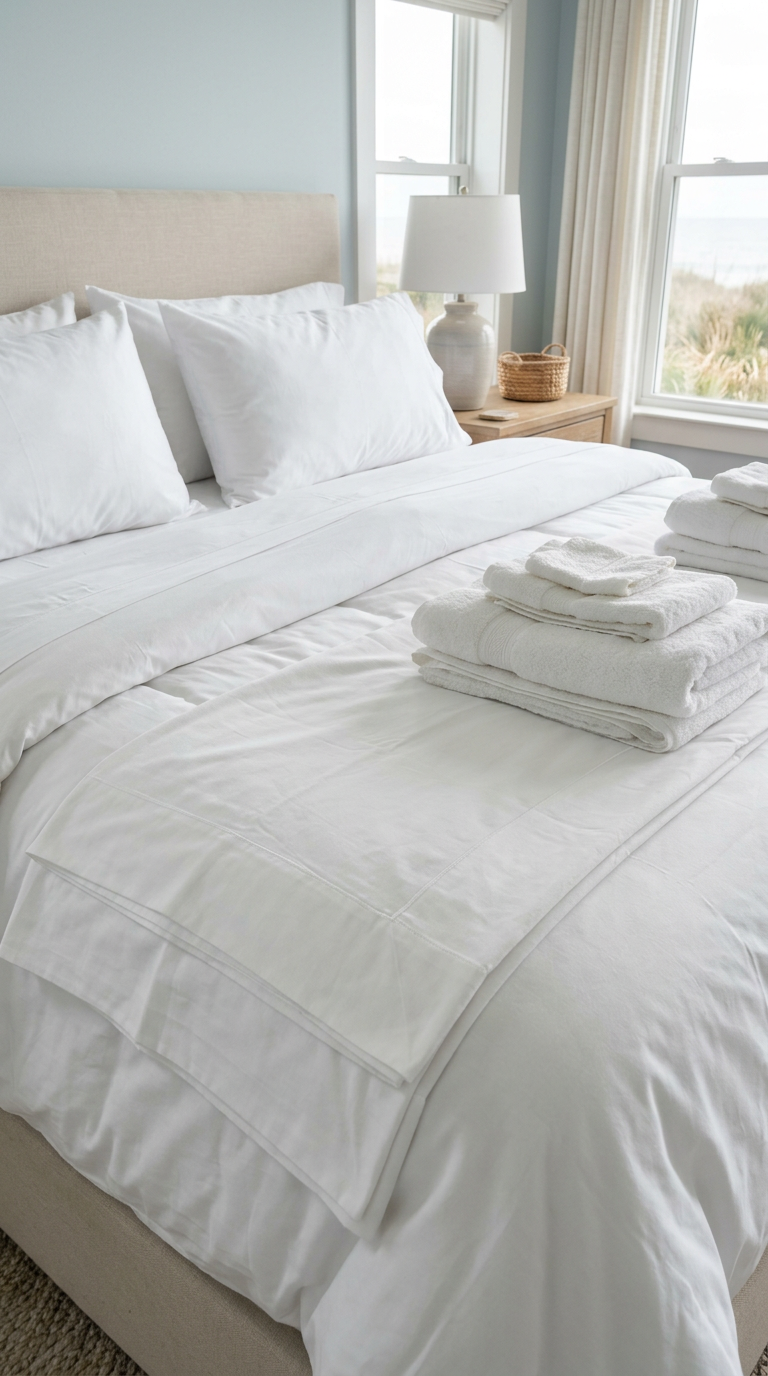
In the fast-paced Grand Strand vacation rental market, traditional bulky comforters and heavy duvets have become a significant operational liability. These thick top-of-bed layers rarely receive the deep laundering they require between back-to-back guest stays, leading to hidden allergen buildup, sand accumulation, and low guest satisfaction scores. To meet the stringent hygiene standards of modern travelers and survive the high-pressure Saturday turn window, professional property managers are transitioning to the hotel-grade triple-sheeting bedding system. A2Z Cleaning & Linen Services has developed this technical guide to help Myrtle Beach hosts master the fabric specifications, wash chemistry, and inventory logistics required to implement this elite system successfully.
Demystifying the Triple-Sheeting Bedding System in High-Turnover Coastal Rentals
The triple-sheeting bedding system is an elegant, multi-layered assembly that replaces the traditional bedspread or duvet cover with three distinct sheets and a middle insulating layer. The construction begins with a fitted or flat bottom sheet covering the mattress encasement, followed by a flat middle sheet. Next, a lightweight, thermally efficient blanket is laid down, and the entire assembly is capped with a decorative, heavy-weight top sheet that is neatly tucked under the mattress on all three sides. This design ensures that every fabric layer that touches a guest's skin can be completely stripped, washed, and sanitized after every single stay.
For Grand Strand vacation rental hosts, the operational advantages of this system during peak-season Saturday turns are profound. Stripping a triple-sheeted bed takes a fraction of the time required to remove and re-stuff a traditional duvet cover, which is notoriously difficult and time-consuming. Housekeepers can quickly collect all layers in a single bundle, reducing in-unit turnover times and ensuring that incoming guests are welcomed by an immaculate, crisp bed that smells freshly laundered. By eliminating the mystery of unwashed comforters, hosts can confidently market a higher standard of cleanliness.
From a hygiene perspective, triple-sheeting addresses the unique challenges of the coastal environment, where high humidity, sand, and sunscreen run rampant. Bulky comforters act as giant filters that trap microscopic beach sand, body oils, and salt moisture, creating a breeding ground for mildew and musty odors. Because triple-sheeting utilizes flat commercial sheets that can withstand aggressive high-temperature laundering, the entire bed envelope is restored to a pathogen-free, allergen-free state before the next check-in. This systemic approach is the ultimate defense against negative cleanliness reviews.
Fabric Specification: Thread Count, Tensile Strength, and Weave Selection
Selecting the correct fabric specification is critical to ensuring that your triple-sheeted linens can survive the physical demands of high-volume commercial laundering. While residential hosts often select 100% cotton sheets for their soft hand-feel, these fibers quickly degrade, thin, and tear under industrial stress. For a professional rental portfolio, a high-performance 60/40 cotton-polyester blend is the industry standard. The polyester component provides exceptional tensile strength, resists shrinking, and prevents severe wrinkling, while the cotton fibers maintain breathability and a soft texture that guests appreciate.
Thread count must also be carefully balanced; a common misconception is that a higher thread count always equates to a better commercial sheet. In commercial laundry facilities, T-250 to T-300 thread count sheets are preferred over T-400+ sheets because they allow better water and chemical penetration during the wash cycle and dry much faster. A weave that is too dense traps water and body oils, requiring longer drying times that waste energy and cause premature thermal degradation of the fibers. A standard percale weave offers a crisp, cool feel ideal for warm Myrtle Beach summers, while a subtle tone-on-tone sateen stripe adds visual depth to the top decorative sheet.
When sourcing sheets, pay close attention to the hem construction and the quality of the yarn. Ring-spun yarns are vastly superior to open-end yarns because they utilize longer, twisted fibers that resist pilling and maintain their structural integrity over hundreds of wash cycles. Ensure that all sheets feature double-stitched, lock-locked hems to prevent fraying when subjected to high-speed commercial folding and ironing equipment. Investing in high-specification fabrics from the start prevents the frequent replacement costs that quickly erode rental profit margins.
- Opt for a 60/40 cotton-polyester blend to balance durability, wrinkle resistance, and guest comfort.
- Target a thread count of T-250 to T-300 to optimize wash chemistry penetration and dry times.
- Specify ring-spun yarns with lock-stitched hems to prevent early pilling and structural fraying.
- Choose a crisp percale weave for bottom and middle sheets, and a decorative sateen stripe for the top layer.
The Thermal-Disinfection Wash Formula: Balancing Chemistry and Temperature
To achieve true hotel-grade sanitation, your laundry process must utilize a precise combination of chemical action, thermal energy, and mechanical agitation. A standard home washing machine cannot reach the temperatures or manage the chemistry required to break down stubborn coastal contaminants like self-tanners, silicone-based sunscreens, and saltwater minerals. The wash cycle must begin with a flush phase to remove loose sand and surface debris, followed by a heavy wash utilizing alkaline builders to swell the cotton fibers and release deeply embedded oils.
The core of the disinfection process is the thermal holding phase, where wash water temperatures must be maintained between 140°F and 160°F for a minimum of ten minutes. This sustained heat destroys bacterial pathogens, dust mites, and fungal spores that thrive in humid coastal environments. During this hot phase, non-ionic surfactants are introduced to emulsify body lipids, followed by an oxygen-based or chlorine bleaching step that brightens the whites and oxidizes organic stains without destroying the tensile strength of the polyester fibers.
The final critical step in the wash formula is the souring and neutralizing phase, where the pH of the rinse water is adjusted to match the natural pH of human skin (5.5 to 6.5). If residual alkali from the detergent is left in the fabric, it will cause the linens to turn a dingy yellow when subjected to the high heat of commercial ironers. It can also cause skin irritation for sensitive guests. Proper souring neutralizes these chemical residues, smooths the fibers, and ensures that the sheets emerge from the wash soft, bright, and completely safe.
Mitigating the Destructive Effects of Salt-Air and Sand Abrasion on Linen Fibers
The Grand Strand's coastal environment presents unique physical challenges to linen maintenance that are not found in inland markets. Microscopic beach sand is highly abrasive, consisting of sharp silica particles that easily wedge themselves between the warp and weft of woven sheets. When sand-laden sheets are placed directly into a washing machine, the mechanical agitation acts like sandpaper, grinding the silica against the cotton threads and cutting the microfibers. Over time, this abrasive action causes microscopic thinning, leading to premature tearing and fabric failure.
To mitigate sand damage, housekeepers and laundry technicians must implement a strict pre-sorting and pre-shaking protocol. Linens should never be dragged across sandy floors or packed tightly into transit bags with loose sand still clinging to the surface. At A2Z Cleaning & Linen Services, our technicians perform a vigorous pre-shake of all soiled linens over a grated sorting table before they enter the wash cycle. This simple mechanical step removes the bulk of the heavy silica grit, protecting both the fabrics and the commercial washing machinery from accelerated wear.
Salt-damp air also introduces hygroscopic sodium chloride molecules into the linen fibers while they are inside the vacation rental. If soiled sheets are left sitting in humid, unconditioned closets or plastic bags for several days before washing, the salt-saturated moisture creates an ideal environment for mold and mildew colonization. This dampness also weakens the natural cotton bonds, making them more susceptible to chemical damage during bleaching. Timely transport from the property to a climate-controlled laundry facility is essential to halting this environmental degradation.
Establishing a Robust Par-Level Inventory System for Scaling Portfolios
Operating a successful vacation rental portfolio in Myrtle Beach without a proper par-level inventory system is a recipe for operational chaos. 'Par' refers to the total amount of linen required to fully dress all beds in a property at one time. To run an efficient, stress-free operation, a minimum of a 3-par inventory system is required for every bed, though a 4-par system is highly recommended during the peak summer rental season. Attempting to operate on a 1-par or 2-par system forces housekeepers to wait in the unit for sheets to wash and dry, destroying turnaround schedules.
A standard 3-par system allocates one full set of linens on the beds, one full set in the clean owner's closet ready for the next turn, and one full set currently in transit to or undergoing laundering at the facility. During the hectic Saturday turn window, this allows housekeepers to strip the dirty beds, immediately dress them with the clean set from the closet, and pack the soiled linens for professional cleaning. This rotational system eliminates delays and ensures that cleaning crews can move smoothly from one property to the next.
Furthermore, maintaining a healthy par level directly extends the lifespan of your linen investment. When sheets are washed, dried, ironed, and put immediately back on a bed without a resting period, the fibers are subjected to continuous mechanical and thermal stress, causing them to wear out twice as fast. Allowing fibers to 'cure' and rest for 24 hours between wash cycles restores their natural moisture balance and structural elasticity. This rotation significantly delays the thinning, graying, and tearing of your expensive sheets.
- Par 1: Currently on the bed, welcoming the active guests.
- Par 2: Clean, folded, and stored in the locked owner's closet for the next turnover.
- Par 3: Soiled, in transit, or currently undergoing professional laundering.
- Par 4 (Recommended): High-season emergency backup to cover unexpected damage or stains.
The Mechanics of High-Speed Ironing: Moisture Retention and Presentation
The pristine, mirror-flat presentation of hotel bed sheets cannot be achieved with a residential hand iron or a simple tumble dryer. It requires the precise calibration of high-speed commercial flatwork ironers. These machines use heavy, steam-heated or gas-heated rotating steel cylinders to press and dry sheets simultaneously. To get the best results, sheets must not be fully dried in a tumble dryer before ironing. Instead, they should be pulled from the extractor while still holding 15% to 20% residual moisture.
Feeding slightly damp sheets into a flatwork ironer at temperatures between 325°F and 350°F is critical for flash-vaporizing the remaining moisture. This rapid steam generation relaxes the cotton fibers, allowing the heavy pressure of the rollers to flatten them completely and lock in a smooth, glossy finish. If sheets are fed through too dry, the friction creates static electricity, fails to remove deep creases, and can burn or yellow the polyester fibers. If they are fed through too wet, the fabric will remain damp, leading to mildew growth when folded.
Once the sheets emerge from the ironer, they must be folded immediately and allowed to cool completely before being packed into airtight transit bags. Packing warm linens traps residual thermal energy, which creates condensation inside the plastic wrapping and compromises the crisp finish. At A2Z Cleaning & Linen Services, we ensure that ironed linens are staged on open cooling racks in a climate-controlled environment to dissipate any lingering warmth, ensuring they arrive at your Myrtle Beach rental crisp, bone-dry, and ready for presentation.
Sourcing and Maintaining the Middle Blanket Layer for Optimal Insulation
The middle blanket of the triple-sheeting system must be chosen with great care, as it provides the thermal barrier that keeps guests comfortable under the air conditioning. Residential blankets made of fleece, wool, or loose cotton weaves are poorly suited for this role because they trap sand, snag easily, and warp during high-temperature washing. The ideal middle layer is a lightweight, high-density microfiber blanket with a down-alternative fill, or a tight, self-hemmed cotton-synthetic waffle-weave blanket.
Because this middle blanket is sandwiched between two protective sheets, it does not require laundering after every single guest stay if it remains clean and dry. However, it must be inspected for physical soil, dampness, or odors during every turnover and laundered immediately if any issues are found. To facilitate quick washing and rapid drying, the blanket must be light enough to be dried on a medium-heat setting without clumping the synthetic filling or causing the outer fabric to melt.
When purchasing these middle blankets, avoid options with satin-bound edges or loose fringe details, as these elements shred quickly under commercial laundering stresses. Instead, look for a double-needle, self-hemmed border that distributes tension evenly across the fabric. A high-quality down-alternative blanket will retain its loft and insulating properties over dozens of commercial wash cycles, ensuring that your triple-sheeted beds look plump, luxurious, and inviting throughout the year.
Quality Control, Reject Management, and Stain Reclamation Protocols
The final phase of a hotel-grade laundry operation is a rigorous quality control inspection. Every sheet that passes through the ironer must be visually audited under high-intensity LED task lighting. Inspectors look for micro-tears, loose threads, hair follicles, and stubborn shadows from makeup or self-tanners. Any sheet that fails to meet the pristine 'Grade-A' standard is immediately pulled from the production line and placed into a dedicated reject bin for specialized treatment.
Pulled sheets are sorted by defect type. Sheets with minor structural damage, such as small tears or loose seams, are sent to the sewing department for repair, while stained sheets undergo a highly concentrated stain reclamation bath. This reclamation process utilizes target-specific oxygen bleach activators and organic solvents to break down stubborn lipids and pigments without degrading the base fibers. If a sheet cannot be restored to Grade-A status, it is downgraded to Grade-B for emergency backup use, or repurposed into utility rags.
Property managers can protect their linen investment by establishing clear standards for stain reporting and separation at the property level. Housekeepers should never mix heavily stained linens, such as those covered in blood or mud, with the standard wash load. Separating these items into designated bags prevents cross-contamination and allows the laundry facility to apply targeted spot-treatment formulas before the stains are permanently set by the high heat of the commercial washing and drying process.
Key takeaway
Implementing a professional triple-sheeting bedding system elevates your rental's presentation while ensuring absolute hygiene for every guest. Partnering with A2Z Cleaning & Linen Services ensures your high-par inventory is managed with precise commercial wash chemistry, industrial ironing, and strict quality control. Contact our Grand Strand linen experts today at 843.800.2788 to optimize your property's linen operations.
Related services
Keep Reading

Linens & Laundry
The Coastal Vacation Rental Pillow Protection, Laundering, and Par-Level Restoration Protocol: Mitigating Sweat-Salt Yellowing, Humid Fill Clumping, and Allergen Accumulation under Grand Strand Saturday Turn Pressures
ReadLinens & Laundry
The TRSA Clean Green and Hygienically Clean Hospitality Standards: Implementing Water-Recycling Technologies, Thermal Disinfection, and Alkalinity-Controlled Wash Formulas in Grand Strand Industrial Laundries
ReadLinens & Laundry
The Coastal Vacation Rental White Sheet Graying and Yellowing Restoration Protocol: Mitigating Sunscreen Lipids, Iron-Rich Municipal Water, and Chemical Scorching
ReadReady for a spotless property?
Call 843.800.2788 or request a free quote from A2Z Cleaning & Linen Services.