Linens & Laundry
The Coastal Vacation Rental Mattress Protector, Zippered Encasement, and Pad Preservation Protocol: Mitigating Polyurethane Membrane Delamination, Salt-Sweat Yellowing, and Sand-Silt Wear in Grand Strand Laundries
Discover professional laundry strategies to clean, sanitize, and preserve coastal mattress protectors and zipped encasements from sand abrasion and chemical delamination.
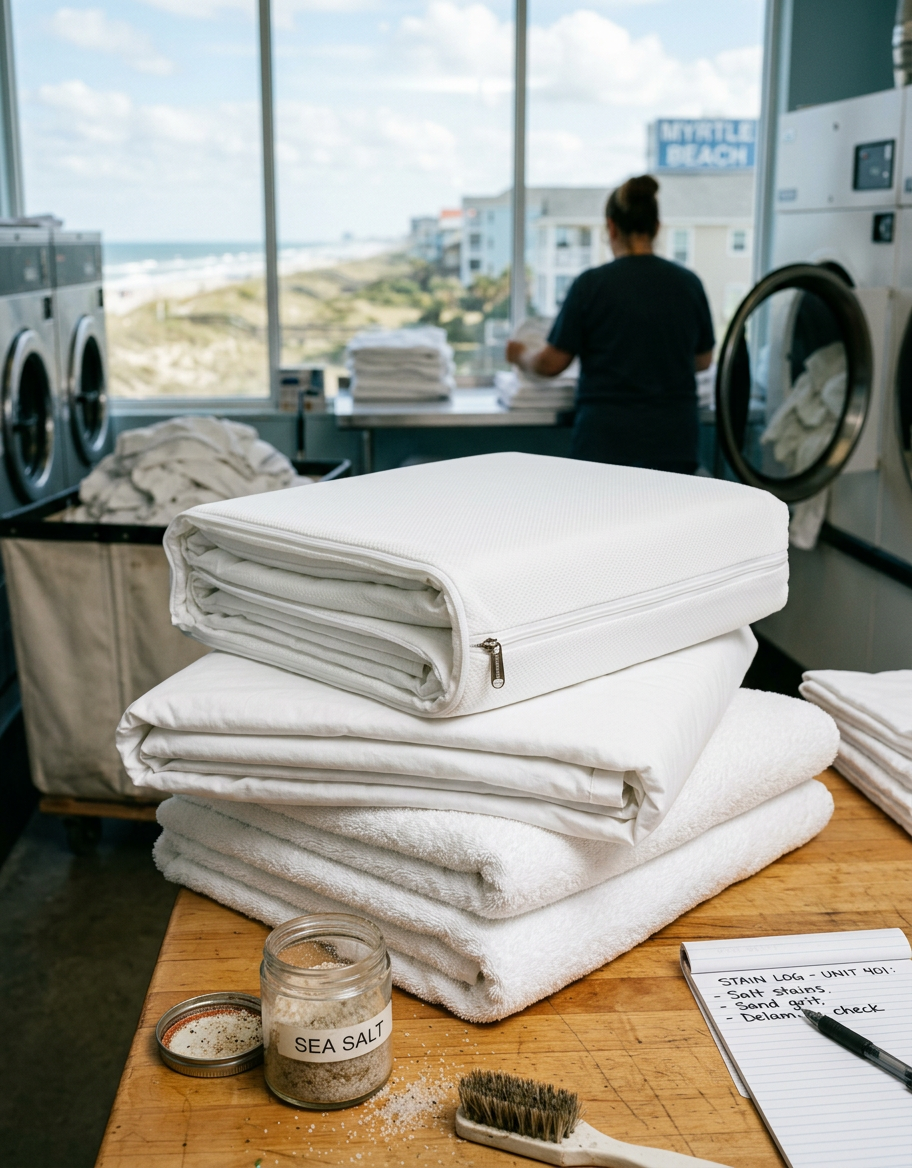
In the high-velocity world of Grand Strand vacation rentals, mattress protectors and zippered encasements serve as the primary defensive barrier for one of your most expensive capital assets: the mattress. However, the combination of salt air, sweat, greasy sunscreens, and abrasive beach sand creates a destructive compound that traditional laundry practices cannot safely resolve. Standard commercial high-heat washing and harsh chlorine bleaching rapidly disintegrate the delicate waterproof polyurethane membranes, leaving mattresses vulnerable to catastrophic biological staining. This technical protocol outlines the precise wash chemistry, mechanical adjustments, and inventory par strategies required to clean, sanitize, and preserve these specialized performance fabrics over hundreds of high-turnover guest stays.
The Physics of Polyurethane Laminates vs. Grand Strand Elements
Modern hospitality mattress protectors utilize a dual-layer design consisting of a soft, absorbent top face (often polyester knit, cotton terry, or bamboo rayon) heat-fused to a micro-thin backing of thermoplastic polyurethane (TPU). This TPU membrane contains billions of microscopic pores that are large enough to allow vapor molecules (body heat and humidity) to escape, but small enough to block liquid water, bodily fluids, and microscopic allergens from passing through. In the humid, salt-saturated atmosphere of the Myrtle Beach coastline, these membranes are subjected to constant chemical and physical stress.
When guests return from the beach, they bring with them fine quartz sand, ocean salts, and sebum-saturated sunscreen oils. As these soils accumulate, they migrate through the top textile layer and rest directly against the vulnerable TPU membrane. Under the weight of subsequent guests, these sharp sand particles act as micro-abrasives, grinding against the polyurethane layer and creating microscopic punctures that destroy its water-resistant integrity.
Compounding this mechanical wear is the chemical degradation caused by standard commercial wash formulas. Many high-volume laundries use excessively high pH detergents and high-heat drying cycles to speed up turnover times. Polyurethane is highly sensitive to thermal hydrolysis; when exposed to water temperatures exceeding 140 degrees Fahrenheit or dryer drum temperatures over 130 degrees Fahrenheit, the chemical bonds holding the TPU to the face fabric begin to snap. This results in delamination, characterized by bubbling, peeling, and the eventual disintegration of the waterproof barrier into dry, brittle flakes.
The Chemistry of Extracting Sunscreen, Sebum, and Salt Salts
Vacation rental bedding on the Grand Strand is uniquely prone to a stubborn, orange-brown staining pattern caused by the interaction of chemical sunscreens (specifically avobenzone and oxybenzone) with the iron minerals present in local municipal water. When standard chlorine bleach is applied to these sunscreen residues during a wash cycle, it triggers an oxidation reaction that permanently bonds the yellow-brown pigment to the synthetic fibers of the protector. This chemical stain cannot be resolved with traditional bleaching agents and often leads to the premature discarding of perfectly functional protectors.
To safely extract these lipid-soluble sunscreen oils and organic sweat salts without degrading the underlying polyurethane membrane, laundries must deploy a specialized chemical formulation. The wash cycle must utilize a neutral-to-mildly-alkaline surfactant package (pH 7.5 to 8.5) that targets hydrophobic oils. Non-ionic surfactants are highly effective at emulsifying heavy sunscreen oils and skin sebum at lower water temperatures, preventing them from redepositing onto the fabric during the rinse phase.
Additionally, the wash formula must incorporate a dedicated chemical chelating agent or water softener to bind metallic ions in the water supply before they can react with avobenzone residues. This prevents the chemical reaction that causes yellow-brown staining. Chlorinated bleaches must be strictly avoided; instead, oxygen-based bleaches or mild organic acids should be used in the whitening phase to maintain fiber brightness while protecting the delicate polymer backing.
- Avoid anionic surfactants in high-pH environments to prevent accelerated TPU hydrolysis.
- Use non-ionic surfactants with high emulsifying power for zinc oxide and chemical sunscreen oils.
- Introduce a polymeric chelating agent during the flush cycle to neutralize iron in municipal water.
- Utilize sodium percarbonate (oxygen bleach) instead of sodium hypochlorite (chlorine bleach).
- Maintain wash bath pH strictly between 7.2 and 8.5 to protect the laminated adhesive bonds.
Low-Temperature Chemical Disinfection Standards
To comply with hospitality sanitation standards, mattress protectors must undergo thorough disinfection to eliminate pathogens, allergens, and dust mites. Traditional commercial laundry disinfection relies heavily on thermal sanitation, requiring wash water temperatures to be maintained at 160 degrees Fahrenheit for a minimum of 25 minutes. While this temperature is highly effective at killing bacteria, it is catastrophic for thermoplastic polyurethane membranes, causing them to melt, blister, and delaminate in a single cycle.
To achieve certified sanitation without thermal destruction, professional Grand Strand laundry operations must pivot to low-temperature chemical disinfection. This is accomplished by utilizing EPA-registered sanitizing agents that are chemically active at lower water temperatures (104 degrees Fahrenheit to 115 degrees Fahrenheit). The primary chemical of choice for this application is peracetic acid (PAA), an organic compound that delivers rapid, broad-spectrum antimicrobial activity through oxidation.
Peracetic acid is highly effective against viruses, bacteria, and mold spores even in cool water, and it breaks down safely into acetic acid (vinegar) and water, leaving zero toxic residues on the fabric. Alternatively, quaternary ammonium compounds (quats) designed specifically for laundry use can be introduced during the final rinse cycle. These chemicals deposit a microscopic, positively charged defensive barrier on the textile fibers, inhibiting the growth of odor-causing bacteria and mold during periods of high humidity.
The Sand-Silt Mechanical Abrasion and Extraction Protocol
Sand is the ultimate silent killer of vacation rental linens on the Grand Strand. When sandy mattress protectors are loaded directly into a standard washing machine, the mechanical action of the wash cycle forces the sharp sand grains deep into the weave of the face fabric. As the machine enters its high-speed extraction spin, which can reach forces of 300 Gs or more, these trapped sand particles are pressed with immense force against the delicate polyurethane membrane, puncturing it and tearing it away from the backing textile.
To mitigate this damage, a strict multi-step sand extraction protocol must be executed before the wet wash cycle begins. First, all soiled protectors must be subjected to a dry mechanical shake-out or run through a dedicated, dry tumbler cycle with zero heat and high airflow. This physical agitation loosens the dry sand grains from the quilted channels and vacuum-extracts them into a lint trap before water is introduced.
Once loaded into the washer-extractor, the program must begin with an initial high-water-level cold flush with no mechanical action. This allows the remaining sand to sink through the perforated drum and exit through the drain valve, rather than being ground into the fabric by the spinning basket. Only after this sand-clearing flush is complete should the machine begin its standard wash agitation and chemical injection cycles.
- Perform a dry mechanical shake-out or dry-air tumble to remove bulk sand prior to washing.
- Program a high-water-level cold flush with zero basket agitation as the first step of the wash cycle.
- Avoid high-G-force extraction spins until the pre-wash flushes have completely cleared all grit.
- Clean washer-extractor drain sumps daily to prevent sand buildup from recirculating into subsequent loads.
- Incorporate a dual-rinse cycle to ensure all loose silica particles are fully flushed from the fabric matrix.
Drying Protocols for Laminated and Quilted Fabrics
Drying mattress protectors is one of the most critical and easily compromised steps in the entire laundry workflow. Laminated fabrics behave unpredictably in commercial dryers because they consist of two materials with vastly different heat capacities: a highly absorbent face fabric that retains water, and a non-porous polyurethane backing that blocks airflow. If the dryer is run at standard commercial temperatures (150 degrees to 180 degrees Fahrenheit), the dry areas of the protector will rapidly overheat while the quilted pockets are still damp.
When the polyurethane backing exceeds its glass transition temperature (approximately 130 degrees Fahrenheit), it softens and becomes extremely tacky. If the protector is tumbling in this state, the heated polyurethane backing can stick to itself or to the metal drum, causing the membrane to peel away in large sheets, a phenomenon known as thermal fusing. Once this occurs, the protector is permanently ruined and must be discarded.
To prevent thermal damage, dryers must be programmed to a dedicated 'Low Heat' or 'Delicates' setting, with exhaust temperatures strictly regulated to a maximum of 120 to 125 degrees Fahrenheit. The dry cycle must utilize moisture-sensing technology to prevent over-drying. Crucially, every cycle must conclude with a minimum 10-minute cool-down phase, during which the dryer tumbles with no heat to allow the polyurethane membrane to cool, solidify, and regain its physical stability before unloading and folding.
Calculating and Managing Par Levels for Encasements and Pads
A common operational bottleneck in Grand Strand vacation rental management is the failure to maintain adequate inventory par levels for mattress protectors and zippered encasements. Because these items require specialized, low-temperature wash and dry cycles that take significantly longer than standard cotton sheets, housekeeping teams under Saturday turn pressures often rush the drying process or skip replacing soiled protectors entirely, exposing expensive mattresses to immediate damage.
To operate a seamless, damage-free vacation rental program, properties must maintain a strict 3-par linen system for zippered mattress encasements and a 3.5-par system for quilted mattress pads. A 3-par system allocates one set of protectors currently on the beds, one set clean and ready in the property's locked owner's closet or linen bin, and one set undergoing processing at the central laundry facility. The additional half-par serves as an emergency reserve to immediately replace items damaged by severe staining or physical tearing.
By maintaining these par levels, housekeeping teams are never forced to wait for protectors to dry during a tight five-hour turn window. They can instantly swap a soiled protector with a clean, fully dry, and inspected unit from the on-site linen supply, allowing the soiled item to be transported back to a controlled laundry facility where it can be processed using the correct, low-temperature preservation protocols.
- Establish a minimum 3-par inventory for zippered mattress encasements to prevent turn-day shortcuts.
- Maintain a 3.5-par inventory for quilted mattress pads to handle peak-season stain emergencies.
- Store clean par inventory in climate-controlled, dust-sealed bins to prevent moisture absorption.
- Conduct monthly physical inventory audits to identify and replace torn or delaminated units immediately.
- Incorporate par replenishment costs directly into seasonal operational budgets to maintain bed quality.
In-Unit Inspection, Zipper Maintenance, and Replacement Triggers
While professional laundering preserves the life of your protectors, regular physical inspections are required to ensure they continue to provide complete protection against bedbugs, fluids, and allergens. Zippered encasements, in particular, must maintain an unbroken seal to prevent pest infestations. The salt-heavy air of the Grand Strand can cause corrosion on metal zipper sliders, while fine sand can jam nylon zipper teeth, leading to zipper failure and tearing during housekeeping operations.
During every guest turnover, housekeeping inspectors must physically audit the mattress protectors. Inspectors must check that the zipper runs smoothly along its entire track, ensuring that the tiny fabric guard at the end of the zipper (the zipper stop) is fully intact and sealed. If a zipper is sticky due to salt-air exposure, field teams can apply a dry, wax-based lubricant to the teeth; wet lubricants must be avoided as they attract and hold abrasive sand grains.
Furthermore, inspectors must examine the interior backing of the protector by holding it up to a bright light source or window. If light shines through pinholes, or if the backing shows signs of bubbling, peeling, or cracking, the waterproof membrane has failed. These compromised protectors must be immediately tagged, retired from service, and replaced from the par inventory to prevent permanent damage to the underlying mattress during the next guest stay.
Partnering with A2Z Cleaning & Linen Services for Professional Preservation
Managing the specialized laundry needs of coastal mattress protectors, zippered encasements, and quilted pads is an incredibly labor-intensive and technically demanding process. For individual property owners and busy vacation rental managers, executing multi-step sand extraction, precise low-temperature chemical disinfection, and moisture-controlled low-heat drying is often impossible within the constraints of tight Saturday turnover windows.
By partnering with A2Z Cleaning & Linen Services, you gain access to our state-of-the-art commercial laundry facility, where we utilize computerized wash formulas, advanced low-temperature sanitizing chemistry, and specialized drying protocols tailored specifically for coastal performance textiles. Our systemized process eliminates the risks of polyurethane delamination, permanently extracts stubborn sunscreen oils, and ensures that your expensive bedding assets are returned to your properties completely clean, sanitized, and structurally sound.
Protect your investments and elevate your guest experience by trusting your high-value linen inventory to the Grand Strand's trusted laundry experts. Contact A2Z Cleaning & Linen Services today at 843.800.2788 to establish a customized linen management and laundry program designed specifically for your vacation rental portfolio.
Key takeaway
Preserving high-value mattress protectors in a coastal environment requires avoiding high-heat commercial drying and harsh chlorine bleaches, which quickly melt and delaminate polyurethane membranes. By implementing low-temperature chemical disinfection, dry sand extraction, and a strict 3-par inventory system, property managers can extend fabric life and secure their mattress assets. Partner with A2Z Cleaning & Linen Services at 843.800.2788 to ensure professional, hotel-grade linen care and reliable Grand Strand turnover solutions.
Related services
Keep Reading
Linens & Laundry
The Coastal Vacation Rental Pool and Cabana Towel Preservation Protocol: Mitigating Sunscreen-Bonded Yellowing, Chlorine Fiber Rot, and Peak-Season Inventory Shrinkage
ReadLinens & Laundry
The Coastal Hotel-Grade Zippered Mattress Encasement Laundering Protocol: Mitigating Polyurethane Membrane Delamination, Salt-Air Zipper Corrosion, and Sand-Abrasion Failures in Grand Strand Rentals
ReadLinens & Laundry
The TRSA Hygienically Clean Hospitality Standard: Implementing Industrial Wash Chemistry, Bio-Burden Testing, and Soil-to-Clean Separation in Myrtle Beach Commercial Laundries
ReadReady for a spotless property?
Call 843.800.2788 or request a free quote from A2Z Cleaning & Linen Services.