Commercial & Hospitality
The ANSI/NFSI Commercial Floor Safety and High-Traction Cleaning Standard: Implementing DCOF Tribometry, Wet-Slip Audits, and Certified Slip-and-Fall Prevention in Grand Strand Facilities
Discover how ANSI/NFSI floor safety standards, digital tribometry, and high-traction cleaning protocols protect Grand Strand commercial facilities from slip-and-fall liability.
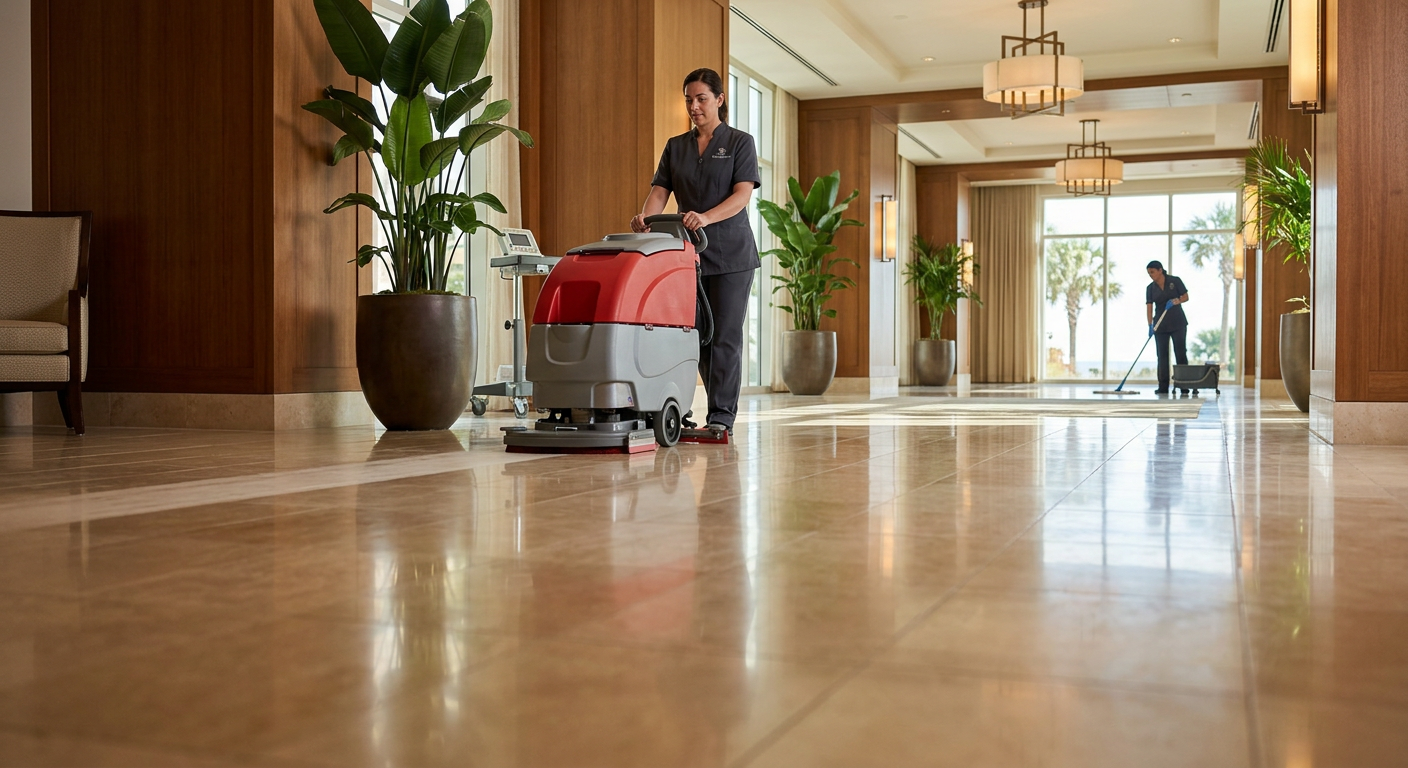
Maintaining safe walkways in high-traffic commercial environments is a complex operational challenge that directly impacts both public safety and corporate liability. In coastal regions like the Grand Strand, this challenge is amplified by constant exposure to abrasive beach sand, damp salt-air, and heavy tourist traffic. Relying on simple aesthetic cleanliness is no longer sufficient; leading operators must adopt scientific floor safety standards to verify traction levels objectively. Implementing the rigorous guidelines of the ANSI/NFSI floor safety framework allows local facility managers to systematically mitigate slip-and-fall hazards while preserving their valuable flooring assets.
The National Landscape of Slip-and-Fall Liability and the ANSI/NFSI Framework
Slip-and-fall incidents represent one of the most significant liability exposures for commercial facilities, hospitality venues, and retail complexes across the United States. To mitigate this risk, national standards have shifted focus from antiquated static measurements to dynamic slip resistance. The National Floor Safety Institute (NFSI) and the American National Standards Institute (ANSI) have established rigorous testing frameworks to measure how a moving human foot interacts with wet or dry floor surfaces, providing commercial operators with clear, scientific benchmarks for safety.
Under the ANSI/NFSI B101.1 and B101.3 standards, facilities are evaluated based on their Dynamic Coefficient of Friction (DCOF). This shift from Static Coefficient of Friction (SCOF) reflects a more realistic assessment of real-world human ambulation on wet surfaces. Leading national operators no longer rely on subjective 'touch and feel' clean tests or old-fashioned wax-and-buff procedures that prioritize shine over safety. Instead, they implement standardized, quantifiable measurement systems to prove floor traction compliance.
Adhering to these standards is not simply about regulatory compliance; it is a critical strategy for asset protection and risk management. Insurance companies increasingly analyze floor maintenance protocols during premium evaluations and liability claims. By implementing a standardized NFSI program, Grand Strand commercial facilities can protect their guests, shield their operations from costly litigation, and establish a legally defensible track record of proactive walkway safety management.
Understanding DCOF and the Role of Digital Tribometer Diagnostics
Dynamic Coefficient of Friction (DCOF) measures the slip resistance of a surface while an object is in motion. For a floor to be classified as 'high traction' under ANSI/NFSI B101.3, it must achieve a wet DCOF value of 0.42 or greater. Surfaces with a wet DCOF below 0.42 present an elevated risk of slips, while surfaces below 0.30 require immediate remedial action. Measuring this precisely requires specialized diagnostic equipment rather than visual inspection alone.
Leading commercial maintenance providers utilize digital tribometers, such as the BOT-3000E, to conduct objective, repeatable field testing. These devices simulate human stride dynamics by applying a specific load and speed across a wet surface, recording real-time traction metrics. Regular tribometer audits allow facility managers to track the degradation of slip-resistant coatings over time, mapping out precisely when a surface requires restorative deep cleaning or chemical re-application.
Integrating digital diagnostics into a floor care regime eliminates guesswork. Instead of waiting for a slip-and-fall incident to highlight a traction deficit, diagnostic audits identify problem areas beforehand. These measurements are carefully logged alongside ambient temperature, relative humidity, and the specific chemical cleaners in use. This data-driven approach transforms floor care from an aesthetic chore into a certified, auditable safety protocol.
Chemical Selection and the Science of High-Traction Floor Finishes
The pursuit of a high-gloss floor has historically compromised slip resistance. Traditional acrylic floor finishes often create a smooth, hydrophobic barrier that, when wet, acts as a slip hazard. Today's national commercial standards favor advanced polymer and polyurethane floor finishes engineered with microscopic texturizers. These high-traction coatings increase the surface contact area for footwear, maintaining high DCOF values even when subjected to heavy foot traffic and moisture.
Chemical selection for daily maintenance is equally critical. Using inappropriate, highly alkaline cleaners or oily dust mops can leave behind micro-films that trap dirt and lower slip resistance. Professional floor care protocols require neutral-pH detergents that lift soil without stripping protective polymers. These chemicals must be certified by the NFSI to ensure they do not alter the floor's engineered coefficient of friction during the cleaning process.
Furthermore, operators must strictly avoid surfactant buildup. If cleaning solutions are not thoroughly rinsed or extracted, a sticky residue remains on the tile or stone. This residue acts like an adhesive for dust and sand, quickly grinding away the floor's slip-resistant properties. High-traction maintenance requires a precise balance of chemical mechanical action and thorough soil extraction to keep the substrate pristine and safe.
- Choose NFSI-certified floor finishes with micro-textured polymers.
- Avoid highly alkaline or residue-prone detergents that leave sticky micro-films.
- Enforce precise chemical dilution rates to prevent excess surfactant buildup.
- Implement deep-extraction rinses periodically to clear accumulated soap residues.
The Sand-Slurry and Salt-Haze Hazard: Grand Strand's Unique Substrate Stressors
In coastal environments like Myrtle Beach, standard floor safety protocols face extreme environmental stressors. Fine silica beach sand is tracked indoors daily, acting as an abrasive grit that grinds down high-traction coatings and smooths textured slip-resistant tiles. Additionally, humid salt-damp air deposits a fine, hygroscopic film over hard surfaces. This salt haze attracts moisture from the air, creating an invisible, low-friction micro-moisture layer that dramatically lowers DCOF values.
When wind-driven rain mixes with sand and salt on entryways, lobby tiles, and transition zones, it creates a highly hazardous sand-slurry. This slurry fills the microscopic recesses of slip-resistant tile grout lines and textured stone, neutralizing the floor's inherent traction. Standard janitorial sweeps cannot clear this compacted debris. Left untreated, high-traffic commercial foyers quickly transform into major liability zones under the pressure of daily visitor volumes.
Addressing these coastal-specific hazards requires specialized cleaning frequencies and targeted soil-suspension chemistry. Local facility managers must deploy cleaning protocols designed to break the ionic bond of salt deposits and suspend abrasive silica sand for complete physical removal. Regular floor diagnostics in coastal zones must be performed during peak humidity hours to capture the true, real-world friction levels of the facility's walkways.
Daily Mechanical Scrubbing and Microfiber Soil-Extraction Workflows
Achieving ANSI/NFSI traction compliance is impossible using traditional cotton mops and standard mop buckets. Cotton fibers lack the structural integrity to lift fine sand and salt films, often merely redistributing dirty water across the floor surface. When this water dries, it leaves behind a hazy, slippery film of suspended soils. Leading facility managers replace manual mopping with automated, mechanical cylindrical brush auto-scrubbers and dual-chamber mop systems.
Cylindrical brush scrubbers are highly effective for textured tile and grout because they rotate vertically, reaching deep into crevices to scrub away compacted sand-slurry. The machine simultaneously applies fresh cleaning solution and vacuums up the soiled liquid in a single pass. This ensures that dirty water never dries on the floor, leaving behind clean, dry, high-traction walkways that are immediately safe for foot traffic.
For areas inaccessible to auto-scrubbers, split-bucket systems and ultra-fine microfiber flat mops are mandatory. Microfiber carries a natural positive charge that attracts and locks in negatively charged salt particles and microscopic sand-silt. By maintaining a strict clean-to-dirty mop water separation and utilizing high-performance microfiber, cleaning teams can prevent the accumulation of dulling, slip-inducing residues across large commercial floor footprints.
Facility Audit Protocols: The Three-Tiered Surface Friction Verification System
To maintain a legally defensible floor safety program, commercial facilities should implement a structured, three-tiered verification system. The first tier involves daily visual inspections and qualitative checks by the on-site custodial staff. These checks ensure that walk-off mats are positioned correctly, spills are addressed within minutes, and no unusual film or haze is visible on the floor's surface under ambient lighting.
The second tier is a weekly chemical-residue and cleanliness audit. This process involves monitoring chemical dilution ratios, checking the wear on auto-scrubber squeegee blades, and closely inspecting grout lines for soil accumulation. By auditing the actual execution of the daily cleaning plan, facility managers can identify operational failures, such as soap scum buildup or clogged vacuum lines, before they impact floor safety.
The third and most critical tier is the quarterly or semi-annual digital tribometry audit. Using certified walkway auditing equipment, an auditor measures the wet DCOF across high-risk zones, such as main lobbies, elevator landings, and pool-to-indoor transitions. The resulting data points are compiled into a formal safety report, which is kept on file as concrete evidence of the facility's adherence to ANSI/NFSI standards.
- Perform daily visual sweeps and rapid-response spill checks.
- Conduct weekly chemical-ratio audits and equipment inspection logs.
- Execute quarterly digital tribometry testing on high-traffic transitions.
- Archive all calibration records, digital DCOF outputs, and cleaning logs.
Certified Walk-Off Matting Systems and Entrance Zone Management
The first line of defense in protecting hard floors and maintaining DCOF standards is a certified, high-performance entrance matting system. According to national walkway safety standards, a minimum of fifteen to twenty feet of walk-off matting is required to effectively capture moisture, salt, and sand from incoming footwear. In coastal zones, this entry barrier is vital to prevent abrasive wear on expensive lobby substrates.
Entrance mats must be NFSI-certified for slip resistance, ensuring that the mats themselves do not slide or ripple under foot traffic. Mats with improper backing or curling edges create dangerous trip hazards, defeating their safety purpose. The backing must be composed of high-quality nitrile rubber that resists salt-air degradation and lays perfectly flat on the subfloor, even under heavy rolling loads.
Maintenance of these matting systems must be aggressive and systematic. Daily deep vacuuming with commercial-grade pile-lifter vacuums is necessary to extract dry sand-grit from deep within the fibers. Additionally, routine hot-water extraction must be scheduled to lift dissolved salt deposits and embedded grease, restoring the mat's absorption capacity so it can continue to shield indoor hard floors from slip-inducing moisture.
Staff Training, Certification Pathways, and Compliance Recordkeeping
Implementing a high-traction standard requires a highly trained custodial workforce. Professional operators invest in training programs that align with the NFSI's Walkway Auditor guidelines. Cleaning technicians must understand the chemical interactions of flooring substrates, the mechanics of soil suspension, and the correct operating parameters of automatic floor-scrubbing machinery. This technical knowledge ensures that floor care protocols are executed consistently and safely.
Robust recordkeeping is the foundation of any defensible floor safety program. In the event of an incident, a facility must be able to produce daily logs detailing when a floor was last scrubbed, the specific chemicals used, and chemical dilution verification. Combining these logs with quarterly tribometer DCOF data creates an ironclad compliance trail that demonstrates a standard of care exceeding basic commercial expectations.
At A2Z Cleaning & Linen Services, we specialize in high-performance commercial floor care programs tailored to the challenging coastal conditions of the Grand Strand. Our expert teams are trained in soil extraction, chemical safety, and high-traction restoration. To consult with our commercial floor specialists or schedule a walkway safety assessment for your facility, contact our office directly at 843.800.2788.
Key takeaway
Transitioning to an ANSI/NFSI-compliant floor care program protects your guests, employees, and business from the severe consequences of slip-and-fall incidents. By combining advanced chemical science, daily mechanical soil extraction, and objective digital tribometer diagnostics, Grand Strand commercial facilities can maintain safe, high-traction walkways year-round. Partnering with a technically certified cleaning provider ensures your floors meet the highest standards of safety, durability, and visual appeal.
Keep Reading

Commercial & Hospitality
The Grand Strand Hospitality Career Ladder: Structuring Pay, Certifications, and Retention for Year-Round Environmental Services Crews
ReadCommercial & Hospitality
Professional Cleaning Careers in Myrtle Beach: What Defines a Top-Tier Hospitality Cleaner
ReadCommercial & Hospitality
The Grand Strand Medical and Outpatient Facility Environmental Services (EVS) Specialist Career Pathway: Technical Infection-Control Certifications, Behavioral Interview Standards, and High-Retention Compensation Models
ReadReady for a spotless property?
Call 843.800.2788 or request a free quote from A2Z Cleaning & Linen Services.