Linens & Laundry
The Coastal Vacation Rental Kitchen Linen, Tea Towel, and Oven Mitt Preservation Protocol: Mitigating Seafood-Grease Rancidity, Humid Yeast Colonization, and Par-Level Bleaching in Grand Strand Laundries
Discover how professional laundry protocols extract rancid seafood oils, eliminate humid yeast, and manage par levels for kitchen linens in Myrtle Beach vacation rentals.
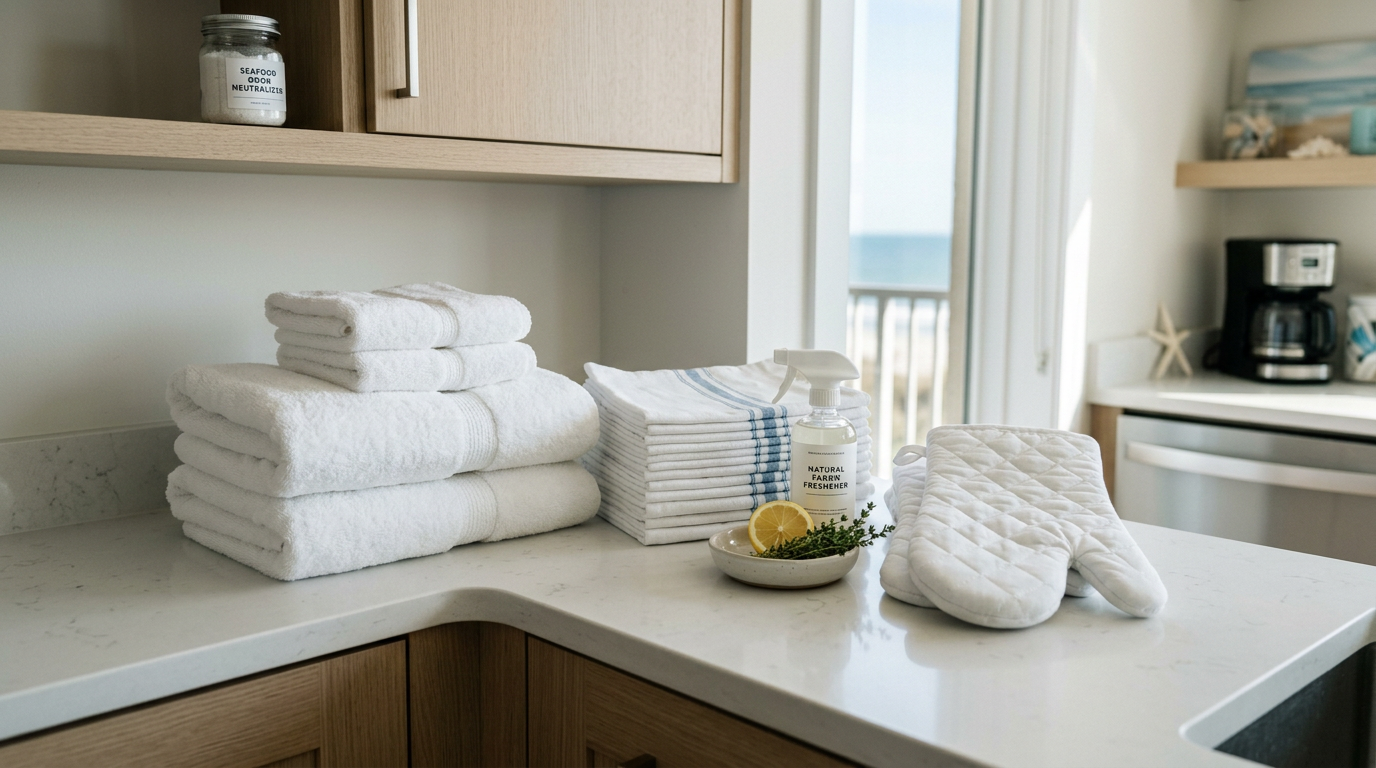
When guests stay at a Grand Strand vacation rental, cooking fresh, local seafood in the kitchen is a central part of the coastal experience. However, the preparation of blue crabs, shrimp, and pan-fried fish leaves behind complex unsaturated lipids on kitchen tea towels, dishcloths, and oven mitts. When exposed to Myrtle Beach's high humidity, these oils polymerize rapidly, trapping foul odors and encouraging fungal growth. Implementing a specialized, industrial-grade laundering and inventory protocol is the only reliable way to preserve these hard-working fabrics and maintain a high-end guest presentation.
The Chemistry of Seafood-Grease and Culinary Oil Binding in Coastal Climates
Culinary fats, particularly those from local coastal seafood, are rich in unsaturated fatty acids that behave differently than standard organic soils. When a guest uses a cotton tea towel to wipe down countertops, splattered pan grease, or butter residue, these lipids coat the individual cotton fibers. In the warm, salt-saturated air of the Grand Strand, these oils undergo rapid oxidation, forming a sticky, polymerized film that bonds to the fabric matrix.
Unlike water-soluble soils, polymerized culinary grease cannot be cleared by standard retail detergents or short residential wash cycles. If these oils are not chemically dismantled, they undergo auto-oxidation over time, releasing highly volatile ketones and aldehydes. This chemical breakdown is the root cause of the persistent, sour, fishy odors that often plague vacation rental kitchens, even after the linens have supposedly been washed.
Cotton is a highly absorbent natural fiber with a hollow center known as the lumen, which acts as a straw for liquid fats. Once grease wicks deep inside this lumen, it becomes shielded from basic surface-level surfactants. Professional-grade wash chemistry is required to swell the cotton fibers, open the lumen, and lift the trapped lipids out of the fabric entirely, restoring the linen's natural absorbency and fresh smell.
- Unsaturated seafood lipids oxidize rapidly in warm, salt-laden coastal air.
- Polymerized grease creates a sticky, hydrophobic film that repels water.
- Auto-oxidation of trapped fats produces sour, volatile organic compounds.
- Deep fiber penetration requires swelling the cotton lumen to release oils.
The Microbial Threat: Humid Yeast and Mold Colonization on Wet Kitchen Linens
Myrtle Beach's sub-tropical climate, where summer humidity levels routinely exceed eighty percent, creates an ideal incubation chamber for microbial growth. When guests leave damp dishcloths crumpled under the sink or inside a dark pantry hamper, they trap residual organic starch, water, and heat. Under these conditions, environmental yeasts and black mold spores can colonize the cotton fibers in as little as twelve hours.
As mold species like Aspergillus and Cladosporium establish colonies within the wet weave, they secrete cellulase enzymes to break down the organic cotton. This biological digestion physically weakens the fabric, causing premature thinning, graying, and easy tearing during use. A tea towel subjected to repeated damp storage can lose up to fifty percent of its tensile strength in just a few weeks of active summer rental service.
The musty odor produced by these microbial colonies is incredibly difficult to eliminate once it takes hold. Standard home washing machines, which typically operate at low temperatures to conserve energy, fail to reach the thermal death point of these resilient fungal spores. The spores remain dormant in the damp fibers, reactivating and releasing foul odors the very moment a new guest uses the towel to dry warm dishes.
- Relative humidity above eighty percent accelerates fungal spore germination.
- Cellulase enzymes secreted by mold physically digest and weaken cotton fibers.
- Residential washing machines fail to reach the thermal death point of spores.
- Dormant mold spores reactivate instantly when exposed to moisture and heat.
The Industrial Wash Formula for Kitchen Linen Decontamination
Removing stubborn grease and eliminating microbial spores from kitchen fabrics requires a highly controlled, multi-stage industrial wash formula. The first step relies on saponification, which is the chemical process of turning insoluble fats into water-soluble soaps. To achieve this, professional laundries introduce alkali builders, such as sodium metasilicate, to elevate the wash water's pH level to a highly alkaline range of eleven to twelve.
Thermal energy is the next critical component of the formula, as the wash water must reach a sustained temperature of at least one hundred and forty degrees Fahrenheit. This heat melts solid animal fats and butter lipids, allowing highly concentrated, non-ionic surfactants to surround, suspend, and lift the emulsified oils. Without this precise thermal-chemical combination, the dissolved grease would simply redeposit onto other linens in the drum, turning the entire load gray.
The final phase of the industrial wash cycle involves neutralizing the fabric's pH to prevent skin irritation and fiber damage. A specialized commercial acidifier, or 'sour,' is introduced during the final rinse cycle to bring the pH back down to a skin-neutral range of five point five to six point five. This step also dissolves any residual calcium scale from municipal hard water, ensuring the towels dry soft rather than stiff and scratchy.
- Alkali builders elevate the wash pH to saponify stubborn kitchen lipids.
- Sustained temperatures of one hundred and forty degrees melt saturated fats.
- Non-ionic surfactants emulsify and suspend oils to prevent redeposition.
- Commercial souring agents neutralize the pH during the final rinse cycle.
Stain Remediation: Destaining Red Pasta Sauce, Wine, and Coastal Seasonings
Grand Strand vacation rental kitchens see heavy use, resulting in tough stains from red pasta sauces, dark wine, and heavily pigmented seafood seasonings like Old Bay. These substances contain tannin and carotenoid pigments that chemically bind to cotton cellulose. Standard bleach applications often fail to remove these stains completely, leaving behind faint orange or purple silhouettes that guests immediately notice and object to.
To combat these stubborn organic pigments without destroying the fabric, a dual-action bleaching process is employed. First, oxygen-based bleaches are introduced at elevated temperatures to break down the chemical bonds of the organic pigments through oxidation. This targeted approach is highly effective on complex food starches and natural dyes, removing the discoloration while protecting the structural integrity of the cotton threads.
For lingering, localized stains, targeted enzyme pre-treatments containing amylase, protease, and lipase are manually applied prior to the main wash cycle. These bio-enzymatic agents systematically break down complex starch, protein, and lipid molecules into simple, water-soluble chains. This precise, multi-tiered stain treatment maximizes the first-pass recovery rate of soiled kitchen linens, keeping high-quality items in active circulation longer.
- Tannins and carotenoid pigments create strong chemical bonds with cotton.
- Oxygen-based bleaching at high temperatures oxidizes food dyes safely.
- Targeted enzymes break down complex protein and starch residues.
- Pre-treatment protocols preserve fabrics and maximize first-pass recovery.
Oven Mitt and Hot Pad Mechanical Preservation
Oven mitts and hot pads pose unique laundering challenges because of their dense, multi-layered construction. Unlike flat, single-ply kitchen towels, these protective items feature thick cotton or polyester batting sandwiched between heavy outer fabrics. This interior insulation traps moisture, sand grit, and spilled food oils deep inside the glove, where they are shielded from normal washing action.
If these insulated layers are not thoroughly dried, the trapped moisture creates a perfect microclimate for internal mold growth that remains hidden from sight but highly apparent to the nose. To prevent this, commercial dryers must run on specialized, low-temperature cycles with high airflow for extended periods. This process ensures the thick, inner insulating batting is completely dry without scorching or shrinking the outer protective shell.
Additionally, many modern oven mitts feature rubber or silicone grips designed to prevent slips. These synthetic elements can melt, warp, or crack if exposed to the high heat of a standard residential dryer. Professional processors inspect these items individually, adjusting dry times and temperatures to preserve the flexible, heat-resistant properties of the silicone accents and maintain guest safety.
- Multi-layered construction traps water, food particles, and sand internally.
- Low-temperature, high-airflow commercial drying prevents internal mold.
- Extended drying times ensure insulating batting is completely moisture-free.
- Specialized drying paths prevent synthetic silicone grips from melting.
The Par-Level Calculations for High-Turnover Kitchen Linens
In the fast-paced Grand Strand vacation rental market, maintaining proper inventory par levels is essential for smooth operations. A single 'par' represents the exact number of kitchen linens required to outfit one property for a single guest stay. For a standard rental kitchen, this includes two high-absorbency dish towels, two lint-free glass cloths, and two heavy-duty oven mitts or hot pads.
To survive the intense Saturday turn window during the summer peak, property managers must operate on a minimum four-par inventory system. This system allocates one par in the active rental unit, one dirty par awaiting pickup, one par currently processing at the commercial laundry facility, and one par resting in reserve storage. This structure guarantees that housekeeping teams always have a clean, complete setup ready to install.
Kitchen linens experience the highest rate of loss, staining, and accidental guest disposal of any linen category, with average summer attrition rates reaching twenty percent per month. Incorporating this high depreciation rate into your inventory calculations is critical. Regularly auditing and restocking your reserve par levels prevents emergency shortages and ensures that worn or stained items are never forced back into service.
- One par contains two dish towels, two glass cloths, and two oven mitts.
- A four-par system is essential to survive peak Saturday turn windows.
- Kitchen fabrics suffer a high twenty percent monthly summer loss rate.
- Proactive inventory audits prevent emergency linen shortages on turn days.
Quality Control: Inspection Standards, Sorting, and Reject Criteria
A kitchen towel is often the very first item a guest reaches for when they unpack their groceries or make their morning coffee. If that towel is stained, frayed, or smells faintly of old grease, it immediately damages the guest's perception of the property's cleanliness. Establishing strict quality control standards during the sorting and folding process is critical to maintaining a luxury brand image.
Before washing, all incoming kitchen linens must be sorted by soil level to prevent grease from transferring to lightly soiled items. Once washed and dried, every item must pass a thorough visual and tactile inspection under bright, color-corrected light. Technicians must check for stubborn stains, thinning fabric, broken hems, and any scorch marks from hot pots or stove burners.
Any linen that fails to meet these rigorous standards must be instantly retired from the guest rotation. However, retired cotton towels can still serve a valuable purpose. At A2Z Cleaning & Linen Services, we repurpose retired kitchen towels as heavy-duty cleaning rags for our field teams, reducing waste while ensuring that only pristine, restaurant-grade linens ever reach your guests' hands.
- Incoming kitchen linens are sorted by soil level to avoid grease transfers.
- Post-wash inspections check for stains, thinning fibers, and broken hems.
- Bright, color-corrected lighting is used to spot subtle yellowing or graying.
- Failed guest linens are repurposed as commercial cleaning cloths.
Frictionless Kitchen Linen Integration for Housekeeping Teams
During the busy summer rental season, housekeeping teams operate under extreme time pressure. To maximize efficiency and eliminate packing errors, kitchen linens should be pre-assembled into standardized, heat-sealed plastic kits at the laundry facility. These kits contain the exact counts of towels, cloths, and oven mitts required for the property, allowing cleaners to simply grab and go.
Standardizing the kit setup prevents housekeepers from leaving behind mismatched, faded, or incomplete linen sets, which can make a kitchen look disorganized and neglected. The clean, professional appearance of a sealed package also reassures arriving guests that their kitchen fabrics have been thoroughly sanitized and prepared exclusively for their stay.
Finally, housekeeping workflows must include a designated containment process for dirty kitchen linens. Because these items are saturated with food oils and moisture, they must be stored in separate, color-coded bags during transport. This simple step prevents kitchen grease and food odors from cross-contaminating delicate bed sheets and bath towels while they are packed together in transit vehicles.
- Pre-packaged, heat-sealed kits eliminate packing errors on busy turn days.
- Standardized kits ensure a uniform, professional kitchen presentation.
- Sealed packaging gives arriving guests peace of mind regarding sanitization.
- Color-coded bags isolate oily kitchen linens to protect high-value bedding.
Key takeaway
Maintaining pristine kitchen linens in a high-turnover coastal rental requires a deliberate combination of industrial wash chemistry, strict quality control, and a disciplined four-par inventory strategy. Partnering with a professional Grand Strand laundry service like A2Z Cleaning & Linen Services ensures your kitchen fabrics remain fresh, hygienic, and free of stubborn seafood odors. Contact our expert team today at 843.800.2788 to elevate your property's linen management.
Related services
Keep Reading
Linens & Laundry
The Coastal Duvet Insert and Protector Sanitation Protocol: Managing Body-Oil Yellowing, Sand-Grit Intrusion, and Mildew Spores in Grand Strand Vacation Rentals
ReadLinens & Laundry
The Sunscreen Stain Solution: Protecting Myrtle Beach Rental Linens from Orange Rust Spots
ReadLinens & Laundry
The Grand Strand Commercial Linen and Industrial Laundry Plant Specialist Career Pathway: Thermal Disinfection Standards, Heavy-Machinery Safety, and Competitive Compensation Structures
ReadReady for a spotless property?
Call 843.800.2788 or request a free quote from A2Z Cleaning & Linen Services.