Vacation Rentals
The Grand Strand Vacation Rental Cleaning Cap and Real-Time Turn-Rate Auditing Protocol: Balancing PMS Guest Booking Capacity with Saturday Turnover Operational Limits in Myrtle Beach Portfolios
Discover how setting up robust PMS cleaning caps and real-time turn-rate audits can prevent operational failures on peak-season Saturdays across the Grand Strand.
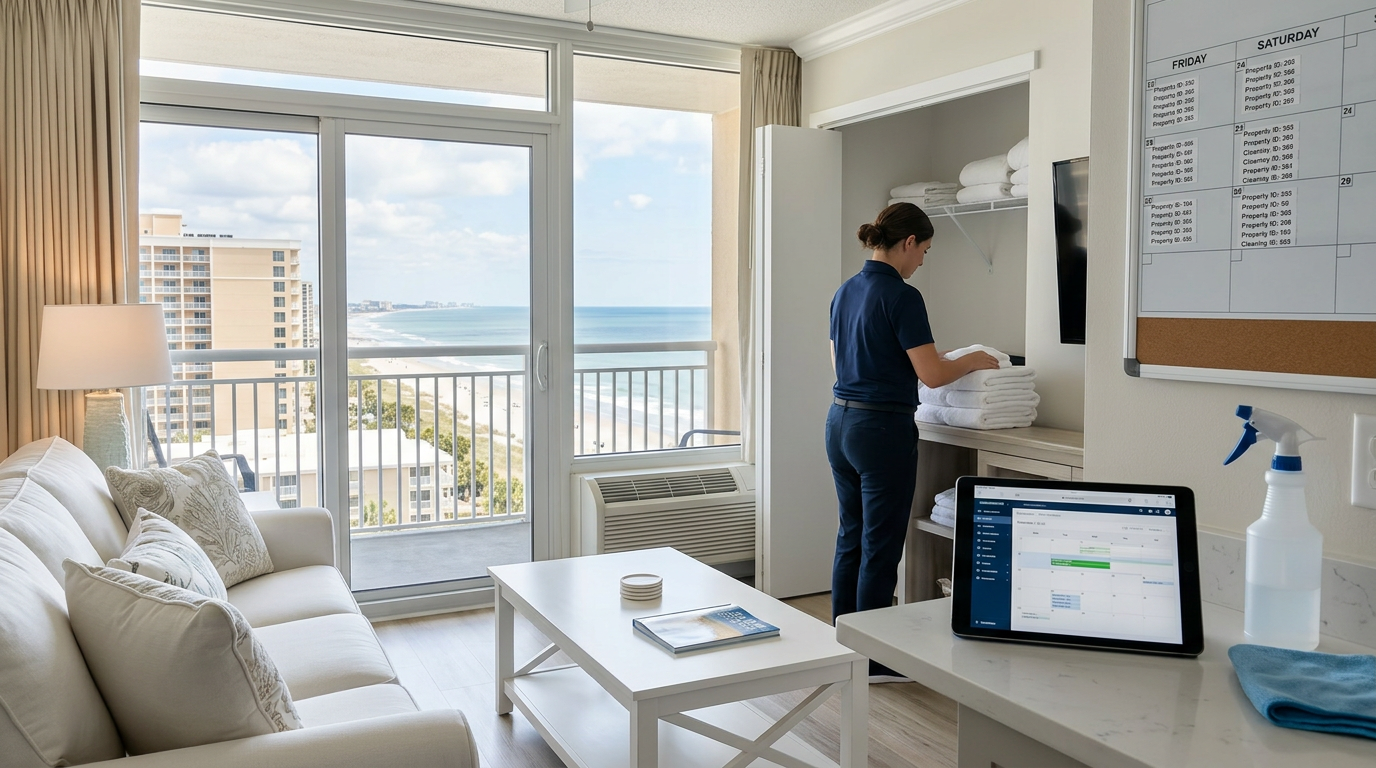
The massive surge in summer vacationers arriving at the Grand Strand between June and August creates a tight operational bottleneck that can easily crush scaling rental portfolios. Without a structured cleaning-cap protocol integrated directly into your Property Management System (PMS), over-booking turn capacity leads to missed check-ins, poor guest reviews, and severe vendor burnout. By establishing real-time turn-rate auditing, property managers can balance booking volume with guaranteed labor capacity to protect their properties. Implementing these operational safeguards ensures that every rental is delivered on time and up to professional standards, even during the busiest summer Saturdays.
The Operational Physics of Grand Strand Saturday Turnovers
The Grand Strand presents a unique operational challenge during peak summer months, stretching sixty miles from Little River to Pawleys Island. On any given Saturday, hundreds of thousands of visitors are transitioning out of and into vacation rental units. The sheer volume of traffic on Highway 17 and Ocean Boulevard creates logistical choke points that instantly delay cleaning crews and linen deliveries. Understanding the physical constraints of this coastal geography is the first step in building a resilient operations plan.
Standardizing housekeeps under these conditions requires moving away from hopeful scheduling to rigid, data-driven planning. A three-bedroom oceanfront condo in Myrtle Beach cannot be treated with the same operational timeline as an inland property. Factors such as high-rise elevator wait times, parking deck clearances for cargo vans, and sand-dragged walkways heavily degrade crew efficiency. If your operational modeling assumes a flat cleaning rate across your entire portfolio, you are setting your operation up for mid-afternoon failures.
Scaling a Grand Strand portfolio successfully depends on recognizing these spatial-temporal bottlenecks before the season begins. A single traffic accident on the swing bridge or a backup at the bypass can delay a crew by forty-five minutes, which ripples through the rest of the day's cleanings. Portfolio managers must build buffer zones into their geographical routes, grouping properties into tight clusters rather than expecting teams to cross major municipal boundaries mid-day. This localization of operations is key to preserving clean quality and meeting check-in deadlines.
Configuring PMS Cleaning Caps and Blockout Rules
Property Management Systems are highly effective at maximizing booking revenue, but they often do so at the expense of operational capacity. To prevent your software from accepting more Saturday arrivals than your housekeeping force can physically execute, you must establish rigid cleaning caps. These caps are dynamic limits programmed directly into your PMS that trigger a block on specific arrival dates once your maximum turnover threshold is reached. This operational guardrail prevents the catastrophic scenario of having more arrivals than clean-up crews on a peak Saturday.
Setting up these rules requires evaluating your portfolio by total bedroom count and complexity rather than just unit volume. For instance, a six-bedroom beach house requires three to four times the man-hours of a standard one-bedroom efficiency condo. Your PMS should be configured to allocate 'operational weight points' to each property based on turn-time data. Once the cumulative weight points for a single calendar day reach your labor ceiling, the system must automatically restrict further bookings for that check-in date.
Integrating this cap system with your marketing and booking engines requires close communication between your operations team and revenue managers. While it is tempting to keep booking channels wide open to capture late-minute premium rates, the cost of a failed turn is devastating. A single relocated guest due to an uncleaned unit can wipe out the profit margin of multiple bookings, not to mention the negative impact of a one-star review. Cleaning caps protect your brand equity by ensuring that every guest arrives at a pristine, fully prepared property.
Calculating Your True Portfolio Clean-Time Index
To implement an accurate cleaning-cap system, you must calculate your portfolio's True Clean-Time Index (CTI). The CTI represents the average number of minutes required to return a specific unit type to guest-ready condition under high-pressure turn conditions. This metric must be derived from historical performance data collected during peak season, rather than idealized off-season trials. It must account for realistic challenges such as excessive sand accumulation, heavy kitchen grease, and multi-bed laundry configurations.
To calculate the CTI, track the clock-in and clock-out times of your cleaning teams over a minimum of ten consecutive peak turns. Factor in the time spent unloading supplies, navigating access codes, and performing the initial trash-out phase of the clean. For properties with specialized amenities, such as private hot tubs or expansive outdoor kitchens, add a fixed time premium to the index. This raw, verified time requirement forms the basis of your operational capacity planning.
Once you have established the CTI for each property class, compare the total hours required against your active workforce capacity. If your active pool of cleaning technicians can provide one hundred hours of labor on a Saturday, and your scheduled turns require one hundred and twenty hours based on your CTI, you have a critical labor deficit. This deficit must be resolved either by adjusting your booking caps, onboarding certified vendor partners, or optimizing team routing to squeeze out efficiency.
Establishing Real-Time Turn-Rate Auditing Milestones
Waiting until 4:00 PM to realize that half of your portfolio remains uncleaned is a recipe for operational disaster. Successful property managers implement a real-time turn-rate auditing protocol with strict hourly milestones throughout the day. These milestones act as early-warning indicators, allowing coordinators to redeploy assets and adjust schedules before delays become unmanageable. By tracking clean progress hour-by-hour, you can transform chaotic turn days into controlled, predictable operations.
The audit schedule should divide the turn window into distinct, measurable checkpoints starting immediately after the 10:00 AM checkout. By 11:30 AM, all departing guests should be confirmed out of their units, and initial trash-out and linen stripping should be underway. By 1:30 PM, fifty percent of your scheduled turns must be actively being cleaned, with early-turn properties entering the quality inspection phase. If the real-time dashboard shows a lag at any of these checkpoints, dispatchers can immediately intervene.
Utilizing mobile housekeeping applications that sync instantly with your central dashboard is non-negotiable for this level of auditing. Cleaning crews must tap to start and complete tasks, uploading real-time photos of completed zones such as the kitchen, bathrooms, and linen setups. This digital paper trail allows your quality control inspectors to pre-audit units remotely, focusing their physical visits on high-risk properties or those managed by newer crew members.
- 10:30 AM: Guest departure verification and digital lock lockout confirmation completed across the entire portfolio.
- 12:00 PM: Trash-out, linen stripping, and primary sanitization sweep finished in sixty percent of units.
- 1:30 PM: Mid-point operational audit; identify stalled teams and deploy mobile support units to lagging zones.
- 3:00 PM: Eighty percent of standard cleanings completed; quality control inspectors begin final walk-throughs and key activations.
- 4:00 PM: Standard check-in hour; all priority units cleared for arrival with digital codes sent to incoming guests.
Vendor SLA Integration and Capacity Commitments
When scaling a vacation rental portfolio along the Grand Strand, relying solely on in-house cleaning staff is rarely feasible. Integrating professional third-party cleaning and linen vendors is essential for handling peak-season surges, but it requires structured Service Level Agreements (SLAs). These agreements must outline precise performance expectations, turnaround times, and penalty clauses for missed milestones. A vague handshake agreement is insufficient when thousands of dollars in guest revenue are on the line.
A robust SLA must define the exact standard of cleanliness required, referencing specific quality checklists and sanitization standards. It must also establish a guaranteed weekly labor capacity, ensuring the vendor reserves adequate staffing for your properties on peak Saturdays. This capacity commitment should be backed by a clear communication protocol, specifying how delays or property damage discovered during turns will be reported and resolved.
Working with a dedicated, family-owned partner like A2Z Cleaning & Linen Services (843.800.2788) provides property managers with the operational reliability needed to scale. Our teams are trained in local coastal hospitality standards, ensuring your units are turned efficiently without sacrificing quality. By aligning your vendor agreements with your internal PMS scheduling caps, you create a seamless operational ecosystem that protects your assets and satisfies your guests.
The Turn-Day Logistics and Runner Dispatch Framework
No matter how well you plan, unexpected emergencies will arise on a peak Saturday in Myrtle Beach. A broken coffee maker, a stained comforter, or an unstocked supply of starter amenities can stall a clean or trigger an immediate guest complaint. To handle these issues without pulling cleaning crews off-site, you must implement a dedicated turn-day runner dispatch framework. This system utilizes mobile, strategically stationed runners equipped with fully stocked utility vehicles to resolve issues on the fly.
Runners should be positioned at key geographical hubs along the Grand Strand, such as North Myrtle Beach, Central Myrtle Beach, and the South End. Each runner vehicle must be stocked with a standardized 'hot-swap' inventory, including spare linens, small appliances, backup smart locks, and bulk consumables. When a cleaning crew or inspector reports an issue via your operational software, the nearest runner is dispatched immediately to resolve the issue.
This separation of labor keeps your core cleaning crews focused on their primary task: turning the units quickly and thoroughly. A cleaning technician should never leave a property to purchase a replacement toaster or hunt down a clean set of queen sheets. By delegating these logistical tasks to a specialized runner team, you preserve your clean-time index and maintain momentum across your entire portfolio throughout the high-pressure turn window.
Post-Departure Damage and Maintenance Work Order Triage
A successful vacation rental turn is not just about cleaning; it is also about maintaining the physical integrity of the property. When a guest departs, the immediate post-checkout window is your only opportunity to identify and repair damage before the next arrival. To manage this effectively, property managers must implement a rapid maintenance triage protocol. This workflow integrates maintenance inspections directly into the initial phase of the cleaning process, ensuring issues are caught and addressed early.
Cleaning crews must be trained to perform a five-minute visual inspection immediately upon entering a vacant unit. This 'triage walk' focuses on critical infrastructure: checking that the air conditioning is cooling, ensuring the electronic door locks are functioning, and inspecting major appliances for damage. If a critical-path maintenance issue is discovered—such as a leaking pipe or a broken refrigerator—it must be logged as an emergency work order immediately.
By logging these issues at the very beginning of the turn window, you give your maintenance team the maximum amount of time to respond. While the cleaning crew works on bedrooms and bathrooms, a technician can be dispatched to repair the air conditioning unit. This parallel workflow prevents the common bottleneck of discovering a major maintenance failure at 3:30 PM, right as the incoming guest is pulling into the driveway.
Post-Turn Audit and Quality Validation Protocols
The final step in a successful turnover operation is the post-turn audit, which validates that the unit meets your portfolio's exact standards before the guest arrives. This audit must be performed by a dedicated quality control inspector who is independent of the cleaning crew. Utilizing an objective, checklist-driven inspection protocol ensures that no detail is overlooked, from the freshness of the linens to the cleanliness of the balcony glass.
The inspector's checklist should be structured geographically, guiding them through the property in a logical sequence that mimics the guest's arrival experience. Special attention must be paid to high-impact touchpoints, such as the cleanliness of the entryway, the presentation of the primary bedroom, and the sanitization of the kitchen and bathrooms. Inspectors should also verify that all electronics, including televisions and Wi-Fi routers, are fully operational and ready for use.
Only after the inspector completes the digital audit and uploads photo validation should the unit status be updated to 'Ready for Check-In' in your PMS. This update automatically triggers the release of the digital door code to the incoming guest, ensuring that no visitor enters an unverified property. This commitment to quality validation is what separates high-performing Grand Strand vacation rentals from the rest of the market.
Key takeaway
Balancing booking volume with operational capacity is essential for scaling a successful vacation rental portfolio in Myrtle Beach. By establishing rigid PMS cleaning caps, real-time turn auditing milestones, and partnering with experienced vendors like A2Z Cleaning & Linen Services, you can protect your property assets and ensure consistent guest satisfaction.
Keep Reading

Vacation Rentals
The Coastal Under-Bed and Behind-Furniture "Look-Back" Inspection Protocol: Mitigating Hidden Guest Detritus, Lost Charging Cables, and Low-Angle Inspection Failures in Grand Strand Vacation Rentals
ReadVacation Rentals
The Mid-Season Cleaning Vendor Transition Protocol: Managing Mid-Contract Transfers, Key Access Migrations, and Quality Audits in Grand Strand Portfolios
ReadVacation Rentals
The Pull-Out Sleeper Sofa Turnover Protocol: Preventing Sand-Grit Accumulation, Fabric Sanitation Failures, and Mechanical Rust in Grand Strand Rentals
ReadReady for a spotless property?
Call 843.800.2788 or request a free quote from A2Z Cleaning & Linen Services.