Commercial & Hospitality
The OSHA Hazard Communication Standard and Closed-Loop Chemical Dilution Systems: Implementing GHS Compliance, Secondary Container Labeling, and Chemical-Contact Mitigation in Grand Strand Hospitality Operations
Align your coastal resort, commercial property, or vacation rental business with national OSHA HazCom standards using closed-loop chemical dilution systems to protect workers and control costs.
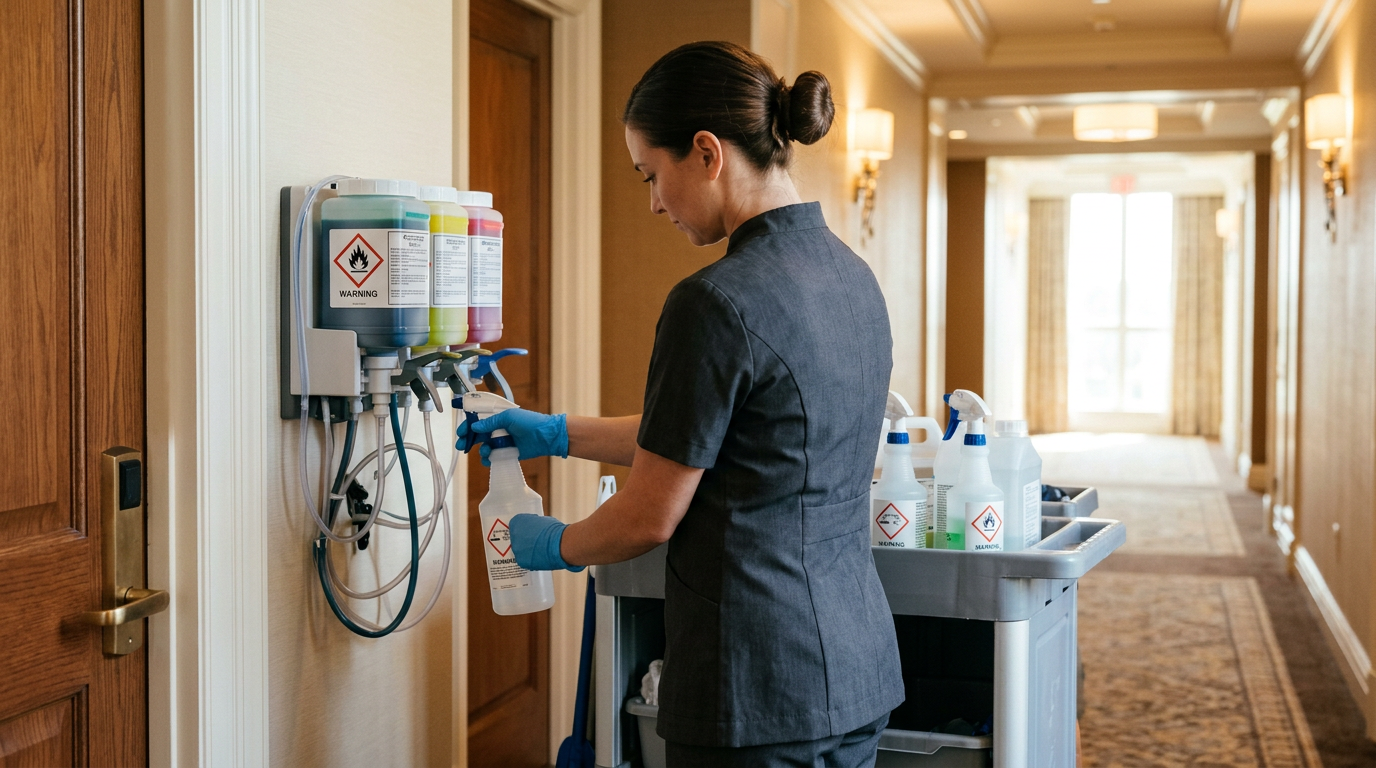
In the fast-paced hospitality and commercial cleaning sectors of the Grand Strand, high-volume properties must maintain exceptional sanitization standards while protecting their frontline workforce. Achieving this balance requires strict adherence to national safety regulations, specifically the Occupational Safety and Health Administration (OSHA) Hazard Communication Standard (29 CFR 1910.1200). Leading operators in Myrtle Beach are phasing out manual chemical mixing in favor of automated, closed-loop chemical dilution systems to control costs and prevent hazardous exposures. Implementing these standardized systems protects workers, minimizes chemical waste, and ensures full compliance during regulatory inspections.
The National OSHA Hazard Communication Standard in Commercial Hospitality
The OSHA Hazard Communication Standard (HCS) is designed to ensure that the hazards of all chemicals used in the workplace are evaluated and that information concerning these hazards is transmitted to employers and employees. In high-turnover hospitality environments, from high-rise oceanfront resorts to expansive vacation rental portfolios, housekeeping staff handle a wide array of concentrated disinfectants, degreasers, and acid-based descalers daily. Without a structured program, workers face significant risks of chemical burns, respiratory irritation from volatile organic compounds, and accidental chemical cross-contamination, such as the highly dangerous mixing of bleach and ammonia.
A common point of failure for coastal businesses during OSHA audits is the practice of 'free-pouring' or manually mixing concentrated chemicals in mop buckets and spray bottles. This outdated approach relies on guesswork, which often leads to overly concentrated chemical solutions that damage delicate interior finishes, leave sticky chemical residues that attract dirt, and release harmful vapors into confined spaces. Nationally, regulatory bodies are cracking down on improper chemical storage and preparation, emphasizing that safe chemical management begins with the elimination of manual measuring processes.
Under the Globally Harmonized System of Classification and Labeling of Chemicals (GHS), employers must maintain a comprehensive written hazard communication program. This program must detail how the property manages chemical inventory, labeling, Safety Data Sheets (SDSs), and employee training. Failing to provide a clear, standardized framework for chemical handling not only exposes operators to steep fines but also increases workers' compensation claims due to avoidable dermal and respiratory injuries.
- Mandatory written Hazard Communication Plan tailored to the specific hospitality site.
- Maintenance of a comprehensive chemical inventory list updated at least annually.
- Elimination of unmeasured manual mixing of chemical concentrates.
- Immediate reporting protocols for accidental exposure or chemical spills.
The Engineering Control Solution: Closed-Loop Chemical Dilution Systems
To mitigate the inherent human error of manual chemical mixing, leading commercial cleaning operators utilize closed-loop chemical dilution systems. These wall-mounted or portable dispensing systems represent a highly effective engineering control, separating the operator from the raw chemical concentrate. In a closed-loop system, the chemical container is sealed with a custom insert that can only be breached by a matching docking connector on the dispensing unit, preventing accidental spills, siphoning, or direct skin contact.
These systems operate using venturi technology, where water pressure draws a precise micro-measurement of chemical concentrate into a flowing water stream. This guarantees that the final cleaning solution is dispensed at the exact dilution ratio recommended by the manufacturer for specific tasks, whether it is an EPA-registered disinfectant, glass cleaner, or heavy-duty bathroom descaler. By securing the concentrates inside locked cabinets, property managers prevent unauthorized staff from altering dilution dials or dispensing raw, dangerous chemicals.
From an operational perspective, automated dilution ensures chemical efficacy, which is critical for meeting public health standards. Under-diluted disinfectants fail to kill targeted pathogens, leaving guests vulnerable to norovirus or influenza, while over-diluted solutions waste money and accelerate the degradation of expensive property assets. Adopting closed-loop systems brings Myrtle Beach hospitality portfolios into alignment with best practices advocated by the ISSA and the American Chemistry Council.
- Sealed, spill-proof chemical cartridges that prevent direct skin or eye contact.
- Venturi-driven water flow controls that eliminate measuring errors.
- Lockable cabinets that prevent tampering and unauthorized concentrate access.
- Consistent chemical delivery that meets manufacturers' EPA disinfection guidelines.
GHS Compliance and Secondary Container Labeling Requirements
A frequent citation in hospitality housekeeping closets involves secondary containers—such as plastic spray bottles, automatic scrubbers, and mop buckets—that contain diluted chemical solutions but lack proper identification. OSHA regulations are clear: if a chemical is transferred from an original manufacturer container to a secondary container, and is not used immediately by the employee who performed the transfer during that same shift, the secondary container must bear a compliant label.
Under GHS standards, these secondary labels must clearly convey the product identifier, appropriate pictograms depicting physical and environmental hazards, signal words such as 'Danger' or 'Warning,' hazard statements, and precautionary statements. Hand-writing the name of a chemical on a piece of masking tape and sticking it to a spray bottle does not meet OSHA standards and will result in non-compliance penalties during a workplace inspection.
Modern closed-loop dilution systems simplify this compliance hurdle by integrating dedicated labeling stations or offering pre-printed, color-coded, water-resistant GHS labels that correspond directly with the cartridge system. Leading operators train their teams to inspect every spray bottle at the start of each shift, ensuring that any faded, peeling, or missing labels are replaced immediately before the container is filled.
- Requirement of full GHS details if a chemical is left unattended or stored.
- Use of durable, water-resistant labels that withstand humid coastal environments.
- Color-coded systems matching the dispenser, the cartridge, and the secondary bottle.
- Prohibition of hand-written tape labels for secondary chemical storage.
Safety Data Sheets Accessibility and Digital Management Trends
Safety Data Sheets (SDSs) are 16-section technical documents that provide detailed information on chemical hazards, handling instructions, personal protective equipment (PPE) requirements, and emergency first-aid procedures. OSHA mandates that SDSs must be readily accessible to employees for all hazardous chemicals used in the workplace during each work shift. Historically, this meant maintaining bulky, yellow three-ring binders in breakrooms or housekeeping closets, which often became outdated or disorganized.
National trends among advanced commercial cleaning operators are shifting away from physical binders toward digital SDS management systems. By utilizing cloud-based databases accessible via mobile devices, tablets, or QR codes posted directly on wall-mounted dilution stations, frontline workers can instantly access the exact SDS they need in their preferred language. This rapid digital access is invaluable during an emergency, such as an accidental chemical splash, where immediate first-aid instructions are required.
However, digital systems must not rely solely on internet connectivity if cellular service is unreliable in certain resort areas or concrete parking garages. OSHA requires that a back-up plan be in place, such as a localized digital backup on a dedicated tablet or a well-maintained physical folder located at a central dispatch desk. Regular training must be conducted to ensure that every cleaner knows how to navigate the SDS database and locate critical safety information under pressure.
- Instant access to 16-section SDS files for all active on-site chemistries.
- QR codes affixed to dilution units for rapid mobile retrieval of safety sheets.
- Multi-language availability to accommodate diverse seasonal housekeepers.
- Redundant access protocols in case of localized cellular or power outages.
Labor Safety and PPE Protocols for Chemical Handling
While closed-loop systems greatly reduce the risk of chemical exposure, personnel must still use appropriate Personal Protective Equipment (PPE) during chemical dispensing and routine cleaning tasks. OSHA requires employers to conduct a personal protective equipment hazard assessment to identify the specific PPE needed for each job function. During the replenishment of chemical cartridges in a dilution station, workers are handling raw concentrates, requiring a higher level of protection than when using diluted cleaning agents.
Standard operating procedures should mandate that employees wear heavy-duty nitrile gloves, splash-resistant safety goggles, and closed-toe slip-resistant footwear when accessing chemical closets or swapping out spent cartridges. Standard thin latex gloves do not provide sufficient chemical resistance against concentrated acids or alkaline strippers. Housekeepers must also be trained on the proper sequence of putting on and taking off PPE to avoid transferring chemical residues to their skin or faces.
Furthermore, facilities must provide accessible emergency eyewash stations near chemical dispensing areas, conforming to ANSI Z358.1 standards. These eyewash stations must be capable of delivering a continuous, tepid water flow for a full fifteen minutes, and must be tested weekly to ensure proper function and sediment removal. Neglecting to maintain these basic safety fixtures puts cleaning staff at serious risk of permanent ocular damage during a splash event.
- Mandatory heavy-duty chemical-resistant nitrile gloves for cartridge handling.
- Splash goggles or face shields to protect eyes from high-concentration chemical mist.
- ANSI-compliant eyewash stations positioned within a 10-second walk of dispensers.
- Weekly documented testing of eyewash water flow and temperature consistency.
Supply-Chain Optimization and Environmental Sustainability
Transitioning to concentrated chemical cartridges utilized in automated dilution systems delivers significant supply-chain and environmental benefits. Ready-to-use (RTU) liquid cleaning products consist of up to ninety-five percent water, meaning that properties are paying high shipping rates to transport water across the country. By purchasing super-concentrated cartridges and diluting them on-site with local municipal water, commercial operators reduce shipping costs, decrease fuel emissions, and reclaim storage space in their linen closets.
This shift also plays a major role in waste reduction. A single cartridge of concentrated glass cleaner can generate dozens of spray bottles of active cleaning solution, preventing hundreds of single-use plastic bottles from entering South Carolina landfills. Many leading hospitality operations utilize Green Seal, Ecologo, or EPA Safer Choice certified concentrates within their closed-loop dispensers, verifying that the chemical formulations meet strict national standards for biodegradability, low toxicity, and minimal environmental impact.
Implementing sustainable chemical systems enhances a property's appeal to eco-conscious travelers and corporate meeting planners who evaluate a resort's environmental footprint. By standardizing these green cleaning technologies, local operations demonstrate a commitment to both local ecological preservation and national occupational safety guidelines.
- Up to ninety percent reduction in plastic packaging waste and carbon footprint.
- Lower shipping and storage costs through concentrated product procurement.
- Utilization of Green Seal or EPA Safer Choice certified non-toxic chemistries.
- Reduction of volatile organic compound (VOC) levels in guest accommodations.
Training and Behavioral Audits for High-Turnover Environmental Service Teams
The effectiveness of any safety and compliance program depends on the training of the frontline staff who execute it. In the Grand Strand's seasonal economy, housekeeping teams are often composed of a diverse mix of permanent, seasonal, and J-1 international workers. Language barriers and varied experience levels make visual, interactive, and bilingual training program designs essential for conveying critical safety and operational procedures.
Training should begin with hands-on demonstrations of how to safely connect and disconnect chemical cartridges, read dilution dials, and verify correct spray bottle labeling. Operators should utilize visual aids, such as color-coded diagrams and instructional videos without voiceover barriers, to ensure universal understanding. Every training session must be documented with sign-in sheets and competency checklists, providing a paper trail that verifies OSHA-mandated training compliance.
To maintain these high standards throughout the year, quality assurance managers must perform regular behavioral safety audits. These audits involve observing housekeepers on the floor, verifying that they are wearing the correct PPE, checking that their secondary containers are properly labeled, and confirming that they are utilizing the appropriate cleaning dilution settings for their assigned tasks. Identifying and correcting safe-work deviations immediately prevents workplace accidents and ensures high-quality sanitation.
- Interactive, bilingual training materials tailored to diverse workforces.
- Documented hands-on competency testing for chemical dilution equipment.
- Frequent, unannounced behavioral safety audits in guest room environments.
- Prompt corrective action plans when compliance gaps are observed.
Implementing a Transition Plan to Closed-Loop Systems
For resorts, vacation rental operations, and commercial facilities looking to upgrade their cleaning programs, transitioning to a closed-loop chemical dilution system requires a systematic approach. The first step involves auditing all current cleaning chemicals, consolidating redundant products, and identifying high-hazard chemicals that should be phased out. By standardizing a core group of four to five high-performance concentrates, properties can simplify their inventory and reduce training requirements.
Next, operators should partner with a commercial laundry and cleaning services provider to select and install the dispensing equipment. These wall-mounted systems must be installed in designated utility closets equipped with dedicated water lines and appropriate backflow prevention devices (such as ASSE 1055-certified dispensers) to comply with local plumbing codes and prevent chemical contamination of the municipal water supply.
For advice on optimizing chemical management systems, installing compliant commercial dispensing units, or upgrading a property's overall cleaning and linen operations, commercial clients and property managers can reach A2Z Cleaning & Linen Services at 843.800.2788. Once the physical infrastructure is in place, operators must roll out the updated GHS-compliant labeling, distribute new PPE, and execute the initial staff training program to launch a safe, compliant, and highly efficient cleaning operation.
- Consolidation of cleaning chemical inventory down to core essential products.
- Installation of ASSE 1055-certified dispensers with backflow prevention.
- Coordinated rollout of new GHS secondary labels and matching safety equipment.
- Partnership with professional commercial specialists for ongoing system support.
Key takeaway
Transitioning to automated, closed-loop chemical dilution systems is a proven strategy for Grand Strand hospitality operations to maintain OSHA HazCom compliance, reduce labor-related safety incidents, and control chemical costs. By eliminating manual free-pouring and ensuring proper secondary container labeling, property managers protect both their workers and their physical assets while delivering a consistent level of clean. Implementing these national industry standards positions your hospitality business as a leader in safety, sustainability, and operational excellence.
Keep Reading

Commercial & Hospitality
The OSHA Bloodborne Pathogen Standard for Coastal Hospitality and Commercial Facilities: Implementing Exposure Control Plans, EPA List Q Disinfectants, and Post-Incident Workflows in Myrtle Beach
ReadCommercial & Hospitality
The Commercial Custodial Supervisor Competency Blueprint: Structuring Skills-Based Assessments, Technical Interview Rubrics, and Competitive Pay Scale Models for Myrtle Beach Facilities
ReadCommercial & Hospitality
The National Color-Coded Zone Cleaning Standard: Cross-Contamination Mitigation and Microfiber Chemistry in Myrtle Beach Commercial Facilities
ReadReady for a spotless property?
Call 843.800.2788 or request a free quote from A2Z Cleaning & Linen Services.