Commercial & Hospitality
The OSHA Bloodborne Pathogen Standard for Coastal Hospitality and Commercial Facilities: Implementing Exposure Control Plans, EPA List Q Disinfectants, and Post-Incident Workflows in Myrtle Beach
A comprehensive compliance blueprint for Grand Strand property managers and facility operators implementing OSHA-compliant biohazard and exposure control protocols.
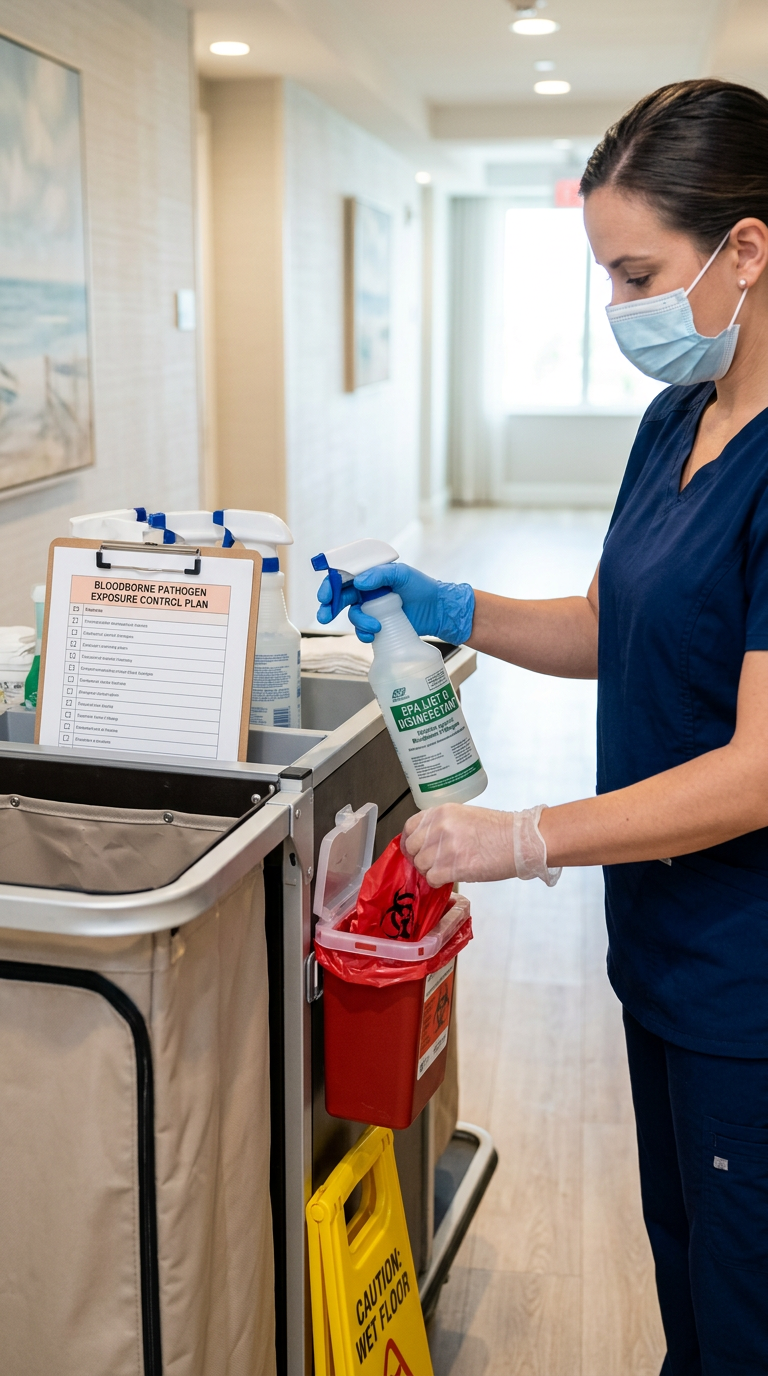
In the high-velocity hospitality and commercial real estate sectors of Myrtle Beach, maintaining pristine interiors is more than an aesthetic necessity—it is a regulatory and public health imperative. Every summer, the Grand Strand hosts millions of visitors, dramatically increasing the wear on commercial facilities and vacation rentals, which also elevates the risk of exposure to biological hazards. Understanding and implementing the Occupational Safety and Health Administration (OSHA) Bloodborne Pathogens Standard is critical for local facility managers, HOAs, and property management companies. By establishing rigorous exposure control plans and aligning field operations with national sanitization benchmarks, local businesses can protect their frontline staff, minimize liability, and ensure a safe environment for guests.
The Regulatory Landscape: Demystifying OSHA 29 CFR 1910.1030 in Grand Strand Hospitality
The OSHA Bloodborne Pathogens Standard (29 CFR 1910.1030) is often mistakenly viewed as a regulation exclusive to healthcare environments. In reality, any commercial enterprise where employees face reasonable anticipation of contact with blood or other potentially infectious materials (OPIM) must comply with this federal standard. For Myrtle Beach hotel operations, vacation rental portfolios, and high-traffic retail spaces, environmental services (EVS) staff and turn cleaners are frequently exposed to these risks. From cuts sustained on the beach to sudden medical incidents in public areas, local staff must be trained to identify and handle biohazards under strict regulatory guidelines.
Failing to implement these standards exposes Grand Strand businesses to severe financial penalties and reputational damage. OSHA actively inspects hospitality and commercial properties, particularly following worker complaints or reported workplace injuries. A compliant program requires a written exposure control plan, specialized training, and structured record-keeping. By elevating local cleaning operations to meet these national standards, property owners demonstrate a commitment to worker safety and professional excellence that transcends basic janitorial practices.
At A2Z Cleaning & Linen Services, we build our commercial workflows around these rigorous federal standards. We recognize that in a tourist-driven economy, our clients require more than surface-level polishing; they need validated sanitation that protects their assets and their guests. Operating as a family-owned business at 843.800.2788, we integrate national compliance structures into the daily routines of our Grand Strand service teams, ensuring that local properties remain safe, sanitary, and fully compliant with federal law.
- Applies to all employees with occupational exposure to blood or OPIM.
- Requires a written, site-specific Exposure Control Plan updated annually.
- Mandates the implementation of engineering and work practice controls.
- Enforces strict guidelines for handling, labeling, and disposing of biohazardous waste.
The Exposure Control Plan: Structuring a Compliant Framework for Seasonal Teams
A compliant Exposure Control Plan (ECP) is the cornerstone of any professional commercial cleaning operation in the Grand Strand. This document must be highly specific, outlining exactly which job classifications face exposure risks and detailing the precise steps required to eliminate or minimize those risks. In Myrtle Beach, where high seasonal staff turnover can dilute operational knowledge, having a highly structured, easily accessible written plan is essential. The ECP must clearly define the chain of command, the location of spill response kits, and the specific decontamination protocols utilized across the property portfolio.
To remain compliant, the ECP must undergo an annual review to reflect changes in technology, chemical selections, and staff positions. It must incorporate input from non-managerial frontline technicians who are directly responsible for executing the cleaning and decontamination procedures. This collaborative approach ensures that the plan remains practical and grounded in the actual physical realities of maintaining high-turnover oceanfront resorts, commercial plazas, and multi-family residential complexes.
For local property managers, outsourcing environmental services to a partner with an established, audited ECP mitigates operational risk. Rather than drafting, updating, and training internal seasonal staff on complex biohazard protocols, managers can rely on certified external professionals. This structural safety net allows resort and commercial property teams to focus on guest relations and asset management while knowing their cleaning protocols meet the highest national regulatory benchmarks.
Color-Coded Microfiber and Tools: Preventing Cross-Contamination of Bioactive Soilages
Cross-contamination is one of the greatest operational risks in commercial facilities and vacation rentals. Dragging a cleaning tool from a high-risk zone, such as a restroom floor or a biohazard spill site, into a food preparation area or guest bedroom can rapidly spread dangerous pathogens. To prevent this, leading national operators utilize a strict, color-coded cleaning system. This system visually segregates microfiber cloths, mops, buckets, and personal protective equipment based on the specific bio-risk zone of the facility being serviced.
Under the industry-standard color-coding system, red is universally reserved for high-risk biohazard areas, including toilets, urinals, and direct bloodborne pathogen spill cleanups. Yellow is utilized for low-risk restroom surfaces such as sinks and walls. Blue and green are allocated for general dusting and food preparation surfaces, respectively. By enforcing this visual protocol, supervisors can instantly verify compliance from across a room, ensuring that a cloth used to clean a biohazard spill is never introduced to a high-touch guest surface.
Implementing this standard in the Grand Strand requires continuous, hands-on monitoring and physical segregation of laundry streams. Red-coded materials must be collected in distinct, leak-proof biohazard bags and laundered separately using industrial sanitization cycles that meet the Association for Linen Management (ALM) guidelines. This level of operational discipline prevents the cross-contamination of linens and cleaning textiles, protecting both subsequent guests and the technicians handling the laundry.
Personal Protective Equipment (PPE) Protocols: Donning, Doffing, and Disposal in Warm Climates
Personal Protective Equipment (PPE) is the final line of defense between a cleaning technician and a hazardous pathogen. In coastal South Carolina, the physical demands of wearing heavy-duty protective gear are amplified by high summer temperatures and humidity. When responding to a biohazard event or performing deep-clean sanitization, technicians must wear appropriate barriers, including medical-grade nitrile gloves, fluid-resistant gowns, face shields, and respiratory protection. Managing heat stress while maintaining this protective barrier is a key operational challenge.
Proper 'donning' (putting on) and 'doffing' (taking off) sequences are critical to preventing self-contamination. OSHA guidelines dictate a precise order of removal, as the exterior of the PPE is highly likely to be contaminated. Technicians must peel gloves off inside-out, remove gowns without touching the front surface, and immediately wash their hands with antimicrobial soap and warm water. Training must include physical demonstrations of these sequences, as intellectual knowledge alone rarely prevents accidental exposure during a stressful cleanup scenario.
Disposal of contaminated PPE must also follow strict protocols. Any materials saturated with blood or OPIM cannot be thrown into standard commercial trash receptacles. They must be placed in designated, color-coded biohazard bags (typically red) that bear the universal biohazard symbol. These bags must then be sealed and stored in a secure, climate-controlled holding area until they can be collected by a licensed medical waste disposal service, ensuring complete compliance with both local environmental regulations and federal law.
- Enforce a mandatory PPE donning and doffing sequence for all biohazard responses.
- Provide lightweight, breathable, fluid-resistant barriers to mitigate technician heat stress.
- Ensure immediate access to hand-washing stations or high-alcohol sanitizers post-doffing.
- Isolate and seal contaminated PPE in marked, leak-proof biohazard disposal containers.
Post-Incident Spill Cleanups: STEP-by-STEP Decontamination of Hard and Soft Coastal Surfaces
When an active bodily fluid spill occurs in a public lobby, hotel room, or commercial space, immediate and structured containment is required. The first step in any post-incident workflow is securing the area. Technicians must establish a physical perimeter using safety cones or warning tape to keep guests and unauthorized staff away from the biohazard. Once the area is secure, the responding technician dons full PPE and prepares the specialized spill response kit containing solidifiers, disinfectants, and disposal bags.
On non-porous hard surfaces like luxury vinyl tile (LVT), ceramic tile, or sealed concrete, the fluid should first be stabilized using an absorbent solidifier powder. This turns liquid spills into an easily sweepable gel, preventing the spread of the pathogen during physical removal. After the bulk material is swept and double-bagged in biohazard waste containers, the EPA-registered disinfectant is applied, remaining wet for the full mandated dwell time before being wiped clean with color-coded red microfiber cloths.
Soft, porous surfaces such as commercial carpets, luxury rugs, or upholstered furniture present a greater technical challenge. Because these materials absorb fluids, they cannot be reliably decontaminated using surface-applied liquids alone. The protocol requires extracting the biological material using hot-water soil extraction equipment paired with an EPA-registered sanitizer formulated specifically for soft surfaces. If the material cannot be thoroughly decontaminated or if the backing is compromised, the standard requires physical removal and replacement of the affected textile to prevent mold, odor, and pathogen reservoirs.
Employee Training, Record-Keeping, and Hepatitis B Vaccine Protocols
A highly robust training program is the primary mechanism for ensuring compliance and safety in high-turnover hospitality environments. OSHA requires that all employees with occupational exposure potential receive comprehensive training at the time of initial assignment and at least annually thereafter. This training must cover the epidemiology of bloodborne diseases, the specific details of the company's Exposure Control Plan, proper PPE usage, and the post-exposure evaluation process. Training records must be meticulously maintained for three years from the date of the training session.
A critical and often overlooked component of 29 CFR 1910.1030 is the Hepatitis B vaccination mandate. Employers must make the Hepatitis B vaccine and vaccination series available to all employees who have occupational exposure. This must be offered free of charge, at a reasonable time and place, and within ten working days of initial assignment. If an employee chooses to decline the vaccine, they must sign a specific, legally binding OSHA declination statement, which must be kept on file for the duration of their employment plus thirty years.
At A2Z Cleaning & Linen Services, we maintain exhaustive compliance records for all our field staff and supervisors. Our family-owned operation is built on trust and professional accountability, which is why we handle regulatory record-keeping with the same rigor as a medical facility. When Grand Strand property managers partner with us, they gain peace of mind knowing that every technician entering their property is fully trained, vaccinated or documented, and medically cleared to handle biohazard risks safely.
- Provide comprehensive, interactive OSHA BBP training upon hire and annually.
- Maintain detailed training records including dates, content, and trainer credentials.
- Offer the Hepatitis B vaccine series free of charge to all exposed staff within 10 days.
- Retain signed OSHA declination forms and medical records securely for 30 years post-employment.
Auditing and Quality Assurance: Validating Compliance in High-Volume Portfolios
To ensure that national sanitization standards are actively maintained in the field, commercial properties must implement structured auditing protocols. Visual inspections alone are insufficient to confirm the destruction of invisible biological pathogens. Progressive operators utilize advanced quantitative validation methods, such as Adenosine Triphosphate (ATP) bioluminescence testing. By swabbing high-touch surfaces before and after decontamination, supervisors can mathematically prove that the surface is clean, establishing a clear paper trail of safety and compliance.
These audits should target high-touch zones that are prone to organic contamination, such as handrails, elevator buttons, restroom fixtures, and light switches. In Myrtle Beach resorts, where families and beachgoers frequently transition between outdoor and indoor spaces, these high-touch zones accumulate a complex mix of sand, sunscreen, sweat, and environmental bacteria. Regular auditing ensures that standard cleaning chemical selections and application techniques remain effective against these challenging coastal soilages.
By integrating quantitative auditing into a property's preventive maintenance program, managers can identify training deficiencies or chemical failures before they result in a public health issue or a regulatory citation. Standardizing these audit loops across a portfolio safeguards guest health, reduces corporate liability, and provides local businesses with the data necessary to defend against potential legal claims regarding property cleanliness and safety.
Key takeaway
Implementing a fully compliant OSHA Bloodborne Pathogen program is essential for protecting staff and guests in Myrtle Beach's commercial and hospitality spaces. Partnering with a professional, family-owned provider like A2Z Cleaning & Linen Services at 843.800.2788 ensures your properties meet rigorous national sanitization standards, giving you complete operational peace of mind.
Keep Reading
Commercial & Hospitality
The ATP Bioluminescence Testing Standard for Coastal Commercial Facilities: Quantitative Disinfection Validation, National Hygiene Benchmarks, and Crew Training Protocols in Myrtle Beach
ReadCommercial & Hospitality
The National Color-Coded Zone Cleaning Standard: Cross-Contamination Mitigation and Microfiber Chemistry in Myrtle Beach Commercial Facilities
ReadCommercial & Hospitality
The Grand Strand Commercial Disinfection Specialist Career Pathway: Class-A Office Standards, Biohazard Mitigation Certifications, and Local Retention Models
ReadReady for a spotless property?
Call 843.800.2788 or request a free quote from A2Z Cleaning & Linen Services.