Commercial & Hospitality
The ATP Bioluminescence Testing Standard for Coastal Commercial Facilities: Quantitative Disinfection Validation, National Hygiene Benchmarks, and Crew Training Protocols in Myrtle Beach
Transition from visual-only cleaning inspections to quantitative ATP bioluminescence verification. Learn how national hygiene benchmarks protect Grand Strand commercial facilities.
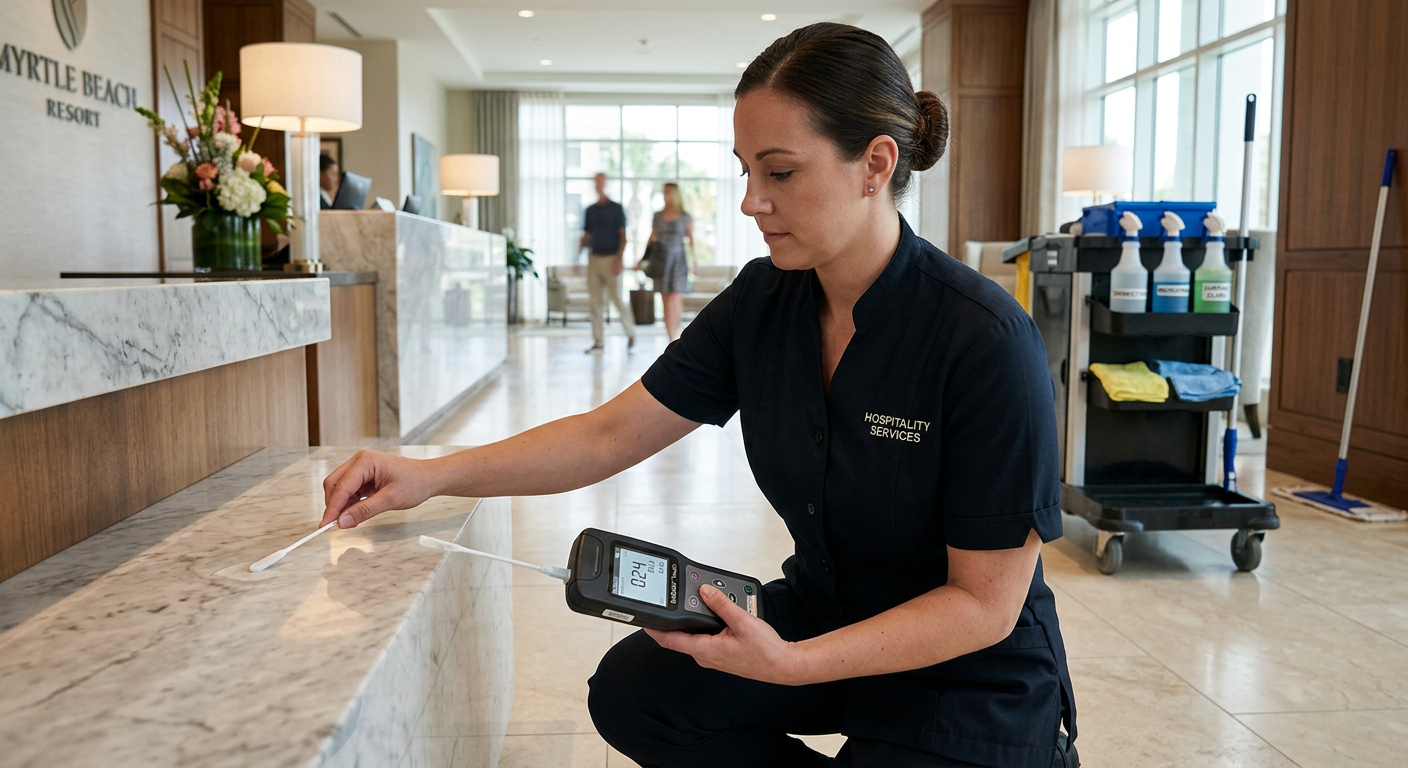
For decades, commercial cleaning in Myrtle Beach and across the Grand Strand has relied on visual inspections to confirm cleanliness. However, high-traffic coastal facilities face unique biological loads, from sand-trapped organic matter to humidity-fueled microbial growth, which cannot be assessed by sight alone. National cleaning standards are shifting toward quantitative hygiene validation, using scientific testing to confirm true sanitization. Embracing these advanced validation protocols elevates local commercial properties to the level of elite, bio-secure environments.
The Evolution from Aesthetic to Quantitative Commercial Hygiene
Historically, commercial building managers and hospitality operators judged the quality of a cleaning program by the absence of visible dust and trash. While a shiny floor and clean-smelling lobby provide a positive first impression, national hygiene agencies have long warned that visual cleanliness does not equate to sanitary surfaces. Microscopic pathogens, organic residues, and allergen-dense biofilms frequently remain on surfaces that appear pristine to the naked eye.
In our coastal climate, where high humidity and constant tourist turnover accelerate the accumulation of biological matter, relying solely on visual audits is an operational liability. Leading environmental services (EVS) providers now adopt objective, data-driven validation methods that remove human bias from the inspection process. This transition aligns local Grand Strand operations with national healthcare and institutional hygiene standards.
By implementing quantitative testing, facility directors can identify hidden infection vectors before they lead to outbreaks or negative guest reviews. This shifting paradigm elevates commercial cleaning from a basic utility to an essential component of public health and asset protection. It provides property owners with verifiable proof that their spaces are truly sanitized.
Understanding ATP Bioluminescence: The Science of Clean
Adenosine Triphosphate, or ATP, is the universal energy molecule present in all living and once-living cells, including bacteria, mold, yeast, and bodily fluids. When organic residue is left behind on a commercial surface, ATP remains present as a clear marker of contamination. Measuring this molecule provides an immediate, indisputable reading of the biological load on any given high-touch surface.
The testing process uses a specialized swab and a portable device called a luminometer. When the swab collects organic matter and reacts with a specific enzyme (luciferase) inside the testing tube, it emits light. The luminometer measures this bioluminescent reaction and outputs a numerical value expressed in Relative Light Units (RLUs). A higher RLU count directly correlates with a higher level of organic contamination.
In the Grand Strand's high-humidity environments, organic residues on common surfaces quickly become breeding grounds for bacteria and mold. ATP testing exposes these invisible micro-environments instantly, allowing cleaning crews to adjust their chemistry or dwell times before the space is cleared for public use. This real-time diagnostic capability is a game-changer for high-occupancy coastal properties.
National Benchmarks and RLU Thresholds for High-Traffic Facilities
To implement an effective ATP monitoring program, facilities must establish clear, standardized RLU thresholds that define "pass," "caution," and "fail" categories. While food service and healthcare environments maintain the strictest national standards, general commercial spaces and hospitality venues have adopted standardized ranges to protect occupants. Generally, a reading below 10 RLU indicates an exceptionally clean, food-grade or clinical-grade surface.
For most high-traffic coastal commercial facilities, such as resort lobbies, fitness centers, and office suites, an RLU reading between 11 and 30 is considered acceptable or "passed" for non-porous surfaces. Readings from 31 to 100 RLU fall into a caution zone, indicating that while no immediate danger exists, the surface is accumulating organic residue and requires more thorough mechanical agitation or a disinfectant change. Any reading above 100 RLU constitutes a clear failure, demanding immediate re-cleaning and re-testing.
These benchmarks are not arbitrary; they are backed by research from the ISSA (International Sanitary Supply Association) and the CDC. Adhering to these national thresholds ensures that Myrtle Beach property managers can back up their cleanliness claims with hard, scientific data that satisfies both corporate clients and safety-conscious tourists.
Designing a Localized ATP Sampling and Auditing Protocol
Designing an effective ATP monitoring protocol requires targeting the surfaces most likely to host and transfer pathogens. In a Grand Strand resort or commercial building, these high-touch zones include elevator buttons, registration desks, stair handrails, and entry door handles. Random sampling across these zones prevents cleaning crews from focusing only on anticipated test areas, ensuring a consistently high level of sanitization throughout the facility.
A robust protocol divides the property into distinct risk zones, dedicating a specific number of monthly or weekly tests to each area. The results are logged in a centralized database to identify systemic cleaning failures, such as underperforming staff or ineffective chemical dilutions. Over time, this data reveals seasonal trends, showing when high humidity or peak tourist volumes require increased cleaning frequencies.
By mapping and tracking these microscopic hot spots, property managers can allocate their cleaning resources more efficiently, focusing labor where biological loads are heaviest. This targeted approach reduces chemical waste and saves labor hours while significantly boosting overall sanitation scores.
- Elevator call buttons and interior control panels
- Reception counter tops and touch-screen kiosks
- Restroom flush valves, faucet handles, and soap dispensers
- Shared kitchen appliance handles and breakroom tabletops
- Stairway handrails and main entry door push plates
- Gym equipment handles and digital console screens
Integrating Quantitative Validation into Crew Training and Scorecards
Introducing ATP testing to a commercial cleaning crew should never be framed as a punitive measure. Instead, elite operators use quantitative validation as a powerful, objective training tool. When a technician can see an immediate RLU score change from 250 down to 12 after adjusting their wiping technique or disinfectant dwell time, the science of cleaning becomes tangible and rewarding.
Connecting objective ATP data to technician training scorecards shifts the workplace culture from subjective criticism to pride in craftsmanship. Technicians understand exactly what is expected of them and can verify their own success. This clarity significantly improves job satisfaction and retention rates among environmental services staff in the competitive Myrtle Beach labor market.
Regular training sessions should include live demonstrations of how wiping techniques, such as the S-pattern vs. circular buffing, impact RLU scores. By showing how circular wiping redistributes contaminants while the S-pattern removes them, managers can visually and numerically prove the value of proper cleaning mechanics.
Equipment Selection, Calibration, and Reagent Management
Operating an ATP validation program requires high-quality, professional-grade equipment and careful inventory management. Handheld luminometers must be regularly calibrated according to manufacturer specifications to ensure reading consistency across different devices. Additionally, the chemistry of the testing swabs is highly sensitive to environmental factors and must be protected from extreme conditions.
Swab reagents are enzymatic proteins that degrade when exposed to heat or direct sunlight, a constant challenge during Myrtle Beach summers. Leading operators store their test swabs in temperature-controlled environments or insulated cooler bags when performing field audits. Utilizing expired or heat-damaged swabs can produce false negatives, compromising the integrity of the entire sanitation database.
When selecting a system, look for software integrations that automatically sync testing data to the cloud. This allows facility managers to review real-time hygiene dashboards, generate compliance reports for stakeholders, and easily track multi-site performance from a single interface.
Mitigating False Readings: Chemical Interference and Coastal Environmental Factors
While ATP testing is highly accurate, field technicians must be trained to recognize and mitigate factors that cause false readings. In coastal environments, airborne salt, sand-grit, and heavy mineral deposits from hard water can coat surfaces. While inorganic minerals do not contain ATP, their presence can physically interfere with the enzymatic reaction inside the test tube, occasionally leading to skewed results.
Chemical disinfectants themselves can also interfere with ATP readings. Some heavy-duty quat-based disinfectants or sanitizers contain quenching agents that can suppress the light reaction, leading to false-low readings if the surface is swabbed while still wet. To combat this, technicians must allow surfaces to dry completely or use specialized swabs designed to resist chemical interference.
Proper training ensures that swabs are used at the correct angle with uniform pressure, ensuring that only organic residues are lifted. Understanding these environmental nuances separates true commercial cleaning experts from operators who simply purchase a device without mastering the science behind it.
The Financial and Operational ROI of Data-Driven Sanitation
Investing in an ATP validation program requires resources for equipment, swabs, and administrative tracking, but the financial returns are substantial. For commercial property owners, presenting verifiable disinfection data is a powerful marketing tool that attracts premium tenants and corporate events. It demonstrates a proactive commitment to occupant wellness that goes far beyond generic clean-smelling air fresheners.
Operationally, data-driven sanitation prevents costly service calls and localized viral outbreaks that can devastate a hospitality business during peak season. When a facility can prove its common areas are maintained below national RLU thresholds, it minimizes liability and builds deep trust with visitors and employees alike. In Myrtle Beach's competitive market, scientific proof of clean is a distinct competitive advantage.
Over time, the accumulated testing data allows managers to optimize chemical purchases and labor allocation. By identifying which disinfectants yield the lowest RLU scores with the shortest dwell times, facilities can reduce product waste and streamline their daily cleaning routines without sacrificing safety.
Key takeaway
Transitioning your Grand Strand commercial facility to quantitative ATP testing replaces guesswork with measurable, scientific proof of hygiene. Partnering with a professional team that understands national sanitization standards protects your brand, your tenants, and your visitors. Contact A2Z Cleaning & Linen Services at 843.800.2788 to elevate your property's sanitation protocols today.
Keep Reading
Commercial & Hospitality
The OSHA Bloodborne Pathogen Standard for Coastal Hospitality and Commercial Facilities: Implementing Exposure Control Plans, EPA List Q Disinfectants, and Post-Incident Workflows in Myrtle Beach
ReadCommercial & Hospitality
The Grand Strand Commercial Disinfection Specialist Career Pathway: Class-A Office Standards, Biohazard Mitigation Certifications, and Local Retention Models
ReadCommercial & Hospitality
The ISSA CIMS-GB Commercial Custodial Standard: Transitioning Grand Strand Facilities to High-Performance, Low-Emission Sustainable Cleaning Systems
ReadReady for a spotless property?
Call 843.800.2788 or request a free quote from A2Z Cleaning & Linen Services.