Commercial & Hospitality
The ANSI/NFSI B101.3 Wet Dynamic Coefficient of Friction (DCOF) Standard for Coastal Commercial Flooring: Mitigating Sand-Grit Ball-Bearing Effects and High-Humidity Slip Hazards in Grand Strand Facilities
A guide to maintaining commercial flooring safety in coastal environments using ANSI/NFSI B101.3 traction standards, digital tribometry, and advanced sand-grit extraction protocols.
For commercial property managers, resort operators, and HOA boards along the Grand Strand, floor safety is a primary operational priority that directly impacts visitor safety and liability. The coastal environment introduces unique hazards, most notably fine beach sand and high humidity, which combine to turn high-traffic hard floors into slippery surfaces. Relying on visual inspections or basic wet mopping is no longer sufficient under modern safety standards. This guide details how to implement a professional floor safety program that aligns with national standards and protects your facility.
The Physics of Coastal Slip Hazards: Understanding the Sand-Grit Ball-Bearing Phenomenon
Coastal facilities in Myrtle Beach face a unique mechanical friction challenge that standard inland properties rarely encounter. Fine beach sand consists of silica particles that act as miniature ball bearings on smooth surfaces. When tracked onto polished stone, porcelain tile, or luxury vinyl plank (LVP), these dry grains decouple the pedestrian's shoe sole from the flooring material, reducing friction and inducing sudden slips.
The risk amplifies exponentially when coastal humidity enters the equation. Relative humidity levels along the Grand Strand routinely exceed 80%, causing a microscopic moisture film to condense on non-porous hard surfaces. This ambient moisture combines with fine airborne salt spray and tracked-in sand to create a slick, abrasive slurry that strips away the natural traction of the flooring material.
Traditional cleaning methods often exacerbate this issue rather than solving it. Standard damp mopping with generic neutral cleaners merely redistributes the fine sand-and-salt slurry across the floor, leaving behind a sticky surfactant residue that attracts even more grit. To combat this, commercial facility managers must understand the physics of traction and implement specialized soil-extraction protocols that pull soil out of the floor's micro-textures.
Deciphering ANSI/NFSI B101.3 and DCOF Standards
For decades, the commercial cleaning industry relied on Static Coefficient of Friction (SCOF) measurements to evaluate floor safety. However, modern national safety standards, specifically ANSI/NFSI B101.3, have shifted the focus to Wet Dynamic Coefficient of Friction (DCOF). DCOF measures the slip resistance of a floor while a person is already in motion, providing a far more accurate representation of actual pedestrian slip risks.
Under the ANSI/NFSI B101.3 standard, a wet floor surface must maintain a minimum DCOF value of 0.42 to be classified as 'high traction.' Floors measuring between 0.30 and 0.42 present a moderate slip risk, while surfaces falling below 0.30 are classified as low traction and require immediate remediation. In coastal resort lobbies and commercial entryways, maintaining this 0.42 threshold requires a precise balance of mechanical soil extraction and traction-enhancing chemistry.
Leading commercial operators do not guess when it comes to compliance and liability. Adhering to these national standards protects property owners from slip-and-fall litigation, which is a major financial risk for high-traffic Grand Strand properties. By aligning daily maintenance protocols with ANSI/NFSI guidelines, facilities can prove they are exercising due diligence and actively mitigating environmental hazards.
- High Traction (DCOF >= 0.42): Lower risk of slip-and-fall incidents; the target safety standard for commercial wet zones.
- Moderate Traction (DCOF 0.30 - 0.41): Marginal safety; requires monitoring, increased maintenance, and eventual remediation.
- Low Traction (DCOF < 0.30): High slip risk; requires immediate deep restoration, slip-resistant treatments, or floor replacement.
- Dry vs. Wet Testing: Focuses on wet testing because moisture is the primary catalyst for commercial slip-and-fall incidents.
Tribometry and Floor Testing Protocols in Grand Strand Resorts
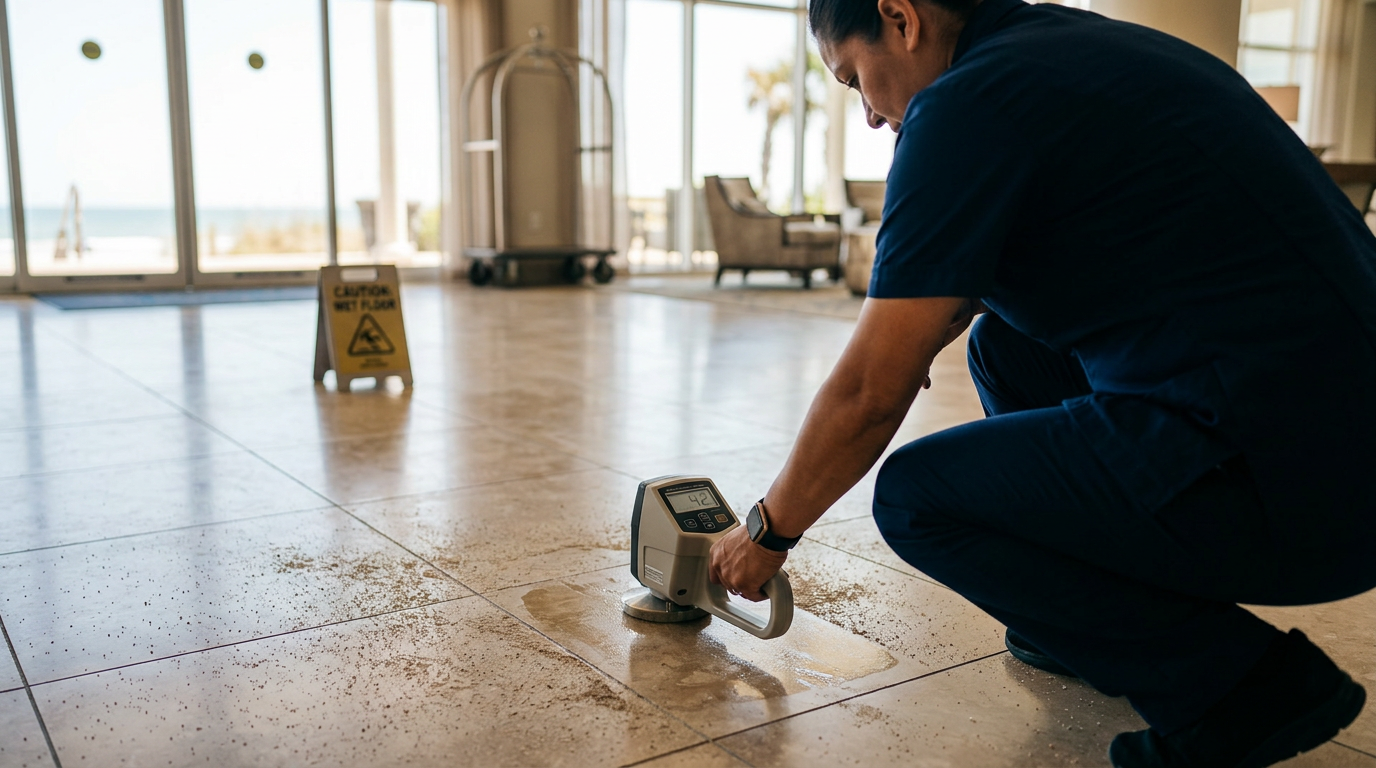
Visual inspections are completely inadequate for determining whether a commercial floor is slip-resistant. A glossy lobby floor may look pristine but possess a dangerously low DCOF due to microscopic grease, salt deposits, or worn-down slip-resistant coatings. To achieve true compliance, facility managers must employ digital tribometers, such as the BOT-3000E, to conduct standardized wet traction testing.
These advanced diagnostic tools run an automated rubber sensor across the wet floor surface under controlled pressure, calculating the exact dynamic coefficient of friction in real time. Standard operating procedures dictate that testing should be performed in high-risk zones, including transition points from outdoor pool decks, main entrances, and public restrooms. The resulting data points are logged to build an auditable trail of safety compliance.
Integrating regular tribometric testing into your property's maintenance schedule is the gold standard for risk management. It allows operators to catch deteriorating traction levels before an accident occurs, identifying wear patterns caused by abrasive beach sand. This proactive diagnostic approach enables targeted floor restoration and refinishing, optimizing maintenance budgets while maximizing guest safety.
The Chemistry of Deep Soil Extraction vs. Gloss Preservation
Cleaning commercial coastal flooring requires specialized chemistry that can break down salt and mineral deposits without stripping slip-resistant finishes. Tracked-in sea salt leaves a crystalline residue that is highly alkaline and abrasive. Using standard high-pH cleaners can damage acrylic finishes and make stone surfaces hazy, while acidic cleaners can etch delicate marble or terrazzo substrates.
The optimal approach involves a dual-phase chemical extraction system. First, neutral or low-pH rinses are applied to dissolve and suspend stubborn calcium and sodium chloride crystals. This is followed by a low-foaming, residue-free surfactant that emulsifies organic body oils, sunscreen, and grease tracked in from the beach. This ensures the microscopic pores of the tile remain open, preserving the natural slip-resistant texture of the floor.
Maintaining a high-gloss finish while preserving slip-resistance is a common commercial dilemma. High-gloss finishes are often perceived as slippery, but a clean, contaminant-free floor with a high-quality, slip-resistant finish will easily meet the 0.42 DCOF standard. The key is avoiding oil-based dust mops, silicone-based gloss enhancers, and cheap restorative sprays that leave behind microscopic, slippery films.
- Neutral pH Rinses: Dissolve salt minerals without stripping existing protective sealers or dulling natural stone.
- Residue-Free Surfactants: Suspend oils, sunscreen, and dirt in suspension so they can be completely extracted rather than wiped around.
- Avoid Silicone Polish: Prevents the buildup of invisible, slick barriers that lower DCOF below the required 0.42 safety limit.
- Abrasive Mitigation: Regular extraction of silica sand prevents the microscopic scratching that destroys floor gloss over time.
Hard Surface Sealers: Slip-Resistant Penetrating Impregnators vs. Topical Acrylics
Choosing the correct sealing agent is critical for preserving coastal commercial floors and maintaining high traction. Topical acrylic coatings create a thick, sacrificial wear layer that protects the stone or tile below. However, in high-humidity Grand Strand environments, these topical sealers can trap rising moisture vapor from sub-slab concrete, causing the finish to haze, delaminate, and become exceptionally slick when wet.
Modern national standards recommend using penetrating, vapor-permeable impregnating sealers for natural stone, terrazzo, and grout joints. These sealers penetrate deep into the substrate's pores, anchoring themselves chemically without altering the surface's natural texture or DCOF. They repel water-based and oil-based contaminants from within, allowing the stone to breathe and preventing the formation of slick subsurface moisture pockets.
For resilient flooring like luxury vinyl tile (LVT) and sheet vinyl, which have become ubiquitous in coastal properties, traditional waxing is increasingly replaced by ultra-durable polyurethane and UV-curable coatings. These high-performance coatings often incorporate microscopic slip-resistant aggregate particles. This ensures that even under wet conditions, the surface provides the necessary mechanical grip to meet ANSI/NFSI safety metrics.
Walk-Off Matting Science: The 15-Foot Rule for Coastal Entryways
The most cost-effective way to preserve floor traction and prevent slip-and-fall accidents is to capture soil before it ever reaches the hard surface. Industry studies show that up to 90% of tracked-in sand, dirt, and moisture can be stopped at the door with a properly engineered zone-matting system. In coastal environments, this requires a strategic layout of scraper, wiper-scraper, and interior wiper mats.
National standards recommend a minimum of 15 feet of continuous walk-off matting at all major commercial entrances. The first five feet should consist of aggressive scraper mats designed to dislodge coarse beach sand and heavy grit from shoe treads. The next five feet utilize a hybrid wiper-scraper mat to trap finer sand particles and absorb bulk moisture. The final five feet consist of high-performance microfiber mats that dry the shoe soles completely.
Proper maintenance of this matting system is just as important as the flooring itself. If a walk-off mat becomes saturated with sand and salt, it loses its capacity to clean shoe soles and begins acting as a source of tracking. Commercial cleaners must vacuum mats daily using dual-motor upright vacuums with HEPA filtration, and perform regular hot-water extraction to remove deeply embedded sand and salt crystals from the mat fibers.
- Zone 1 (Scraper Mats): Outdoor placement to catch heavy sand-grit, gravel, and bulk moisture before entry.
- Zone 2 (Wiper-Scraper Mats): Vestibule placement to trap fine silica sand dust and absorb remaining water.
- Zone 3 (Microfiber Wiper Mats): Indoor placement to completely dry shoe soles and restore traction before steps hit hard tile.
- Daily HEPA Vacuuming: Removes dry sand before it can act as an abrasive that degrades mat fibers and reduces absorption limits.
Restroom and Wet-Zone Tile and Grout Restoration
Commercial restrooms, locker rooms, and pool deck transitions are high-risk slip zones that require specialized maintenance protocols. In these areas, water, body oils, cosmetic lotions, and aerosolized soap residues combine with fine sand to form an extremely slick, organic biofilm. This biofilm fills the grout lines and coats the tile surfaces, rendering slip-resistant features completely useless.
Restoring these wet zones requires deep mechanical extraction paired with targeted restorative chemistry. Standard mopping will not remove biofilms; instead, it pushes them deeper into the porous grout lines. Professional operators use high-pressure, enclosed tile-cleaning extraction tools operating at 800 to 1,200 PSI, which blast away the bio-contaminants and vacuum them instantly into a recovery tank.
Once the tile and grout are thoroughly cleaned and sanitized, a high-traction penetrating sealer should be applied to the grout joints. This prevents future absorption of moisture and organic oils, making daily maintenance significantly more effective. Ensuring these wet zones are treated with slip-resistant restoration chemistries keeps guests safe and helps commercial properties maintain compliance with municipal health and safety codes.
Implementing a Documented Floor Safety Management Program (FSMP)
In the commercial and hospitality industries, documentation is your strongest shield against liability. Establishing a formal Floor Safety Management Program (FSMP) demonstrates that your facility actively monitors and maintains its surfaces to national safety standards. This program should outline daily cleaning procedures, periodic deep-extraction schedules, and formal tribometer testing intervals.
A well-structured FSMP requires detailed record-keeping. Every time a floor is cleaned, buffed, tested, or treated, the details must be logged, including the specific chemicals used, dilution rates, and the name of the technician. In the event of a slip-and-fall claim, these documented logs provide clear, indisputable evidence that the property manager took reasonable and proactive steps to maintain a safe environment.
Partnering with a professional, certified floor-care provider is the most reliable way to execute an effective FSMP. At A2Z Cleaning & Linen Services, we specialize in high-hazard floor restoration and compliance testing for Grand Strand commercial properties. Contact our team at 843.800.2788 to learn how we can help protect your guests, preserve your high-value flooring investments, and ensure your facility meets all ANSI/NFSI slip-resistance standards.
Key takeaway
Maintaining dry dynamic and wet dynamic coefficient of friction standards is crucial for preventing slip-and-fall incidents in sandy, high-humidity coastal environments. Implementing a structured floor safety program with professional sand-grit extraction and documented safety testing protects both your visitors and your property's bottom line. For expert commercial floor care and ANSI/NFSI compliance support along the Grand Strand, call A2Z Cleaning & Linen Services at 843.800.2788.
Keep Reading

Commercial & Hospitality
The Science of Floor Safety: ANSI Standards and Slip Prevention in Coastal Commercial Facilities
ReadCommercial & Hospitality
The IICRC S400 Standard for Professional Cleaning of the Built Environment: Implementing Science-Based Soil Removal, ATP Validation, and Labor-Efficiency Metrics in Grand Strand Commercial Facilities
ReadCommercial & Hospitality
The IICRC S300 Commercial Upholstery Cleaning Standard: Implementing Fiber-Identification Protocols, Wet-to-Dry Extraction Ratios, and High-Humidity Dry-Time Management in Grand Strand Commercial Spaces
ReadReady for a spotless property?
Call 843.800.2788 or request a free quote from A2Z Cleaning & Linen Services.