Commercial & Hospitality
The Science of Floor Safety: ANSI Standards and Slip Prevention in Coastal Commercial Facilities
Discover how coastal salt, sand, and humidity impact floor safety, and how implementing national ANSI/NFSI standards protects Grand Strand commercial properties.
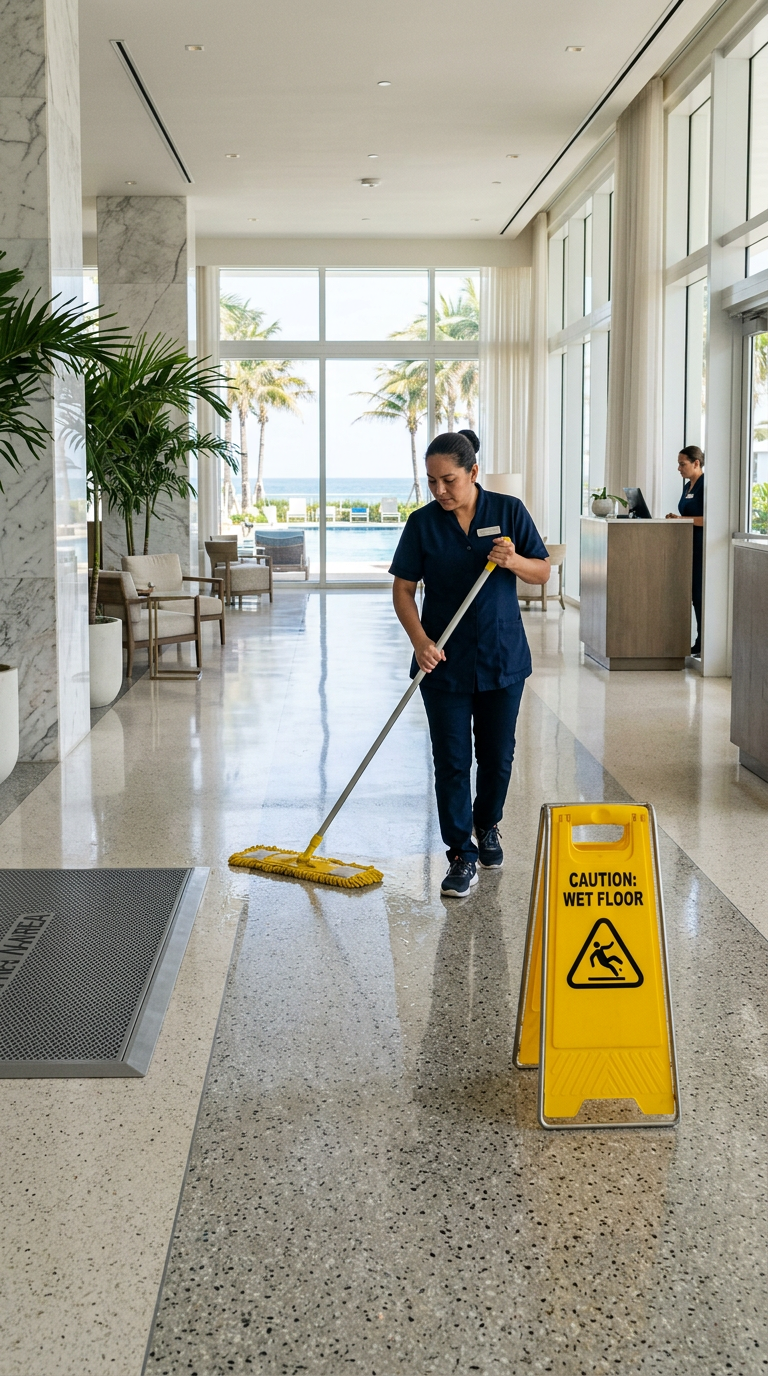
High-traffic commercial properties along the Grand Strand face a silent, continuous threat to safety: the loss of slip resistance on hard flooring surfaces. Managing floor safety in a coastal environment requires more than a simple mop and bucket; it demands compliance with national safety standards. By understanding the intersection of regional environmental challenges and national floor care protocols, property managers can protect their guests and business reputation. A2Z Cleaning & Linen Services provides this professional, scientifically grounded approach to floor care for commercial and hospitality properties across Myrtle Beach.
The Friction Problem: How Sand, Humidity, and Salt Disrupt Coastal Floor Safety
Coastal commercial spaces must battle three relentless environmental elements: airborne salt crust, abrasive silica sand, and elevated relative humidity. When sand is tracked onto hard tile or luxury vinyl plank (LVP) surfaces, it acts like sandpaper under the weight of foot traffic. This abrasive action microscopically scratches the factory-applied protective wear layers, dulling the surface and reducing its inherent slip resistance over time.
High humidity compounding the issue prevents moisture from evaporating quickly from hard floors, especially near entryways, lobbies, and poolside transition areas. When outdoor humidity sits above seventy percent, even a small amount of tracked-in rainwater or pool moisture remains suspended on the floor surface, creating a hydroplaning hazard. The combination of loose sand grains acting as tiny ball bearings and a micro-film of moisture significantly increases the risk of slip-and-fall incidents.
Salt-air residue adds another layer of complexity to coastal floor safety. Airborne sodium chloride settles on hard surfaces, attracting moisture from the air due to its hygroscopic nature. This creates a tacky, microscopic film that traps dirt and oils, making floors look dingy and dangerously slick when slightly wet. Traditional cleaning methods often spread this salt residue around rather than extracting it, which worsens the hazard over time.
Understanding ANSI/NFSI Standards: The Science of Wet Coefficient of Friction
To manage slip hazards objectively, national cleaning industry leaders look to the American National Standards Institute (ANSI) and the National Floor Safety Institute (NFSI). Specifically, the ANSI/NFSI B101.1 and B101.3 standards govern the measurement of wet static and wet dynamic coefficient of friction (COF) on common hard-surface flooring. These standards move floor safety away from subjective visual assessments and into the realm of quantifiable science.
Static Coefficient of Friction (SCOF) measures the force required to start a person sliding, while Dynamic Coefficient of Friction (DCOF) measures the force required to keep a sliding object in motion. For commercial facilities, maintaining a wet DCOF of 0.42 or higher is the gold standard for high traction, according to the ANSI/NFSI standards. Any surface that falls below a wet DCOF of 0.30 is classified as high-risk, requiring immediate remediation or treatment.
Professional commercial cleaning operators utilize specialized tools called tribometers to measure these values directly on the floor. By auditing high-traffic areas like resort lobbies, commercial kitchens, and elevator banks, cleaning technicians can track how wear and product buildup affect floor traction over time. This data-driven approach allows property managers to address safety concerns before an accident occurs, creating a documented paper trail of safety compliance.
- Wet Static Coefficient of Friction (SCOF): Measures the resistance to the start of sliding movement on wet surfaces.
- Wet Dynamic Coefficient of Friction (DCOF): Measures the resistance to continued sliding once motion has already begun.
- High-Traction Threshold: A dynamic value of 0.42 or greater, representing the safest classification for walk surfaces.
- Action Threshold: A dynamic value between 0.30 and 0.41, indicating a surface that requires monitoring or mild remediation.
- High-Risk Classification: Any dynamic value below 0.30, requiring immediate corrective action to prevent accidents.
The Chemistry of Floor Care: Why Traditional Detergents Cause Slips
A common mistake in commercial floor care is the over-use of high-residue, soap-based detergents. When traditional mop-and-bucket systems are used with excessive soap, a microscopic layer of detergent residue remains behind after the water evaporates. In dry conditions, this residue might go unnoticed, but the moment humidity rises or moisture is tracked in, the soap re-emulsifies, creating a highly lubricious and dangerous surface.
To combat this chemical hazard, leading operators have transitioned to surfactant-free, neutral-pH cleaners or advanced engineered water systems. Neutral cleaners break down greasy soils and atmospheric salt without leaving film-forming polymers behind. By eliminating soapy residues, the floor retains its original, slip-resistant texture, and the rate of rapid re-soiling is significantly reduced, meaning floors stay cleaner and safer for longer periods.
Additionally, regional water hardness in the Grand Strand area can react with soap-based chemicals to form insoluble soap scum. This scum bonds to the grout lines of ceramic and porcelain tiles, creating a recessed reservoir that traps dirty water and organic matter. Over time, these filled grout lines eliminate the natural texture and drainage pathways of the tile floor, compounding the slickness of the walk surface during rainy summer days.
Equipment and Technology: The Shift Toward Extraction and Auto-Scrubbers
The commercial cleaning industry has largely retired the traditional cotton string mop for high-volume commercial hard floors. String mops tend to redistribute dirt, sand, and salt water into grout lines and low points rather than lifting them from the building. To truly clean and restore slip resistance, modern operators deploy micro-auto-scrubbers and cylindrical brush machines that scrub and vacuum simultaneously.
These advanced floor machines apply fresh cleaning solution, agitate the surface with heavy downward brush pressure to break up compacted sand and grease, and immediately extract the dirty water using high-vacuum squeegees. This ensures that the floor is left dry, clean, and safe for immediate foot traffic. For large resort lobbies and oceanfront hallways, this technology is essential for maintaining safety standards during peak check-in hours.
Microfiber flat mop technology also plays a crucial role in daily maintenance protocols. Microfiber split-yarn fibers carry a positive charge that naturally attracts and holds negatively charged dust, sand, and salt particles. Unlike cotton, which merely pushes debris, microfiber lifts and locks the abrasive particles away from the floor surface, preventing the microscopic scratching that ruins floor finishes and reduces slip resistance.
Hard Surface Protocols: Tile, LVP, and Polished Concrete in Coastal Zones
Ceramic and porcelain tile are the backbones of Grand Strand resort design, but their safety depends entirely on maintaining grout integrity and surface texture. Acidic deep-cleaning protocols are periodically required to strip away accumulated hard water deposits, lime scale, and soap scum from tile faces. However, these acids must be carefully neutralized and extracted to prevent damage to the cementitious grout lines and surrounding metal fixtures.
Luxury Vinyl Plank (LVP) has exploded in popularity across commercial properties due to its durability and aesthetic appeal. However, LVP cannot be treated with traditional high-speed burnishing or aggressive chemical strippers, which can melt or warp the vinyl wear layer. Instead, LVP requires specialized neutral cleaners and low-speed orbital agitation to remove ground-in sand without compromising the embossed, slip-resistant textures built into the planks.
Polished concrete is another modern choice for commercial common areas, offering extreme durability when properly maintained. To preserve its high-gloss look without sacrificing slip resistance, operators must follow precise diamond-pad conditioning schedules. Using specialized impregnating sealers that penetrate the concrete pores rather than sitting on top of the surface ensures the floor meets wet DCOF safety standards while remaining resistant to salt pitting.
- Ceramic and Porcelain Tile: Requires deep grout cleaning and periodic acid neutralizing to prevent soap scum and mineral buildup.
- Luxury Vinyl Plank (LVP): Demands pH-neutral cleaners and low-speed agitation to preserve embossed slip-resistant textures.
- Polished Concrete: Uses penetrating silicates and diamond-pad conditioning instead of topical wax coatings that can slick over.
- Natural Stone: Requires breathable, slip-resistant impregnating sealers to prevent water absorption and chemical etching.
Staff Training and Certification: Building a Culture of Floor Safety
Implementing advanced chemistry and machinery is ineffective without structured, ongoing training for front-line cleaning staff. Professional cleaning organizations train their technicians on the exact dilution ratios, dwell times, and machine speeds required for various flooring substrates. This structured training ensures that cleaning agents have sufficient time to emulsify oils and suspend salt particles before extraction occurs.
Certification programs, such as those offered by the Association of Residential Cleaning Services International (ARCSI) or ISSA, provide cleaners with a deep understanding of chemical safety and ergonomic machine operation. When technicians understand the science behind floor safety protocols—such as the risk of chemical cross-contamination or the physics of slip resistance—they perform their duties with a higher level of precision and ownership.
This level of professional expertise directly benefits commercial property managers by reducing employee turnover and ensuring consistent cleaning quality. A certified, knowledgeable cleaning crew can identify potential safety hazards, such as worn entry mats or damaged transitions, and report them before they lead to an accident. This proactive observation is a key element of modern risk management in the hospitality industry.
The Liability Landscape: Risk Management and Preventive Floor Auditing
Slip-and-fall accidents represent one of the leading causes of general liability claims for commercial properties and hospitality venues. For resort operators and retail businesses along the Grand Strand, a single lawsuit can result in devastating financial and reputational damage. Courts and insurance adjusters increasingly scrutinize a property's floor maintenance records to determine if reasonable care was taken to prevent slipping hazards.
A robust, documented floor safety program is a property's best defense against liability claims. This program should include daily cleaning logs, chemical safety data sheets (SDS), equipment maintenance records, and periodic wet DCOF testing reports. By showing that the facility proactively monitors and maintains its floors according to ANSI/NFSI standards, management can demonstrate a high level of compliance and care.
Beyond legal defense, preventive floor auditing helps properties optimize their maintenance budgets. By identifying which areas wear out faster or accumulate the most salt and sand, property managers can allocate resources more effectively. Investing in targeted floor care protocols ultimately reduces the frequency of expensive floor replacements and ensures a consistently welcoming, safe environment for guests.
Developing a Site-Specific Floor Safety Program for Grand Strand Commercial Properties
Every commercial facility in Myrtle Beach has unique architectural features, traffic patterns, and environmental exposures that require a tailored floor care plan. A successful program begins with a comprehensive site assessment to map out high-risk zones, such as main entrances, elevator lobbies, and transition points from outdoor pools. Each zone is then assigned specific daily, weekly, and seasonal maintenance protocols.
Matting systems are the first line of defense in any effective floor safety program. A proper walk-off matting system should extend at least ten to fifteen feet inside the entrance to effectively scrape sand, absorb moisture, and dry the soles of shoes. Cleaning protocols must include the daily vacuuming and deep extraction of these mats to prevent them from becoming saturated with sand and moisture, which renders them useless.
Partnering with a professional cleaning service that understands coastal environmental pressures and adheres to national safety standards is crucial for Grand Strand businesses. At A2Z Cleaning & Linen Services, we combine local expertise with industry-leading floor care practices to protect your guests, your staff, and your bottom line. Contact us at 843.800.2788 to schedule a comprehensive floor safety assessment for your property today.
Key takeaway
Maintaining commercial floor safety in a coastal environment requires transitioning from subjective cleaning methods to objective, ANSI-aligned standards. By deploying extraction technology, eliminating soapy residues, and training technicians in wet DCOF management, Grand Strand properties can significantly reduce liability and protect their floors.
Keep Reading
Commercial & Hospitality
The Grand Strand Commercial Disinfection Specialist Career Pathway: Class-A Office Standards, Biohazard Mitigation Certifications, and Local Retention Models
ReadCommercial & Hospitality
The ISSA CIMS-GB Commercial Custodial Standard: Transitioning Grand Strand Facilities to High-Performance, Low-Emission Sustainable Cleaning Systems
ReadCommercial & Hospitality
The OSHA Bloodborne Pathogen Standard for Coastal Hospitality and Commercial Facilities: Implementing Exposure Control Plans, EPA List Q Disinfectants, and Post-Incident Workflows in Myrtle Beach
ReadReady for a spotless property?
Call 843.800.2788 or request a free quote from A2Z Cleaning & Linen Services.