Linens & Laundry
The Balcony-Dried Salt-Lock Phenom: Mitigating Atmospheric Salt and Hard-Water Mineral Graying in Grand Strand Rental Towels
Discover how coastal salt air and hard water chemically combine to ruin rental towels, and learn the professional wash chemistry required to restore bright, soft linens.
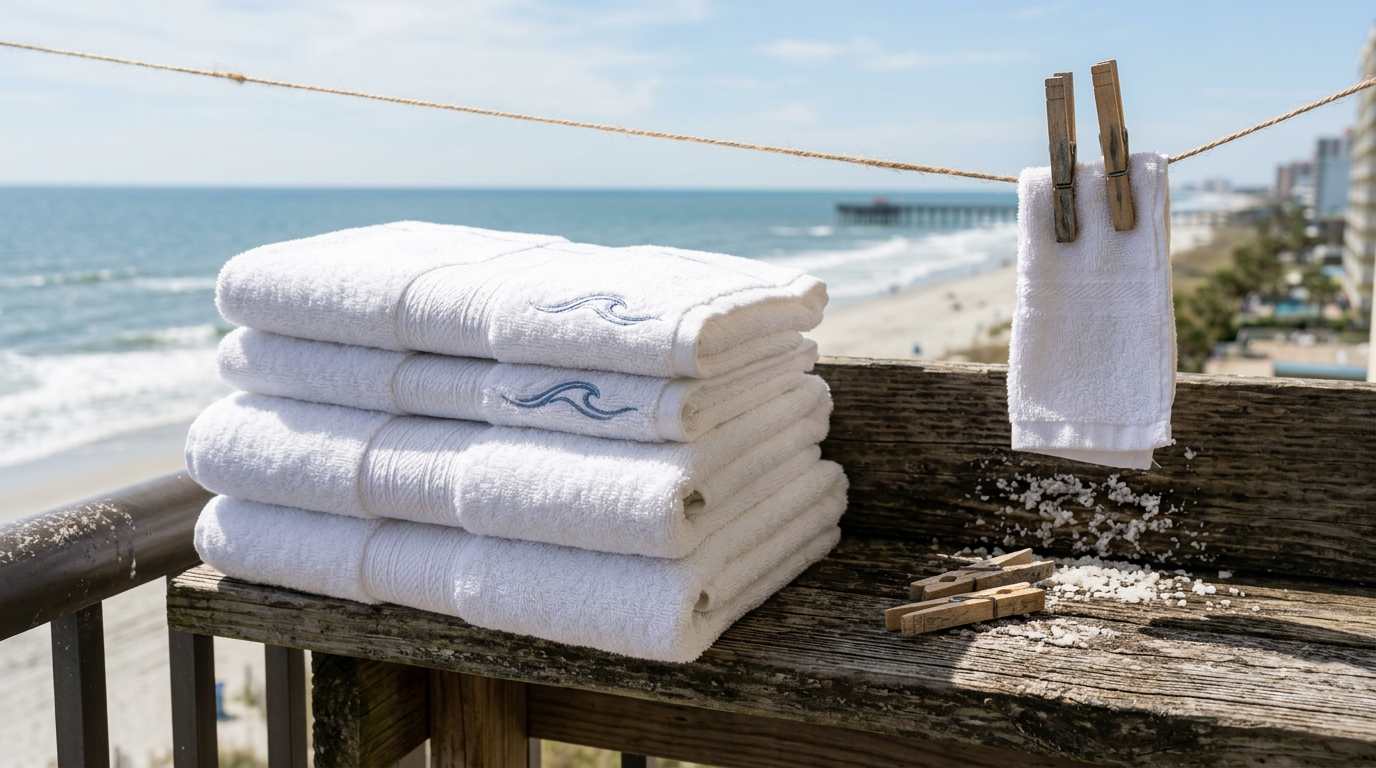
Walk down any oceanfront corridor in Myrtle Beach or North Myrtle Beach, and you will see balconies lined with damp bath sheets and pool towels draped over metal railings. To the vacationing guest, drying linens in the salty southern breeze seems like a natural, eco-friendly way to manage laundry during their stay. For property managers and rental owners, however, this habit initiates a silent chemical reaction that permanently ruins premium cotton assets. At A2Z Cleaning & Linen Services, we specialize in neutralizing these coastal laundry challenges, helping you protect your textile investments through scientific wash chemistry.
The Chemistry of the Balcony Railing: How Wind-Borne Salt Settles in Terry Loops
When guests hang damp towels over oceanfront railings, they expose the cotton fibers to a highly concentrated marine aerosol. The coastal wind carries microscopic droplets of vaporized seawater, which contain sodium chloride, magnesium sulfate, and trace organic elements. As the warm South Carolina sun beats down on the hanging towel, the water content rapidly evaporates, but the minerals do not. Instead, they crystallize and lock deep within the dense, high-loft terry loops of your premium bath sheets.
This crystallization process alters the physical state of the cotton. The salt crystals do not merely sit on top of the fabric; they bond with the microscopic cellulose fibers of the cotton yarns. When these towels are gathered by housekeeping at the end of a stay, they often feel stiff, board-like, and heavily encrusted. If these linens are not treated with specialized chemical wash formulas, the salt deposits will permanently compromise the texture and appearance of the fabric.
Furthermore, oceanfront balconies are frequently coated in thin layers of industrial airborne pollutants, vehicle exhaust, and microscopic sand dust. When damp towels are draped over these railings, they act as magnets for these dark particulates. The combination of sticky sea salt and environmental grime creates a resilient gray paste that embeds itself into the core of the cotton yarn, making standard washing methods completely ineffective.
The Hard-Water Collision: Grand Strand Aquifers and the Precipitate Reaction
The real damage occurs when these salt-encrusted towels enter the washing machine and collide with Grand Strand municipal water. Water across the Grand Strand is drawn from local aquifers that naturally contain high levels of dissolved calcium carbonate, magnesium, and trace iron. When the sodium chloride and magnesium sulfate on the balcony-dried towels mix with this hard water, a rapid chemical precipitation reaction takes place inside the wash wheel.
The dissolved minerals in our local water react with the sodium salts and traditional laundry detergents to create an insoluble substance commonly known as lime soap or calcium curd. Instead of dissolving and flushing down the drain, this sticky precipitate adheres to the cotton fibers, wrapping around them like a microscopically thin plastic sheath. This is the primary driver of 'graying' in coastal hospitality linens, transforming brilliant white towels into dull, dingy assets.
Over time, this mineral buildup traps dirt, body oils, and skin cells within the cotton fibers, preventing the wash water from actually cleaning the towel. The resulting buildup is highly resistant to standard bleach and retail-grade detergents. If your cleaning service does not actively adjust wash water chemistry to account for both coastal salt exposure and regional water hardness, your inventory will suffer a rapid, irreversible loss in cosmetic appeal.
The Mechanical Breakdown: How Salt Crystals Shred Cotton Fibers
Beyond cosmetic graying, salt-lock causes severe mechanical degradation to your linen inventory. Under a microscope, dry salt crystals reveal sharp, jagged, crystalline edges. When salt-laden towels are loaded into a commercial or residential washer without a proper pre-rinse, these crystals act like microscopic sandpaper against the delicate cotton fibers during the agitation cycle.
As the wash wheel turns, the mechanical action rubs the abrasive salt crystals directly against the cotton yarns, slicing the microfibers that give towels their plushness and absorbency. This leads to premature fraying, thinning of the base fabric, and an excessive accumulation of lint in your dryer traps. The structural integrity of a high-quality 100% cotton towel can be degraded by up to forty percent after just ten cycles of balcony-drying followed by unmitigated washing.
This mechanical friction also destroys the natural elasticity of the cotton loop. Once the tiny microfibers are sheared by salt crystals, they lose their ability to bloom or stand upright after drying. The result is a towel that feels flat, scratchy, and harsh against a guest's skin. Providing guests with stiff, abrasive towels directly correlates with lower guest satisfaction scores and negative online reviews regarding property comfort.
The Failure of Domestic Detergents: Why In-Unit Washers Solidify the Salt-Lock
Many property owners rely on in-unit stackable washers and dryers or standard domestic laundry machines to process turn linens. While convenient, these residential appliances are structurally incapable of resolving the salt-lock phenomenon. Standard household laundry detergents rely on basic surfactants and optical brighteners that merely mask soil rather than chemically extracting bound mineral complexes from the fabric.
In-unit washers also struggle with limited water volume and insufficient rinse cycles. Because these machines are designed for water conservation, they do not utilize enough water to fully dissolve and flush away heavy salt concentrations. Consequently, the mineral-laden water is spun back through the towels during the final extraction cycle, redepositing the calcium-salt complexes deeper into the cotton backing.
The problem is further compounded when these towels are placed into residential dryers. The high, unregulated heat of home dryers bakes the remaining mineral residues directly into the cotton fibers, effectively locking them in place. Once these mineral-surfactant complexes are baked onto the cotton by high heat, they become nearly impossible to remove without specialized chemical stripping agents, forcing premature linen retirement.
The Commercial Wash Formula: Chelating Agents and Acid Souring Protocols
Resolving salt-lock requires a sophisticated, multi-stage commercial wash formula designed specifically for coastal environments. At A2Z Cleaning & Linen Services, we utilize professional laundry chemistry that starts with high-volume, temperature-controlled flushes to dissolve and remove free salt crystals before any detergent is introduced. This initial step prevents the mechanical shredding of fibers during agitation.
We then introduce advanced chelating agents, such as ethylenediaminetetraacetic acid (EDTA) or nitrilotriacetic acid (NTA), into our wash formulas. These specialized compounds act like molecular claws, binding tightly to the calcium, magnesium, and iron ions in the water. By sequestering these hard minerals, the chelating agents prevent them from reacting with the salts and detergents, ensuring that no insoluble precipitates can form on your towels.
The final critical step in our commercial wash protocol is the application of an acid souring agent. During the final rinse cycle, we adjust the pH of the wash water to match the natural pH of human skin, which is slightly acidic (typically between 5.5 and 6.5). The laundry sour neutralizes any residual alkaline detergent deposits and breaks down any lingering calcium-salt complexes, leaving the towels exceptionally bright, soft, and completely free of chemical residue.
- Initial thermal flushes dissolve and remove free salt crystals before detergent cycles begin.
- Advanced chelating agents sequester calcium, magnesium, and iron to prevent mineral bonding.
- Phosphate-free builders suspend heavy soils and prevent redepositing on cotton fibers.
- Targeted acid souring agents neutralize alkaline residues and restore the natural pH balance.
- Precise chemical dosing systems ensure consistent results across high-volume laundry batches.
Thermal Dynamics: Drying Protocols for Salt-Stressed Terry
Drying coastal linens requires a deep understanding of thermal dynamics to prevent fiber degradation. While domestic dryers run on simple timers or basic heat sensors, commercial drying systems allow for precise temperature profiling. To preserve salt-stressed cotton, towels must be dried using a stepped-temperature profile that slowly reduces heat as the moisture content of the load decreases.
Over-drying is the enemy of cotton longevity. When a towel is dried past its natural moisture regain level (approximately 7% to 8% moisture retention for cotton), the fibers become brittle, and any microscopic mineral traces left behind will bake and yellow the fabric. Our commercial dryers utilize advanced moisture-sensing technology to terminate the heating cycle at the exact moment the towels reach optimal dryness.
We also employ a dedicated cool-down phase at the end of each drying cycle. This phase tumbles the towels in cool air for several minutes, allowing the cotton fibers to relax and the loops to bloom without being subjected to sudden thermal shock. This precise management of heat and mechanical action is what gives our processed towels their signature high-loft fluffiness and luxurious hand-feel.
Inventory Management and Par Level Buffers for Oceanfront Properties
Because oceanfront properties subject towels to extreme environmental stress, standard inventory models are insufficient. To maintain a premium guest experience, property managers must account for the accelerated wear-and-tear caused by atmospheric salt. We recommend maintaining a strict 3-par linen inventory for all vacation rentals along the Grand Strand to allow fibers adequate rest between wash cycles.
A 3-par system ensures that while one set of linens is in the guest unit, a second set is resting in the owner's closet, and a third set is undergoing professional, restorative laundering at our facility. This rotation schedule prevents fibers from being subjected to back-to-back washing and drying cycles, which dramatically extends the operational lifespan of your towels and prevents the rapid onset of salt-lock graying.
If you try to operate on a 1.5-par or 2-par system, your towels are rushed through hasty, in-unit wash cycles with zero resting time. The cotton fibers never have the opportunity to recover their natural elasticity, and the accumulation of salt and minerals occurs much faster. Investing in a proper 3-par inventory actually saves money over time by reducing your annual linen replacement costs by up to fifty percent.
Operational Signage and Sorting Strategies: Preventing Balcony Abuse
While professional laundering is the ultimate solution, preventative measures can greatly reduce the severity of salt-lock. We advise our property management partners to place clear, polite guest signage in bathrooms or near sliding balcony doors. A simple, well-designed card explaining that wind-borne salt damages cotton fibers and requesting that guests use the provided indoor drying racks can dramatically change guest behavior.
Additionally, housekeeping training is vital. When our field technicians perform a turnover clean, they are trained to identify towels that have been left on the balcony or used at the beach. These salt-stressed towels are bagged separately from standard bath linens. This separation prevents the transfer of heavy salt concentrations and dry sand to other linens during transport and storage.
By separating heavily exposed linens at the point of collection, we can route them through a specialized heavy-flush wash formula immediately upon arrival at our facility. This targeted approach prevents the cross-contamination of other linens in the wash cycle and ensures that every towel receives the exact level of chemical treatment required to restore its original softness and brilliance.
Key takeaway
Preserving the quality of your rental towels in the harsh Grand Strand environment requires more than simple soap and water. By understanding the chemical interaction between ocean salt, local hard water, and cotton fibers, you can prevent graying and extend the lifespan of your textile assets. Partnering with A2Z Cleaning & Linen Services at 843.800.2788 ensures your linens receive the scientific, commercial-grade care needed to keep them bright, soft, and guest-ready turn after turn.
Keep Reading
Linens & Laundry
The TRSA Hygienically Clean Hospitality Standard: Implementing Industrial Wash Chemistry, Bio-Burden Testing, and Soil-to-Clean Separation in Myrtle Beach Commercial Laundries
ReadLinens & Laundry
The Coastal Pillow-Core and Protector Restoration Protocol: Mitigating Humid Yellowing, Mold Spores, and Keratin Accumulation in Grand Strand Vacation Rentals
ReadLinens & Laundry
The Coastal Hotel-Grade Triple-Sheeting Sanitization and Assembly Protocol: Mitigating Comforter Bio-Burden, Sandy Sebum, and Turn-Time Pressures in Myrtle Beach Rentals
ReadReady for a spotless property?
Call 843.800.2788 or request a free quote from A2Z Cleaning & Linen Services.