Linens & Laundry
The Coastal Vacation Rental Pillow Protection, Laundering, and Par-Level Restoration Protocol: Mitigating Sweat-Salt Yellowing, Humid Fill Clumping, and Allergen Accumulation under Grand Strand Saturday Turn Pressures
A professional guide to managing, laundering, and restoring vacation rental pillows in the humid Grand Strand climate, ensuring pristine guest experiences and optimal par levels.
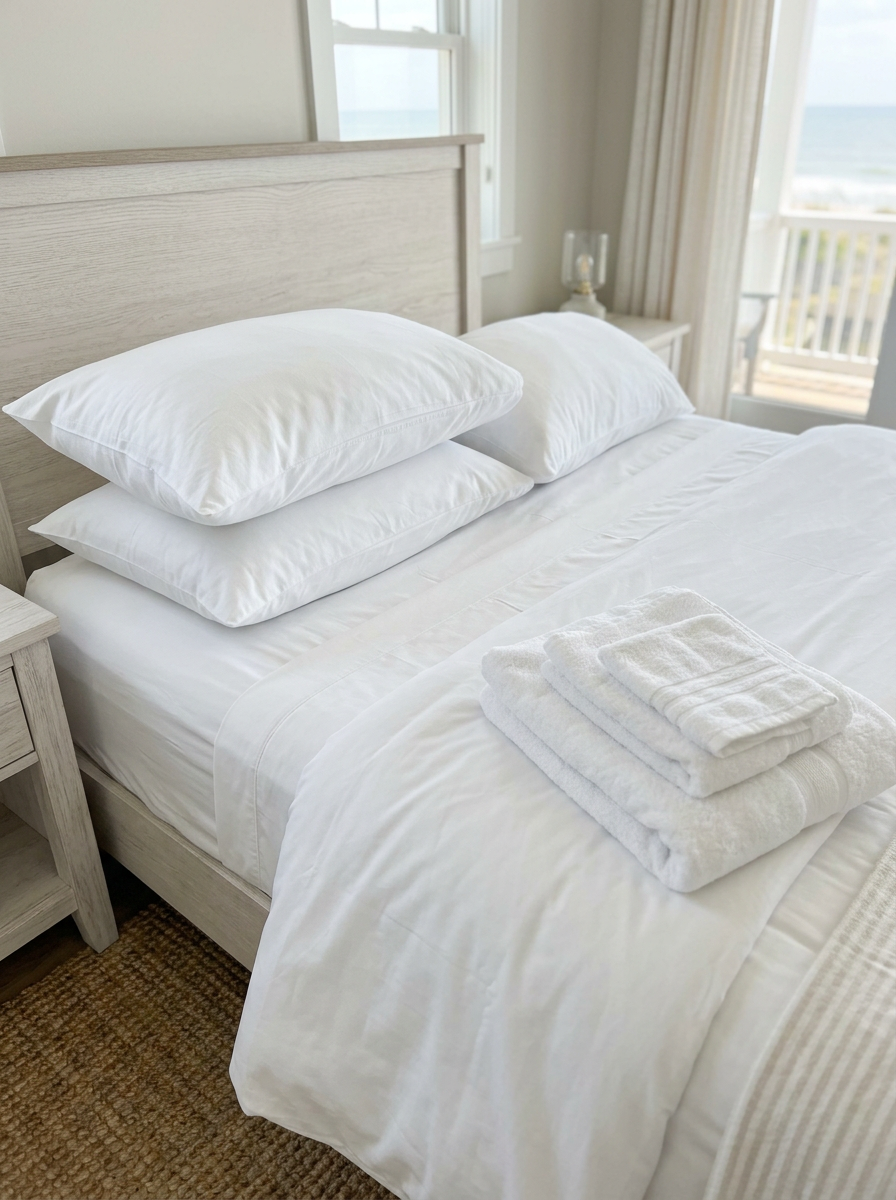
In the competitive Myrtle Beach vacation rental market, a clean bed is the cornerstone of a five-star guest review. Yet, while property managers focus heavily on crisp sheets and pristine duvets, the humble pillow often becomes a hidden reservoir for sweat, salt, and humidity-driven allergens. Under the intense pressure of Grand Strand Saturday turnovers, maintaining hygienic, plump pillows requires a systematic approach to protection, laundering, and inventory rotation. A2Z Cleaning & Linen Services has developed this definitive protocol to help local hosts preserve their assets, protect guest health, and eliminate the dreaded musty odor that can ruin a coastal getaway.
The Physiology of Coastal Pillow Wear: Sweat, Salt, and Sand-Grit Penetration
The Grand Strand's unique combination of high relative humidity, elevated summer temperatures, and active outdoor lifestyles accelerates the physical degradation of vacation rental pillows. Guests returning from a day at Cherry Grove Beach or the Myrtle Beach Boardwalk carry residual body heat, perspiration, salt-spray, and fine sand-grit directly into the bedding. Sweat contains sodium chloride, lactic acid, urea, and sebum, which easily migrate through standard thread-count pillowcases and deposit onto the underlying pillow shell.
Once these biological fluids saturate the pillow shell, they undergo an oxidation process exacerbated by the high ambient humidity of our coastal environment. The chemical reaction between human perspiration, cosmetic residues, and sunscreens containing active ingredients like avobenzone creates stubborn, yellow-brown stains that bond tenaciously to polyester and down-alternative fibers. If left untreated, these organic compounds harden, causing the outer shell fabric to stiffen and lose its breathable texture.
Simultaneously, micro-particles of beach sand and airborne crystalline salt-spray manage to penetrate the weave of standard pillowcases. Once inside the pillow core, these abrasive minerals act as micro-blades, slowly cutting and shredding the delicate synthetic clusters or down fibers during compression. This mechanical wear leads to premature fiber compaction, causing pillows to go flat, lumpy, and structurally compromised within a fraction of their expected service life.
The Multi-Layer Barrier System: Encasement versus Protector Specifications
Relying on a single pillowcase or a basic quilted cover is insufficient in a high-turnover coastal rental environment. Effective asset preservation requires a engineered multi-layer barrier system designed to isolate the pillow core from external liquid and particulate contaminants. This system consists of three distinct layers: the outer decorative pillowcase, an intermediate quilted protector, and an innermost zippered, waterproof, allergen-proof encasement.
The innermost encasement must feature a polyurethane membrane laminated to a lightweight knit fabric. Unlike cheap PVC coatings, polyurethane is quiet, highly breathable, and completely impermeable to liquids, dust mites, and microscopic allergens. It is vital that this encasement utilizes a locking, micro-zipper closure with an internal flap to prevent any physical bypass along the zipper teeth, ensuring sweat and salt-spray cannot seep into the core.
Directly over the encasement, a quilted cotton or cotton-poly blend protector must be installed. This middle layer serves as an absorbent buffer, catching surface moisture and skin oils before they can pool against the slick polyurethane encasement. The quilted protector can be easily stripped and laundered during weekly turns, while the inner waterproof encasement simply requires a thorough wipe-down with a botanical sanitizer, saving valuable wash capacity and drying time.
- Specify polyurethane-laminated interior encasements rather than loud, heat-trapping PVC materials.
- Ensure all zippers are micro-toothed with self-locking sliders to prevent accidental opening during guest stays.
- Use 100% cotton quilted outer protectors to maximize moisture absorption and guest comfort.
- Verify that all barrier seams are double-stitched or bound to prevent unraveling in high-spin commercial washers.
- Maintain a strict color-coding or tagging system on encasements to easily identify installation dates.
Hotel-Grade Laundering Formulas for Down-Alternative and Polyester Fill
When the core pillow itself requires laundering, standard residential wash cycles will ruin the internal fiber structures. Down-alternative and polyester cluster fills require precise wash chemistry and controlled mechanical action to prevent the fibers from melting, matting, or shifting into hard clumps. Commercial-grade front-loading washing machines are mandatory, as top-load center agitators will tear the seams and compress the internal synthetic fibers.
The wash chemistry must utilize a neutral-pH liquid detergent free of optical brighteners, fabric softeners, or harsh alkaline builders. High alkalinity strips the slick, silicone coatings applied to synthetic fibers, causing them to friction-lock and form permanent tangles. Instead of chlorine bleach, which weakens synthetic polymer chains and turns white polyester yellow, professional operators utilize a stabilized oxygen-based bleach at moderate wash temperatures.
Thermal disinfection is achieved by maintaining a wash bath temperature of 140 degrees Fahrenheit (60 degrees Celsius) for a minimum of ten continuous minutes. This temperature profile is scientifically proven to eliminate mold spores, dust mites, and bacterial pathogens thriving in humid coastal air without reaching the thermal softening point of polyester fibers. G-force extraction must be limited to a maximum of 100 Gs to prevent the wet fill from being crushed against the wash drum.
The Drying and De-clumping Protocol: Achieving Loft in Humid Coastal Conditions
In the Grand Strand's heavy summer humidity, drying pillows completely is the most critical step in the entire laundering process. Any residual core moisture will rapidly foster the growth of mildew and black mold, generating a musty, sour odor that will prompt immediate guest complaints and negative reviews. Drying must be executed immediately following the extraction cycle in a commercial dryer equipped with precise temperature sensors.
The drying cycle should be run on a low to medium heat setting, never exceeding 135 degrees Fahrenheit (57 degrees Celsius). Excessive heat causes synthetic down-alternative fibers to fuse together, resulting in hard, uncomfortable lumps that cannot be restored. To mechanically break up clumping and restore loft, clean, heat-resistant wool dryer balls or synthetic agitation spheres must be added to the drum at a ratio of four balls per pillow.
Verification of dry core status cannot be done by touch alone. A2Z Cleaning & Linen Services utilizes a compression-weight test: pillows are weighed post-drying and compared against their dry baseline weight. Any discrepancy indicates trapped internal moisture, requiring additional low-temperature tumble drying. Once dry, the pillows must be allowed to cool completely in a low-humidity holding area before being enclosed in protectors or stacked in storage.
Stain Extraction Chemistry for Yellowed Pillow Shells and Protectors
When sweat-salt residues and sunscreen lipids have bypassed the outer pillowcase, they leave unsightly yellow halos on the quilted protectors and pillow shells. Simply running these through a standard wash cycle will permanently set these organic stains due to the heat of the drying process. A targeted stain extraction protocol is required to break the molecular bonds of these complex lipids and proteins.
The process begins with an enzymatic pre-treatment formulated with protease and lipase enzymes. Protease targets the protein chains found in skin flakes and sweat, while lipase breaks down the complex lipids found in sebum, body lotions, and sunscreens. This enzyme solution is applied at a warm temperature of 110 to 120 degrees Fahrenheit, allowing the biological catalysts to digest the soils inside the fiber weave before the main wash cycle begins.
Following the enzyme bath, an active oxygen bleach step is introduced during the wash cycle to lift the remaining yellow discoloration. For stubborn discoloration on 100% cotton protectors, a mild hydrogen peroxide solution combined with an alkaline booster can be applied, followed by a thorough souring rinse. The souring rinse neutralizes any residual chemicals, adjusting the fabric pH to a skin-neutral 5.5 to 6.5, which prevents skin irritation for subsequent guests.
- Apply targeted enzyme formulas to yellow stains before exposing the fabric to high wash or dry heat.
- Avoid using chlorine bleach on polyester-filled shells to prevent permanent chemical yellowing.
- Implement a dedicated souring rinse to strip alkaline residues and balance the fabric pH.
- Use moderate mechanical action during the pre-soak phase to prevent premature fiber wear.
- Inspect all treated shells under high-intensity LED lighting to verify complete stain removal.
Managing Pillow Par Levels and Rotation Schedules for High-Volume Saturday Turns
Operating a vacation rental with a 1:1 pillow ratio is a recipe for operational failure during the peak Grand Strand summer season. The compressed four-hour turnaround window on Saturdays does not allow sufficient time for deep cleaning, thermal disinfection, and thorough core drying of pillows. To maintain high hygienic standards without delaying guest check-ins, property managers must implement a strict par-level rotation system.
A professional standard dictates a minimum 3:1 par level for all rental pillows. One set of pillows is active on the guest beds, the second set is clean and rested in the property's locked owner's closet or linen depot, and the third set is undergoing professional laundering and sanitization off-site. This buffer ensures that housekeepers can instantly swap out any stained, flat, or suspect pillows during the Saturday turn without waiting on laundry cycles.
Furthermore, pillows require structural rest. Constant compression under the weight of human heads fatigues synthetic down-alternative fibers. Resting pillows in a climate-controlled environment for a rotation cycle allows the fibers to naturally decompress and regain their elastic memory, extending the useful life of the pillow by up to 50 percent. This rotation schedule must be documented and managed via a property-level inventory log.
Quality Assurance Inspections: The Sniff and Squeeze Audit for Turn Teams
To ensure no substandard pillows reach a guest bed, housekeeping teams must be trained in a rigorous, dual-sensory quality assurance audit. This is known as the 'Sniff and Squeeze' inspection, executed during every single property turnover. Housekeepers must physically strip the outer pillowcase to examine the quilted protector and the zippered encasement beneath, checking for any physical defects or sensory triggers.
The visual audit requires inspecting the entire surface of the pillow for faint yellow halos, cosmetic streaks, or damp spots. Zippers on the waterproof encasements must be zipped back and forth to ensure the teeth are fully engaged and have not been damaged by salt-air corrosion. Any broken zippers or torn seams require immediate replacement of the encasement to protect the underlying pillow core.
The physical audit involves compressing the pillow to half its height and releasing it; a high-quality, dry pillow must rebound to its original loft within three seconds. If the pillow remains flat, lumpy, or slow to recover, the fibers have collapsed or contain trapped humidity, and the pillow must be swapped out. Finally, the olfactory check requires smelling the pillow close up; any hint of mustiness, sour laundry, or body odor dictates immediate extraction from the unit.
Sustainability and Cost-Benefit Analysis of Professional Care
For Grand Strand property managers and homeowners, the economics of pillow management are clear. Constantly purchasing cheap, disposable polyester pillows to replace stained or flattened units is both financially wasteful and environmentally irresponsible. Low-grade pillows quickly wind up in Horry County landfills, while high-quality, commercial-grade pillows protected by a professional maintenance program offer a far lower total cost of ownership.
By investing in high-grade, micro-denier gel fiber pillows and protecting them with a dual-layer barrier system, the lifespan of the assets is extended from a few months to over two years. The cost of professional laundering and stain restoration is a fraction of the cost of constant retail replacements. Moreover, the presence of clean, plump, odorless pillows directly correlates with higher guest comfort, leading to repeat bookings and positive online reviews.
Partnering with a specialized coastal laundry provider like A2Z Cleaning & Linen Services removes the operational burden of pillow maintenance from on-site housekeepers. Our industrial washing facilities, automated chemical injection systems, and humidity-controlled drying tunnels ensure that every pillow returned to your Grand Strand property is hygienically clean, perfectly lofted, and ready to provide your guests with a restorative night's sleep.
- Calculate the total cost of ownership over a 24-month cycle to compare cheap disposables versus quality laundered pillows.
- Reduce carbon footprints by diverting bulky synthetic bedding materials away from local landfills.
- Elevate guest comfort scores by consistently providing premium, hotel-grade sleep surfaces.
- Protect valuable mattress warranties by preventing sweat and oils from migrating through the pillows.
- Free up on-premise laundry machines for small, fast-drying kitchen and bath linens during tight turns.
Key takeaway
Maintaining pristine, hygienic pillows in the humid Grand Strand climate requires a dedicated system of commercial laundering, multi-layer barriers, and a strict 3:1 par-level rotation. For professional, reliable linen management and turnover services in Myrtle Beach, contact the experts at A2Z Cleaning & Linen Services at 843.800.2788.
Related services
Keep Reading

Linens & Laundry
The Coastal Pillow-Core and Protector Restoration Protocol: Mitigating Humid Yellowing, Mold Spores, and Keratin Accumulation in Grand Strand Vacation Rentals
ReadLinens & Laundry
The Coastal Terry Towel Absorbency and Softness Restoration Protocol: Mitigating Fabric Softener Build-Up, Hard-Water Crust, and Mildew Odor in Grand Strand Laundries
ReadLinens & Laundry
The Balcony-Dried Salt-Lock Phenom: Mitigating Atmospheric Salt and Hard-Water Mineral Graying in Grand Strand Rental Towels
ReadReady for a spotless property?
Call 843.800.2788 or request a free quote from A2Z Cleaning & Linen Services.