Linens & Laundry
The Coastal Terry Towel Absorbency and Softness Restoration Protocol: Mitigating Fabric Softener Build-Up, Hard-Water Crust, and Mildew Odor in Grand Strand Laundries
Discover how to restore scratchy, gray, and musty rental towels. Our commercial laundering protocol tackles fabric softener build-up, hard-water minerals, and coastal dampness.
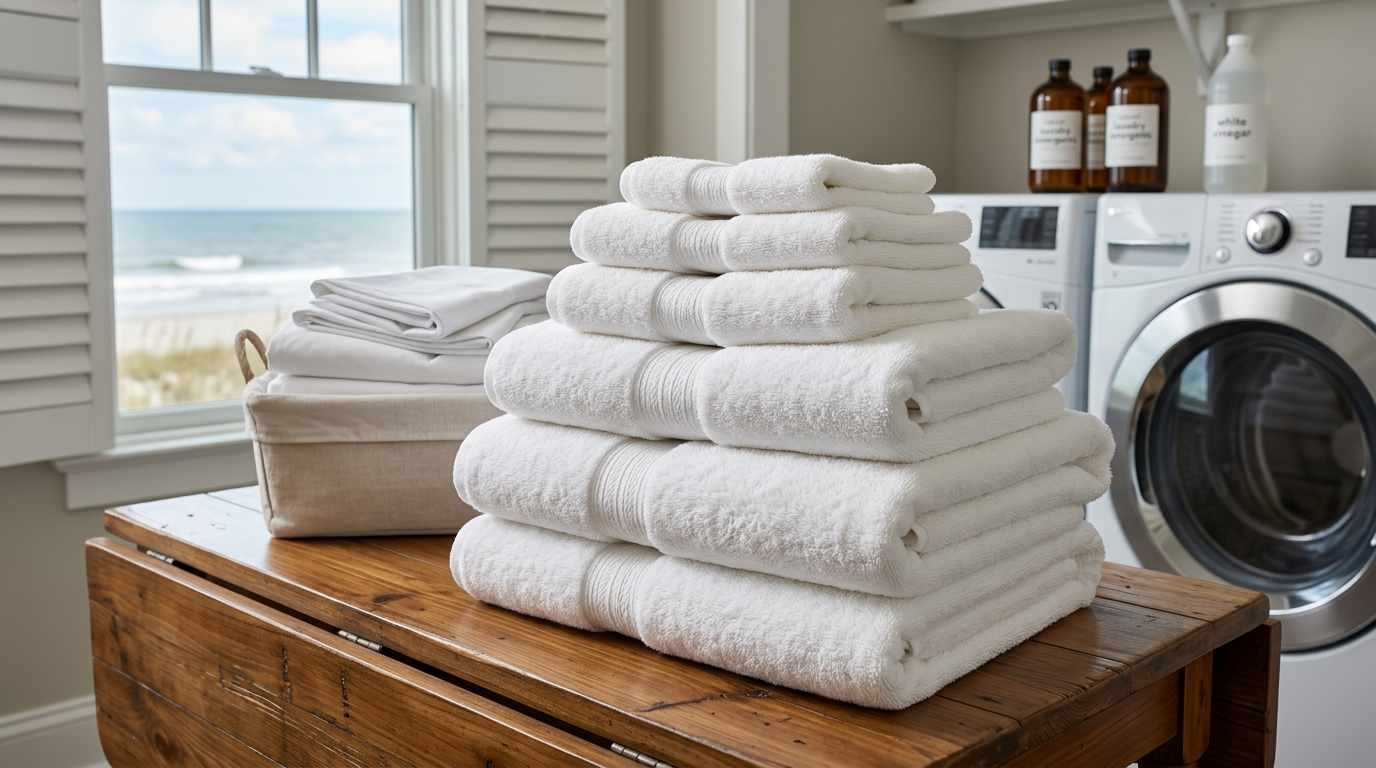
Oceanfront vacation rentals across the Grand Strand consume thousands of high-weight terry bath towels every single week. Over time, continuous exposure to hard-water minerals, sand-grit, sunscreen oils, and incorrect chemical treatments transforms plush resort towels into scratchy, gray, water-repellent sheets that harbor musty odors. At A2Z Cleaning & Linen Services, we have developed a specialized, hotel-grade laundry restoration protocol to salvage these costly assets and keep your guest reviews pristine. Let us look at the precise science of stripping, neutralizing, and restoring terry cloth loop density and absorbency.
The Anatomy of Terry Towel Degradation on the Grand Strand
Terry cloth is uniquely engineered with thousands of raised cotton loops designed to maximize surface area and trap moisture. In our coastal Myrtle Beach environment, this high-surface-area design makes towels highly vulnerable to microscopic contamination. Fine silica beach sand easily penetrates deep into the base weave of the terry pile, while airborne salt-spray and body oils coat the outer fibers. If these elements are not completely flushed out during the wash cycle, they bind together to form a stiff, abrasive matrix that ruins the hand-feel of the fabric.
Compounding this issue is the water chemistry of the Grand Strand. Our local municipal water supplies contain varying levels of dissolved calcium, magnesium, and iron. During the wash cycle, these minerals react with standard alkaline detergents, forming an insoluble lime-soap curd that clings to the cotton fibers. This mineral crusting not only turns bright white towels a dull, dingy gray, but it also crystallizes within the cotton loops, causing them to feel stiff, scratchy, and rough against a guest's skin.
Furthermore, as sand remains trapped in the base of the pile, it acts as a microscopic abrasive during subsequent wash and dry cycles. The friction of the sand grains literally saws through the cotton threads, leading to rapid fiber shedding, thinning spots, and premature fraying along the selvedge edges. To prevent this rapid degradation, property managers must look beyond standard residential wash cycles and implement a targeted, extraction-focused chemistry that frees the cotton loops from both mineral and particulate blockages.
The Softener Paradox: How Chemical Softeners Destroy Towel Absorbency
The most common mistake made by property owners and amateur laundry operations is the heavy use of retail liquid fabric softeners and dryer sheets. While these products are marketed to create softness, their chemical formulation is actually highly detrimental to terry cloth. Most household fabric softeners rely on tallow-derived quaternary ammonium compounds, commonly known as quats. These compounds are essentially specialized animal-fat derivatives or synthetic lipids that coat the cotton fibers in a microscopic, slick, waxy film to reduce static and flatten fibers.
This waxy coating is highly hydrophobic, meaning it actively repels water. When a guest steps out of the shower and attempts to dry off, a towel coated in softener residue simply smears water across their skin rather than absorbing it. This lack of absorbency is a primary driver of negative guest reviews regarding property linens. Furthermore, this waxy layer acts as an adhesive, trapping body sebum, dead skin cells, cosmetic residues, and sweat deep within the cotton matrix, preventing detergent from reaching and cleaning the underlying fibers.
When these wax-laden towels are stored in humid coastal linen closets or owner lockers, the trapped organic matter and moisture begin to decay. This is the root cause of the infamous 'sour towel' or 'Myrtle Beach musty' odor that emerges the moment a dry towel becomes damp with water. Overcoming this problem requires an immediate halt to the use of household softeners and the implementation of a professional stripping process that dissolves the built-up wax barrier.
The Strip-Wash Chemistry: Breaking Down Waxy Residues and Mineral Crusts
Restoring compromised terry towels requires a therapeutic, multi-step chemical stripping protocol designed to break the bonds of accumulated wax and mineral scale. This process cannot be achieved with standard off-the-shelf laundry detergents. It requires a dedicated, high-temperature wash cycle coupled with precise pH manipulation. The water temperature must reach at least 140 degrees Fahrenheit to melt and emulsify the stubborn lipids and tallow-based waxes coating the cotton loops.
To break down the calcium carbonate and magnesium crusts, we introduce a low-pH commercial laundry souring agent, such as citric acid or a specialized silicofluoride compound, during the wash. The mild acid chemically reacts with the alkaline mineral scale, converting the insoluble carbonates into highly soluble citrates that easily wash away. This step is followed by a high-alkaline flush using a non-ionic surfactant. The surfactant acts as an emulsifier, surrounding the melted waxes and lifting them off the cotton fibers, holding them in suspension so they do not redeposit during the drain cycle.
It is critical that the water levels during these flush cycles are calibrated correctly to ensure maximum dilution and removal of the dissolved residues. In our commercial facility, we monitor the rinse water conductivity and pH to verify that all stripped contaminants, chemical residues, and mineral salts have been completely evacuated from the machine. Once stripped, the cotton fibers return to their natural, highly absorbent state, restoring both the loft of the loops and the bright, clean color of the towel.
- Verify wash water temperatures reach between 140F and 160F to liquefy heavy tallow waxes.
- Utilize a low-pH commercial souring agent to dissolve hard-water calcium and magnesium deposits.
- Incorporate a non-ionic surfactant to suspend and flush emulsified oils without leaving residues.
- Perform multiple high-water-level rinses to ensure complete evacuation of dissolved contaminants.
- Monitor the pH of the final rinse to ensure it matches the natural skin-neutral range of 5.5 to 6.5.
Neutralizing the Humid "Myrtle Beach Musty" Odor at the Molecular Level
Standard chlorine bleach is often overused in coastal laundries in a misguided attempt to kill musty odors and whiten towels. However, chlorine bleach is highly alkaline and corrosive; it damages the cotton fiber's tensile strength, leading to rapid thinning, and actually turns iron-heavy local water yellow. To safely neutralize persistent mildew and mold odors at the molecular level, we utilize oxygen-based oxidation. Sodium percarbonate, when activated in water above 140 degrees Fahrenheit, releases a concentrated burst of hydrogen peroxide and sodium carbonate.
This oxidation process physically tears apart the cellular walls of odor-causing bacteria, mold spores, and fungal biofilms that thrive in humid coastal environments. Unlike chlorine, oxygen-based bleaches do not degrade the cellulose structure of cotton when used at recommended dosages, preserving the physical longevity of the terry loops. This process is supplemented by a broad-spectrum, EPA-registered commercial sanitizer in the final rinse cycle, which establishes a microscopic barrier that inhibits future microbial growth.
By addressing the bio-burden through thermal-chemical disinfection rather than masking it with heavy synthetic perfumes, we ensure the towels remain truly clean. When guests open a linen closet in a humid oceanfront villa, they will be greeted by a completely neutral, fresh aroma rather than a chemically perfumed cover-up. This level of sanitary hygiene is a cornerstone of professional vacation rental management and a key indicator of hotel-grade operations.
Mechanical De-Sanding and Loop Agitation Protocols
Sand is the ultimate enemy of laundry machinery and cotton fibers alike. When dry sand is mixed directly with water in a washing machine, it forms an abrasive slurry that grinds against the linens and settles into the drum gaskets and drain valves. To mitigate this, our protocol mandates a mechanical dry-extraction step for all heavily soiled beach and bath towels before they ever touch water. This simple step saves thousands of dollars in mechanical wear and prevents fabric fiber damage.
Soiled towels are loaded into a commercial tumble dryer set to a no-heat, cool-air cycle for 5 to 7 minutes. The high-velocity airflow and physical lifting action of the dryer's baffles open up the dry, compressed cotton loops, allowing heavy sand particles to fall out of the fabric and into the lint collector. Only after this mechanical pre-shake are the towels transferred to the wash wheel, where they can be laundered without the risk of sand abrasion.
During the wash cycle, high-extract G-force spins are utilized. Commercial washers operating at 350 Gs or higher physically force water through the weave of the fabric with incredible pressure, driving out any remaining fine silt or sand particles that gravity rinses cannot dislodge. This physical extraction is vital for maintaining the soft, non-gritty texture that guests expect from high-end oceanfront accommodations.
Managing Par Levels and Fiber Rest Cycles for Terry Durability
The longevity of resort-grade terry towels is directly linked to inventory management. When a property operates on a razor-thin linen inventory, such as a 1.5-par or 2-par system, towels are subjected to immediate reuse. They are stripped from the bed, rushed through a high-heat wash and dry cycle, folded hot, and placed right back on the towel rack. This continuous thermal and mechanical stress quickly exhausts the natural elasticity of the cotton fibers, leading to rapid thinning and bald patches.
To prevent this fiber fatigue, A2Z Cleaning & Linen Services advocates for a strict 3-par inventory control standard. This means having one par in the guest room, one par in dirty transit or undergoing laundering, and one par resting on the shelf in clean storage. A minimum 24-hour rest period between laundering and guest use allows the cotton fibers to naturally re-absorb ambient moisture from the air, relaxing the tension created during high-temperature drying.
This fiber relaxation restores the towel's natural loft, bounce, and flexibility, making it far more resistant to tearing and fraying. In the long run, maintaining a proper 3-par inventory reduces your annual linen replacement costs by up to 40%, while ensuring that every guest receives a towel that looks and feels brand new. Adequate par levels also shield your operations from mid-season supply shortages and laundry bottlenecks during peak Myrtle Beach summer weeks.
Hotel-Grade Drying and Cool-Down Calibration
The drying phase is where many high-quality towels are permanently ruined. Over-drying cotton cooks the fibers, removing the microscopic moisture bound within the cellulose structure of the cotton. This causes the fibers to shrink, become brittle, and lose their natural elasticity, resulting in a stiff, scratchy towel that sheds excessively. To prevent this thermal damage, commercial dryers must be calibrated with precise moisture-sensing automatic shutoffs.
Our dryers are programmed to cease heating when the load reaches approximately 4% residual moisture. At this point, the machine enters a critical 10-minute cool-down phase, during which cool air is circulated through the tumbling load. This cool-down period lowers the fabric temperature gradually, setting the cotton loops in an open, fluffy position and preventing the static electricity that attracts dust, lint, and hair.
Folding towels immediately after they exit the cool-down phase is equally important. Hot cotton is highly receptive to creasing and will quickly absorb any ambient humidity in the laundry room, locking in dampness. By folding towels while they are cool and dry, we preserve their loft and pack them tightly into transit bins without trapping moisture, ensuring they arrive at your vacation rental in optimal condition.
The Standard Operating Procedure for Auditing Towel Quality
Maintaining a 5-star standard across your property portfolio requires continuous quality auditing of your linen pool. Housekeeping staff and laundry technicians should be trained to perform simple, objective tests to determine when a towel needs restoration or retirement. The simplest test is the 'water drop test': place a dry towel on a flat surface and drop a teaspoon of water onto it. If the water pools on top of the loops for more than three seconds before absorbing, the towel is clogged with fabric softener or body oils and must go through our chemical stripping protocol.
Physical inspection should also focus on weight and color. Over time, towels lose fiber mass through friction, reducing their weight (measured in grams per square meter, or GSM). A towel that has lost more than 25% of its original weight will feel thin and cheap, and should be retired from the guest rotation. Check the selvedges and hems for loose threads or puckering; minor frays can be trimmed, but split hems must be retired to prevent a ragged appearance.
By partner-insourcing your laundry operations to A2Z Cleaning & Linen Services, you gain access to industrial-grade restoration chemistry, mechanical de-sanding, and rigorous quality control. We manage your inventory with the care of a family-owned business, protecting your linen investments and elevating your brand. Contact us at 843.800.2788 to discuss establishing a professional linen management program for your Grand Strand properties.
Key takeaway
Restoring the softness and absorbency of coastal rental towels requires breaking down chemical wax build-ups and hard-water mineral crusts through professional, low-pH acid stripping and thermal oxidation. Maintaining a strict 3-par inventory system and avoiding retail fabric softeners are the most effective ways to prolong terry towel lifespans and ensure positive guest experiences on the Grand Strand.
Related services
Keep Reading

Linens & Laundry
The Coastal Pillow-Core and Protector Restoration Protocol: Mitigating Humid Yellowing, Mold Spores, and Keratin Accumulation in Grand Strand Vacation Rentals
ReadLinens & Laundry
The Coastal Hotel-Grade Triple-Sheeting Sanitization and Assembly Protocol: Mitigating Comforter Bio-Burden, Sandy Sebum, and Turn-Time Pressures in Myrtle Beach Rentals
ReadLinens & Laundry
The TRSA Hygienically Clean Hospitality Standard: Implementing Industrial Wash Chemistry, Bio-Burden Testing, and Soil-to-Clean Separation in Myrtle Beach Commercial Laundries
ReadReady for a spotless property?
Call 843.800.2788 or request a free quote from A2Z Cleaning & Linen Services.