Coastal Living
The Carolina Room and Eze-Breeze Restoration: Costs, Vinyl Safety, and Professional Clean-Outs for Grand Strand Homeowners
Learn how to safely clean and restore your Carolina room and Eze-Breeze vinyl panels without causing costly clouding or structural damage in the coastal South Carolina climate.
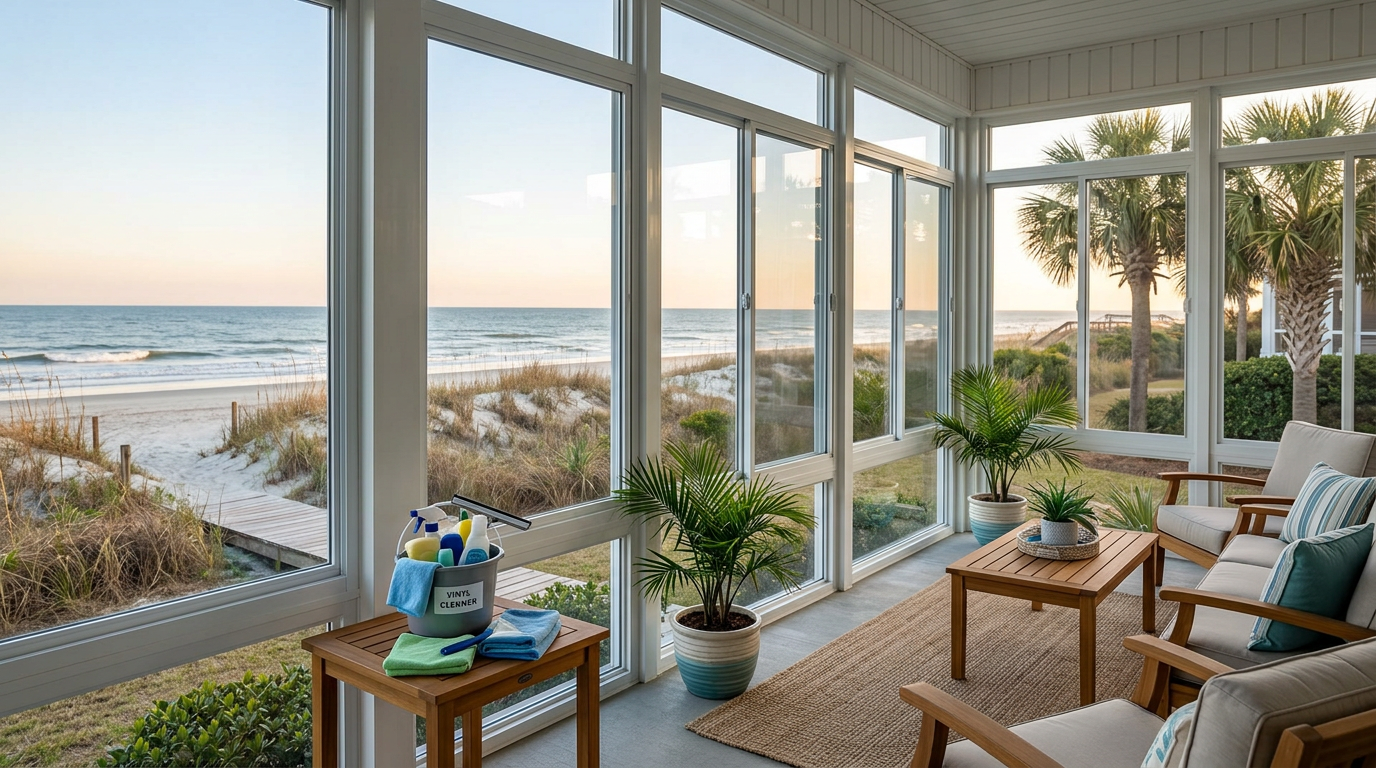
For homeowners along the Grand Strand, from the golf-course estates of Prince Creek to the oceanfront properties of North Myrtle Beach, the Carolina room is the ultimate hybrid living space. Many of these porches are enclosed with Eze-Breeze sliding panels, which use a durable, flexible 10-mil memory vinyl instead of traditional glass to let in coastal breezes while keeping out wind and rain. However, the unique combination of salt air, high humidity, and heavy seasonal pine pollen can quickly turn these beautiful enclosures cloudy and grimy. Cleaning these specialized vinyl systems requires strict adherence to manufacturer-approved protocols, as standard glass-cleaning techniques can permanently ruin the vinyl and lead to thousands of dollars in replacement costs.
The Anatomy of Grand Strand Carolina Rooms and Eze-Breeze Systems
To understand how to clean a Carolina room properly, you must first understand the materials involved. Unlike standard glass windows, Eze-Breeze and similar porch enclosures use a heavy-duty, flexible vinyl designed to expand and contract with temperature changes. This vinyl has a memory, meaning if it is impacted or stretched, it will return to its original taut shape when exposed to warmth. However, this pliable surface is highly porous compared to glass, making it susceptible to chemical degradation and microscopic scratching.
The coastal environment along the Grand Strand introduces unique airborne contaminants that continuously settle on these porch enclosures. Salt spray from the Atlantic Ocean mixes with fine beach sand and organic material, creating a sticky, abrasive film on the exterior of the panels. In the spring, heavy yellow pine pollen coats the screens and panels, which, when mixed with morning dew and humidity, turns into a stubborn, acidic residue that bakes onto the vinyl under the hot Carolina sun.
Beyond the vinyl panels themselves, these systems rely on a complex network of aluminum frames, tracks, vinyl glides, and brass rollers. Sand and salt grit find their way into the sliding tracks, acting like sandpaper every time you raise or lower a panel. Over time, this friction wears down the glides, clogs the weep holes designed to drain rainwater, and jams the operational components. Proper maintenance must address the entire system, not just the clear viewports.
- Flexible 10-mil vinyl panels require completely different chemical care than standard window glass.
- Salt-air residues and fine beach sand create a highly abrasive film on the panels.
- Seasonal pine pollen combines with humidity to create a sticky, acidic layer.
- Sliding tracks easily accumulate grit, leading to mechanical friction and frame damage.
- Clogged frame weep holes trap standing water, leading to localized mold and wood rot.
The High Cost of DIY Mistakes: Chemical and Physical Risks
The most common mistake Grand Strand homeowners make is treating flexible vinyl panels like standard household glass. Reaching for a blue, ammonia-based glass cleaner or an alcohol-based spray is a catastrophic error. Ammonia and alcohol strip the plasticizers out of the 10-mil vinyl, which are the chemical agents that keep the material pliable and clear. Once these plasticizers are stripped, the vinyl permanently loses its elasticity, turns a cloudy yellow, and eventually becomes brittle enough to crack.
Petroleum-based solvents, citrus cleaners, and abrasive scrubbing pads are equally destructive to Carolina room enclosures. While citrus-based degreasers are excellent for kitchen cleanups, they will chemically melt the surface of memory vinyl, leaving behind a permanent, milky haze that cannot be buffed out. Using paper towels, newspapers, or standard kitchen sponges is also highly discouraged, as their rough fibers leave micro-scratches that trap future dirt and scatter light, ruining your backyard view.
Another major risk is the temptation to use a high-pressure washer to quickly blast away pollen and mold from the exterior screens and panels. The extreme water pressure from a typical residential power washer can easily tear the vinyl, pop the spline cord out of its aluminum channel, or bend the delicate frame tracks. Once a panel is blown out or the frame is warped, the entire unit must be uninstalled and sent to a specialty shop for professional restretching or complete replacement.
- Ammonia and alcohol-based cleaners strip vital plasticizers, causing permanent yellowing and cracking.
- Citrus and petroleum solvents chemically melt the vinyl surface, creating an unfixable milky haze.
- Paper towels and newspapers cause micro-scratches that permanently cloud the vinyl panels.
- High-pressure washing easily blows the vinyl out of its retaining splines and warps frames.
- Improper scraping tools can permanently puncture the pliable 10-mil memory material.
The Chemistry of Vinyl-Safe Restoration
Safe and effective vinyl restoration relies on neutral-pH chemistry and non-ionic surfactants. The manufacturer-recommended cleaning solution for Eze-Breeze panels is incredibly simple: a highly diluted mixture of mild dish soap or basic baby shampoo mixed with lukewarm water. This gentle solution breaks the surface tension of grease, pollen, and salt without reacting chemically with the vinyl or stripping the protective UV inhibitors embedded in the material during manufacturing.
For deep-cleaning neglected panels that have developed grey or black mildew spots along the edges, specialty vinyl cleaners must be used. Products specifically formulated for marine vinyl, convertible tops, or flexible porch enclosures are designed to lift organic staining without drying out the substrate. After washing, applying a thin, protective coat of a premium vinyl preservative helps block damaging ultraviolet rays, repels static charge to minimize dust accumulation, and keeps the vinyl soft and pliable.
Water quality is another critical, yet often overlooked, factor in the cleaning process. The municipal tap water across the Grand Strand frequently contains high levels of dissolved minerals like calcium and iron. If hard tap water is allowed to dry on the vinyl panels, it will leave behind unsightly white spots that can permanently etch into the surface over time. Professional cleaning protocols always utilize a final rinse of pure, deionized, or reverse-osmosis water to ensure a spot-free finish.
- Neutral-pH dish soaps or baby shampoos are the safest everyday cleaning agents.
- Specialized marine-grade vinyl cleaners safely lift stubborn mold and mildew stains.
- UV-blocking vinyl protectants restore flexibility and repel static dust accumulation.
- Deionized or purified water rinses prevent hard-water mineral spotting on panels.
- Ultra-soft, clean microfiber cloths must be used to wash, rinse, and dry the surfaces.
Comparing DIY vs. Professional Enclosure Cleaning
Deciding whether to tackle your Carolina room cleaning yourself or hire a professional service comes down to safety, equipment, and the condition of the panels. If your enclosure is on a single-story ground level and receives regular monthly maintenance, a DIY approach can be highly effective. It requires patience, a sturdy work surface covered in soft towels to lay the panels flat, and a dedicated afternoon to wash, dry, and treat each panel individually by hand.
Professional restoration, however, becomes necessary when panels are heavily neglected, located on upper-level balconies, or when the sliding tracks are packed with years of salt and sand. Professional technicians possess commercial-grade water purification systems, specialized low-pressure extraction tools, and scaffold setups that allow them to clean safely at height. They also have the training to disassemble and reassemble complex track systems without damaging the delicate nylon glides or brass rollers.
Safety is a major consideration for multi-story Grand Strand homes. Many homes in master-planned communities feature elevated screened porches with Eze-Breeze systems overlooking golf courses or waterways. Attempting to balance on a ladder on the exterior of a second-story porch while handling a slippery, wet vinyl panel is incredibly dangerous. Professional teams are fully insured and equipped with specialized reach poles and safety harnesses to handle these high-access cleanings without risk to the homeowner.
- DIY is suitable for ground-floor porches with light, regular dust and pollen buildup.
- DIY requires a large, clean, padded workspace to prevent scratching panels during washing.
- Professionals use pure-water filtration systems to eliminate the risk of hard-water spots.
- Professionals can safely access and clean high-elevation panels on multi-story homes.
- Professional services include deep-cleaning and lubricating internal mechanical track components.
Understanding the Costs of Professional Carolina Room Cleaning
When hiring a professional cleaning company for your Carolina room, pricing is typically calculated based on several distinct factors rather than a flat hourly rate. Companies look at the total number of individual vinyl panels, the physical size of the enclosure, the accessibility of the exterior surfaces, and the level of environmental buildup. A neglected porch that has not been cleaned in years requires significantly more labor and specialized chemistry than a home on a biannual maintenance plan.
In the Grand Strand market, a standard professional cleaning for a typical 10-panel Eze-Breeze room generally ranges from $250 to $450 for standard maintenance. This service usually includes washing the panels on both sides, wiping down the aluminum frames, vacuuming the tracks, and clearing the weep holes. For larger enclosures, or rooms with significant mold growth and oxidation on the aluminum frames, a deep restoration service can range from $500 to $900.
While these costs may seem high compared to standard window cleaning, they must be weighed against the cost of replacement. Replacing a single damaged Eze-Breeze panel unit can easily cost between $200 and $400 in materials and labor. If an entire room's vinyl panels are ruined by incorrect DIY cleaning chemicals, a full replacement can run into thousands of dollars. Professional maintenance protects your initial investment and ensures the system operates smoothly for its intended 20-year lifespan.
- Pricing is determined by panel count, accessibility, and the level of environmental buildup.
- Basic professional cleaning for a 10-panel room typically ranges from $250 to $450.
- Deep mold restoration and frame oxidation removal can range from $500 to $900.
- Professional cleaning costs are a fraction of the price of replacing damaged vinyl panels.
- Regular professional maintenance extends the operational lifespan of your enclosure to 20+ years.
Essential Questions to Ask a Grand Strand Cleaning Company
Not all cleaning companies in the Myrtle Beach area are equipped or trained to handle flexible vinyl enclosures. Many general window washers will treat Eze-Breeze panels exactly like standard glass, using squeegees, glass cleaners, and abrasive techniques that can ruin your screens. Before hiring any contractor, you must ask specific vetting questions to ensure they understand the chemistry and physical limitations of flexible memory vinyl.
First, ask the company: "What specific chemical solutions do you use to clean Eze-Breeze vinyl panels?" If the representative mentions ammonia, bleach, alcohol, or standard blue glass cleaners, do not hire them. They should immediately state that they use only neutral-pH, vinyl-safe soaps, or specialized marine vinyl cleaners. Second, ask if they plan to use high-pressure washing equipment on the vinyl panels. A trained professional will emphasize that they only use low-pressure, hand-washing, or soft-wash techniques.
Finally, inquire about their insurance coverage and their experience with track lubrication. Ask: "Does your insurance policy specifically cover accidental damage to flexible vinyl panels and screen splines?" and "How do you clean and lubricate the sliding tracks?" A reputable provider like A2Z Cleaning & Linen Services, reachable at 843.800.2788, will gladly explain their careful hand-washing process, their use of dry-silicone track lubricants, and their full liability protections.
- Ask what specific chemicals they use; avoid any company mentioning ammonia or alcohol.
- Confirm that they will not use high-pressure washers on the flexible vinyl panels.
- Verify that their business liability insurance covers damage to flexible vinyl and screen splines.
- Ask if they clean, clear, and lubricate the internal sliding track mechanisms.
- Inquire if they use purified, mineral-free water to prevent hard-water spotting.
The Step-by-Step Professional Restoration Protocol
A truly professional Carolina room cleaning is a systematic process that begins with dry-soil removal. Before any water or liquid cleaners touch the panels, technicians use soft-bristle detailing brushes and high-efficiency particulate air (HEPA) vacuums to extract loose sand, pine needles, and dust from the window tracks, frames, and screens. If this dry debris is not removed first, adding water will turn it into an abrasive slurry that can scratch the vinyl during the washing process.
Once the dry soil is removed, the technicians carefully slide and stack the panels to access both sides, or completely remove them from their tracks if the system allows. The panels are laid flat on clean, padded, microfiber-covered tables. A mild, neutral-pH surfactant is applied using a soft, plush microfiber wash wand. This detergent is allowed to dwell briefly to emulsify salt and pollen residues, and is then gently wiped clean with minimal physical pressure.
The next phase focuses on the aluminum frames and tracks. Technicians clear out the drainage weep holes at the bottom of the frames using specialized wire brushes to ensure rainwater can escape freely. The tracks are scrubbed clean of all packed sand and lubricated with a premium, non-greasy dry-silicone spray. Finally, the vinyl panels are dried using clean, ultra-soft microfiber cloths, reinstalled into the lubricated tracks, and buffed to a brilliant, crystal-clear shine.
- Dry-soil removal extracts sand and grit before liquids are applied to prevent scratching.
- Vinyl panels are cleaned while resting flat on clean, padded microfiber workstations.
- Neutral-pH surfactants emulsify salt, grease, and pollen residues safely.
- Frame weep holes are cleared of organic debris to ensure proper water drainage.
- Tracks are lubricated with dry-silicone spray to ensure smooth, friction-free operation.
Preserving Your Investment Between Professional Cleans
While professional deep cleaning is recommended once or twice a year, homeowners can take several simple, safe steps to maintain their Carolina room between scheduled visits. First, keep all surrounding landscaping, bushes, and tree branches trimmed back at least three feet from the screens. This prevents physical scratches from windblown branches and reduces the transfer of mold spores, sap, and insects onto your enclosure.
Once a month, use a standard garden hose equipped with a gentle spray nozzle to rinse down the exterior of the enclosure. This simple low-pressure rinse washes away fresh salt mist and pollen before they have a chance to bond to the vinyl under the midday sun. Never use a high-pressure nozzle or attempt to scrub the dry vinyl with a brush, as this will grind any settled sand particles directly into the soft plastic.
If you notice condensation or light dust on the interior of the panels, only use a clean, dry, ultra-soft microfiber cloth to gently wipe it away. Never use paper towels, bath towels, or old t-shirts, as their rough fibers will create microscopic swirls over time. For professional assistance, deep restorations, or to set up a seasonal maintenance plan for your Grand Strand home, contact A2Z Cleaning & Linen Services at 843.800.2788.
- Trim back trees and bushes to prevent physical scratches and mold spore transfer.
- Rinse the exterior panels monthly using a gentle, low-pressure garden hose.
- Only use clean, dry, ultra-soft microfiber cloths for light dusting and condensation wiping.
- Never use paper towels, newspapers, or harsh scrubbing sponges on vinyl panels.
- Avoid using standard household glass cleaners for quick touch-ups.
Key takeaway
Maintaining a Carolina room with Eze-Breeze panels requires specialized, non-abrasive care and neutral-pH chemistry to prevent costly, irreversible damage to the vinyl. While light monthly rinsing can be handled by homeowners, professional deep-cleaning and mechanical track restoration are essential for preserving the clarity, operation, and longevity of your investment. Trusting trained professionals who understand the specific needs of coastal materials ensures your outdoor living space remains beautiful and functional for decades.
Keep Reading
Coastal Living
The Cost of Restoring Coastal Grasscloth Wallcoverings: Humidity-Driven Mold, Dye Bleeding, and Vetting Myrtle Beach Specialists
ReadCoastal Living
Coastal Family Chaos: Managing Sand, Pet Dander, and Humidity-Driven Odors in Grand Strand Homes
ReadCoastal Living
The Coastal Kids' Toy Bin and Beach-to-Playroom Asset Decontamination Protocol: Mitigating Humid Saliva Biofilms, Pet-Dander Adhesion, and Sand-Friction Scratches in Grand Strand Homes
ReadReady for a spotless property?
Call 843.800.2788 or request a free quote from A2Z Cleaning & Linen Services.