Linens & Laundry
The Coastal Hotel-Grade Triple-Sheeting Sanitization and Assembly Protocol: Mitigating Comforter Bio-Burden, Sandy Sebum, and Turn-Time Pressures in Myrtle Beach Rentals
Discover how hotel-grade triple-sheeting eliminates unhygienic comforters, tackles coastal sand and sebum, and streamlines your Grand Strand vacation rental turns.
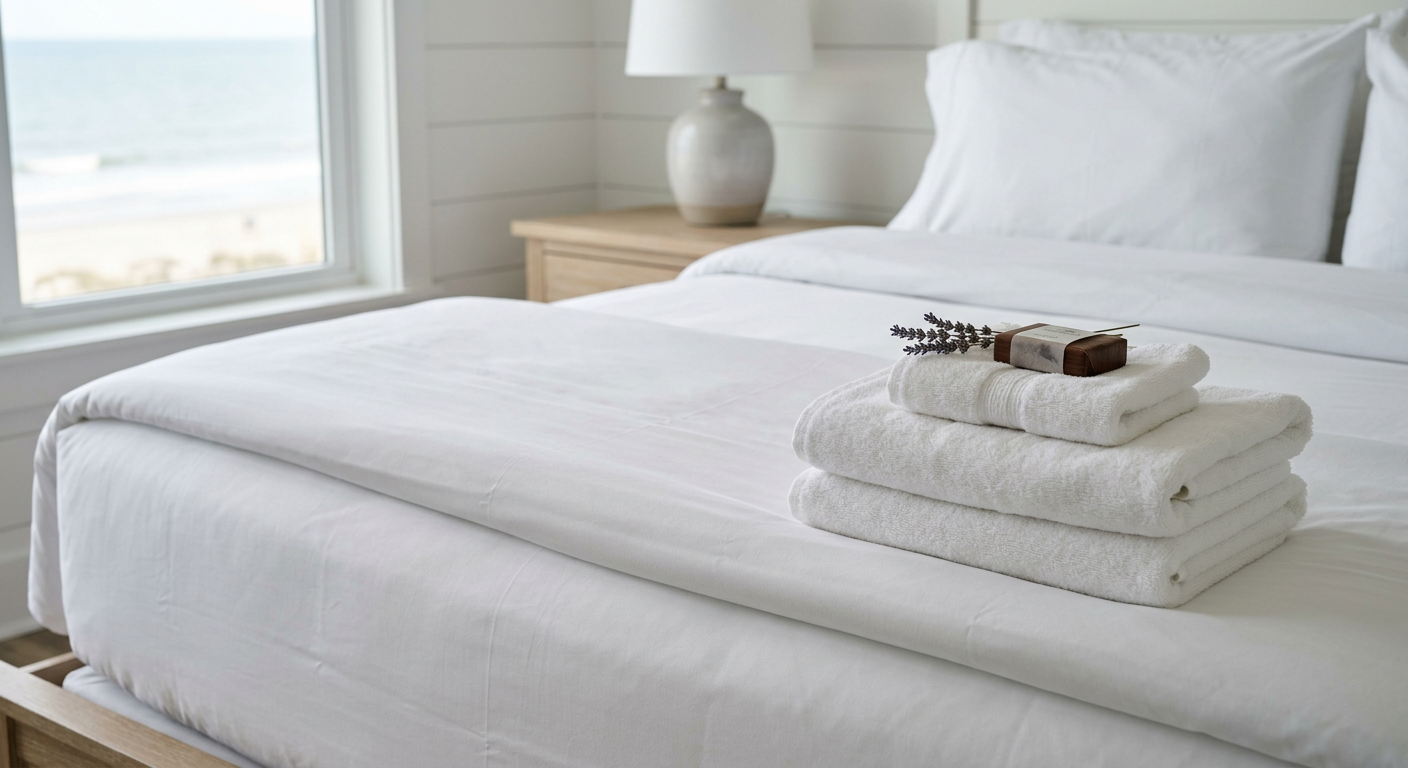
In the fast-paced Grand Strand vacation rental market, maintaining pristine bed hygiene is one of the greatest operational challenges for property managers and homeowners alike. Traditional heavy comforters and thick duvet covers frequently trap fine quartz sand, humid salt air, and organic body oils, yet they are rarely washed between every guest due to their long drying times. Transitioning to a hotel-grade triple-sheeting system solves this hygiene vulnerability while significantly speeding up Saturday turn times. By utilizing three commercial-grade flat sheets and a thin, highly washable thermal blanket, you can guarantee a freshly sanitized bed for every arrival.
The Anatomy of Hotel-Grade Triple-Sheeting in Coastal Environments
Triple-sheeting is a luxury hospitality bedding standard that replaces the traditional bulky comforter or duvet cover with three layers of high-quality sheets sandwiching a lightweight, insulating blanket. The foundation begins with a fitted sheet or a flat sheet tightly mitered around the mattress. The middle layer consists of a flat sheet placed wrong-side up, followed by a lightweight, commercial-grade thermal blanket. The system is completed by a decorative top flat sheet, typically featuring a woven design such as a tone-on-tone stripe, which protects the blanket from direct guest contact and seals the entire assembly.
In the humid Grand Strand climate, this configuration is a game-changer for moisture management. Unlike thick, synthetic comforters that trap humid coastal air and sweat, the multi-layered sheet design allows for optimal airflow and temperature regulation, keeping guests cool and dry. Furthermore, because every single layer that touches a guest can be stripped and laundered, triple-sheeting eliminates the dreaded mystery stain complaints that plague properties relying on dry-clean-only or bulky top-of-bed covers.
From an operational perspective, this system is highly efficient. Washing a thick duvet cover or a quilted comforter can take up to an hour and a half in a residential-style dryer, causing severe bottlenecks during tight seasonal turn windows. In contrast, flat sheets and thin thermal blankets dry in a fraction of the time, allowing housekeeping teams to complete turnovers on schedule. This streamlined workflow ensures that properties are ready for early check-ins without sacrificing linen cleanliness or presentation standards.
The Sanitization Challenge of Non-Washable Top-of-Bed Bedding
Traditional vacation rental bedding, such as heavy quilts and thick duvets, presents a significant hygiene risk in coastal environments. Throughout a typical week-long stay, these fabrics absorb high volumes of sunscreen, sweat, natural sebum, and salt-air humidity. Because these bulky items are difficult and expensive to wash on tight same-day turns, many hosts only launder them monthly or seasonally. This practice allows microscopic organic debris to accumulate deep within the fibers, creating a breeding ground for mold, mildew, and dust mites in our humid climate.
Fine beach sand exacerbates this issue by settling into the textured weave of heavy quilts and comforters. Once sand particles become embedded in these thick fabrics, standard residential vacuums and shake-outs cannot fully remove them, leading to a gritty texture that immediately triggers negative guest reviews. Guests expect a flawless, hygienic sleep surface, and finding sand or faint body-oil odors on top-of-bed linens destroys their trust in the property's overall cleanliness.
Triple-sheeting removes this vulnerability by ensuring that 100% of the bedding is stripped and processed through a high-temperature commercial wash cycle after every checkout. By eliminating non-washable top-of-bed components, property managers protect their guests from residual allergens and organic bio-burden. This absolute sanitation standard not only safeguards guest health but also provides peace of mind that elevates the property's reputation in a highly competitive market.
Fabric Specifications for Triple-Sheet Components
To withstand the demanding environment of commercial laundering and high-volume turnovers, triple-sheeting fabrics must meet strict industrial specifications. Standard retail sheets quickly break down under the high heat and heavy chemical agitation required for sanitization. For the three sheet layers, we recommend a commercial T-250 or T-300 poly-cotton blend, typically composed of 60% cotton and 40% polyester. This specific blend combines the breathable, natural softness of cotton with the structural strength and wrinkle resistance of polyester.
The middle thermal blanket insert must be selected with identical care. A lightweight, 100% micro-flannel or tightly woven cotton-acrylic blanket is ideal, as it provides warmth without bulk and can endure repeated high-temperature washing without pilling, shrinking, or losing its shape. Avoid loosely woven thermal blankets with open-air pockets, as these easily snag on jewelry, zippers, and fingernails, leading to premature tearing and rapid inventory depletion during peak seasons.
For the top decorative sheet, a white-on-white piano key or tone-on-tone stripe pattern is the industry standard. This design element adds visual depth and a luxurious hotel feel while remaining completely bleach-safe. Purchasing linens from commercial hospitality distributors ensures that all pieces feature colorfast dyes, reinforced selvage edges, and consistent sizing designed to wrap around deep-pocket coastal mattresses without riding up or coming untucked.
- Sheet Blend: T-250 or T-300 poly-cotton (60/40 ratio) for high tensile strength.
- Blanket Insert: High-density micro-flannel or cotton-acrylic weave.
- Color Standard: Optical white for universal bleachability and a clean aesthetic.
- Top Sheet Style: Tone-on-tone white stripe to elevate visual presentation.
- Edge Construction: Double-stitched, reinforced hems to prevent fraying in commercial irons.
The Commercial Laundry Wash Cycle Profile for Triple-Sheeting
Laundering triple-sheet components requires a precise balance of temperature, chemistry, and mechanical action to extract stubborn coastal contaminants. The process begins with a tepid flush cycle to remove loose beach sand, preventing these abrasive granules from grinding into the cotton fibers during the main wash. Next, a high-alkaline break cycle at 140 to 150 degrees Fahrenheit is initiated to expand the fabric fibers and suspend stubborn body oils, sunscreen, and sweat that have bound to the material.
A chlorine or oxygen-based bleaching step follows to sanitize the linens and restore their optical whiteness. This step must be carefully monitored, as excess chlorine can weaken polyester fibers and cause cotton to yellow over time. After the sanitizing phase, multiple rinse steps wash away suspended soils and chemical residues. A crucial souring agent is introduced during the final rinse to neutralize the pH of the linen to a skin-compatible 5.5 to 6.5, which prevents skin irritation and yellowing.
The final step in the wash profile is high-extraction spinning, which uses centrifugal force to strip excess water from the sheets. This minimizes drying times, which is critical for reducing fabric exposure to high heat. Commercial dryers should be set to a medium heat cycle with a cool-down phase at the end to prevent heat-setting wrinkles. Properly dried sheets should be removed immediately and either ironed or folded while warm to maintain a crisp, professional finish.
Mathematical Par Levels for Triple-Sheet Operations
Managing a vacation rental portfolio along the Grand Strand requires a strategic approach to linen inventory. Operating on a single set of sheets per bed is a recipe for operational failure, leading to rushed laundry, fabric damage, and check-in delays. To run an efficient triple-sheeting program, we recommend a strict 3-par to 4-par inventory model. This mathematical structure guarantees that your property always has high-quality, fully rested linens ready for immediate deployment.
Under a 3.5-par system, each bed size requires a specific volume of inventory. For a single king bed utilizing triple-sheeting, one par consists of three flat sheets (or one fitted and two flat sheets) and one thermal blanket. A 3.5-par inventory means stocking approximately 11 sheets and 4 thermal blankets for that single bed. This structure ensures that while one par is on the bed, one par is clean in the owner's closet, one par is in the laundry pipeline, and the half-par acts as a safety buffer for damaged or stained items.
Maintaining these par levels prevents the rapid fabric degradation caused by washing and drying sheets back-to-back without a resting period. Cotton fibers need time to reabsorb ambient moisture and recover their structural elasticity after being subjected to high-temperature commercial drying. Resting your linens for at least 24 hours between wash cycles can double their operational lifespan, saving property owners thousands of dollars in replacement costs over the course of a rental season.
Step-by-Step Bed Assembly Protocol for Turnhouse Teams
Achieving the tight, pristine look of a luxury hotel bed requires a disciplined, step-by-step assembly method. First, the base layer (either a fitted sheet or a flat sheet secured with tight mitered hospital corners) must be pulled taut over the mattress to eliminate all wrinkles. Next, the middle flat sheet is placed on top, wrong-side up, ensuring the top hem is perfectly aligned with the headboard or mattress edge, and the sides hang evenly over both edges.
The thermal blanket is then laid over the middle sheet, positioned roughly six inches down from the top edge of the mattress. Following this, the third decorative top sheet is placed right-side up, aligned flush with the top edge of the middle sheet. Housekeepers then take the top six inches of both the middle and top sheets and fold them down over the blanket once, then fold them over a second time to create a crisp, clean cuff that locks the blanket inside.
Finally, the housekeeper moves to the foot of the bed. They tuck the middle sheet, blanket, and top sheet together tightly under the foot of the mattress, pulling the fabrics snug. Using a classic hospital-corner fold, they miter both bottom corners at a precise 45-degree angle, tucking the hanging sides under the sides of the mattress. This locks the entire triple-sheet assembly in place, preventing the layers from shifting or pulling apart when guests climb into bed.
- Base Layer: Smooth fitted sheet or mitered flat sheet pulled completely taut.
- Middle Layer: Flat sheet laid wrong-side up, aligned with the top mattress edge.
- Insulation: Thermal blanket positioned six inches below the headboard.
- Top Layer: Decorative sheet laid right-side up, aligned with the middle sheet.
- The Fold: Double-fold the top sheets over the blanket to create a secure, clean cuff.
- The Anchor: Miter the bottom corners together at 45 degrees for a tight envelope.
Moisture-Control and Storage Protocols for Coastal Linen Closets
In the humid, high-salinity environment of the Grand Strand, storing laundered linens requires careful environmental management. Storing fresh sheets in damp, unventilated owner closets can cause them to absorb moisture from the air, leading to musty odors and localized mildew growth within days. To prevent this, storage closets must be kept clean, dry, and well-ventilated. Using wire shelving instead of solid wood shelves allows air to circulate around the folded sheets, preventing stagnant air pockets.
Never store commercial linens in sealed plastic bags or airtight bins immediately after laundering. Even fully dried sheets retain trace amounts of heat and moisture; trapping them in plastic creates a micro-greenhouse effect that accelerates fiber degradation and sour odors. Instead, store them in breathable canvas bins or neatly stacked on open wire shelves. If a closet is prone to dampness, installing a small, passive dehumidifier or moisture absorber can help maintain the ideal relative humidity level of under 50%.
Additionally, linen inventory should be rotated systematically using a first-in, first-out (FIFO) system. When placing clean linens back in the closet, fresh stacks should be placed at the bottom or back, pushing older stacks to the front for immediate use. This rotation ensures that all sheets in your inventory are used evenly, preventing some sets from sitting unused for months where they can collect dust, yellow from ambient light, or develop a stale odor.
Quality Assurance and Grade-A Sortation Standards
To maintain a high standard of luxury in your rental property, a strict quality assurance protocol must be integrated into your linen folding and staging process. Every sheet must be inspected under high-lumen lighting during the folding phase to identify any defects. Housekeepers look for micro-stains, such as lingering makeup, rust spots from beach chairs, sunscreen yellowing, or stray hairs that may have clung to the fabric during the folding process.
Any linen showing signs of wear, such as fraying hems, small tears, thin spots, or permanent discoloration, must be immediately pulled from the primary inventory loop. These items are categorized as Grade-B linens. While they are no longer suitable for primary guest beds, they can be kept in a designated backup bin for emergencies, used as protective covers during maintenance work, or donated to local shelters. Only pristine, crisp, and stain-free sheets should ever make it to a guest bed.
A rigorous sortation process ensures that your guests' first impression of the property is flawless. When a guest walks into a bedroom and sees a perfectly white, crisp, triple-sheeted bed, it establishes immediate confidence in the hygiene of the entire property. By standardizing this quality control protocol, vacation rental hosts can significantly reduce complaints, boost their property ratings, and build lasting guest loyalty.
Key takeaway
Transitioning to a hotel-grade triple-sheeting protocol is one of the most effective ways to elevate hygiene, protect bedding investments, and accelerate turnover times in your Myrtle Beach rental. By replacing unhygienic comforters with clean, fully washable sheets and thermal blankets, you ensure a spotless stay for every guest. For professional assistance managing your property's commercial laundry and turnover needs, contact A2Z Cleaning & Linen Services at 843.800.2788.
Related services
Keep Reading

Linens & Laundry
The 3-Par Linen Formula: Calculating Inventory Lifespans and Industrial Wash Formulas for Grand Strand Vacation Rentals
ReadLinens & Laundry
The Coastal Terry Towel Absorbency and Softness Restoration Protocol: Mitigating Fabric Softener Build-Up, Hard-Water Crust, and Mildew Odor in Grand Strand Laundries
ReadLinens & Laundry
The TRSA Hygienically Clean Hospitality Standard: Implementing Industrial Wash Chemistry, Bio-Burden Testing, and Soil-to-Clean Separation in Myrtle Beach Commercial Laundries
ReadReady for a spotless property?
Call 843.800.2788 or request a free quote from A2Z Cleaning & Linen Services.