Coastal Living
The Coastal Louvered Door and Airflow Closet Decontamination Protocol: Mitigating Damp Dust Slats, Mold Spores, and Eco-Friendly Airway Protection in Grand Strand Homes
Discover how to clean and decontaminate coastal louvered doors. Learn safe, botanical methods to eliminate damp-dust cake and mold spores while preserving indoor air quality.
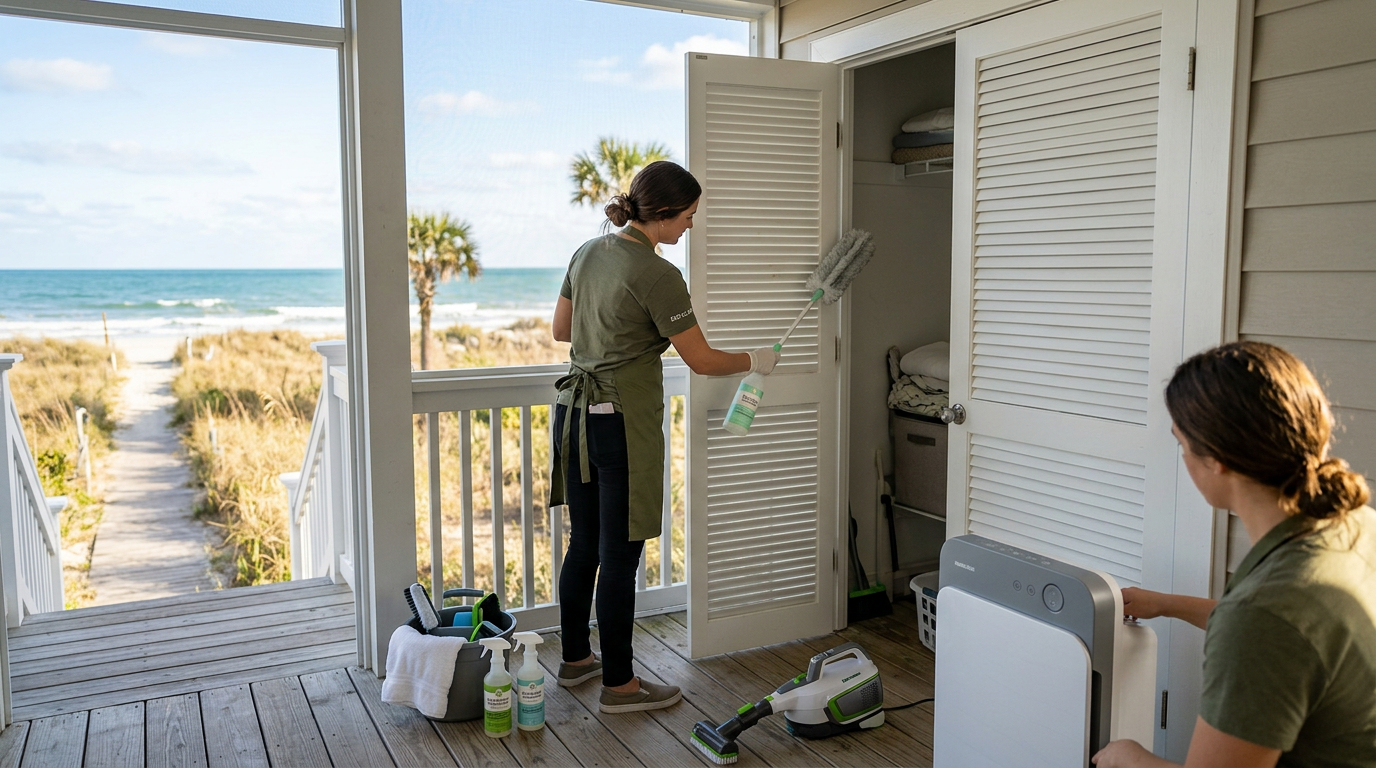
Louvered doors are a staple of coastal Grand Strand homes, designed to promote passive airflow and prevent stagnant air from breeding mold in dark closets and laundry niches. However, their unique design features horizontal slats that capture a high volume of airborne allergens, dander, and dust. In our high-humidity environment, this dust transforms into a sticky layer that can quickly harbor mold spores, impacting indoor air quality. This guide outlines a safe, botanical-based decontamination protocol to clean these specialized structures while protecting your family's respiratory health.
The Dynamics of Damp-Dust Caking in High-Humidity Environments
The high relative humidity characteristic of the Grand Strand fundamentally alters how dust behaves on household surfaces. In dry climates, dust remains loose and easy to sweep away with a simple dry cloth. In our coastal environment, salt-laden moisture binds with airborne particulates, creating a sticky, cohesive film known as damp-dust cake. This film adheres aggressively to the wood, composite, or vinyl surfaces of louvered door slats, defying standard cleaning tools and standard dusting wands.
This sticky layer is not merely unsightly; it serves as a nutrient-rich substrate for mold spores. When indoor relative humidity climbs above sixty percent, mold spores dormant in the dust find the moisture and organic material they need to germinate. Once a colony establishes itself in the recessed corners of a louvered slat, it begins releasing mycotoxins and fresh spores directly into the closet's airflow path, contaminating clean garments, bedding, and the wider living space.
Attempting to clean this damp-dust cake with improper wet-wiping techniques often worsens the problem. Applying excess water or aggressive liquid cleaners dissolves the sticky binder without extracting it, turning the dust into a muddy slurry. This slurry flows into the hard-to-reach joints where the slats meet the door frame. Once dry, this trapped organic mud becomes an inaccessible nursery for future mold growth, locked deep within the door's structure.
Selecting Material-Safe, Non-Off-Gassing Botanical Chemistries
Because louvered doors open directly into confined closet spaces, the choice of cleaning chemistry is critical for resident safety. Traditional household disinfectants and commercial cleaners often rely on volatile organic compounds, synthetic fragrances, and harsh bleach. When sprayed or wiped in enclosed areas, these chemical residues linger on clothing and fabrics, off-gassing into the bedroom and causing headaches, asthma flare-ups, and skin sensitivities.
A sustainable, health-first protocol demands the use of EPA Safer Choice or green-certified botanical sanitizers. Thymol-based botanical disinfectants and pH-neutral plant-derived surfactants are highly effective at breaking down the organic binders in damp-dust cake. These natural chemistries penetrate the cell walls of mold spores without releasing toxic vapors, ensuring that the air within the closet remains safe for sensitive individuals, children, and household pets.
Additionally, these eco-friendly formulas protect the physical integrity of the door itself. Harsh alkaline or acidic cleaners can degrade paint finishes, soften wood sealants, and corrode the metal hinges of coastal doors. A neutral botanical cleaner lifts the soil while leaving the protective coating intact, preventing the underlying wood from absorbing moisture and warping in the coastal humidity.
The Dry Extraction Phase: Mitigating Airborne Allergen Dispersion
The first operational phase of louvered door decontamination is dry extraction. Executing this step correctly prevents the airborne dispersion of allergens and stops the formation of a muddy slurry during the subsequent wet-cleaning phase. Homeowners should never use feather dusters or dry rags, which simply launch fine dust back into the room's air currents, where it can settle on beds, carpets, and upholstery.
Instead, the protocol utilizes a variable-speed vacuum cleaner equipped with a certified HEPA filter and a soft horsehair brush attachment. The HEPA filter ensures that microscopic allergens, pet dander, and mold spores are captured down to 0.3 microns rather than exhausted back into the home. Starting at the top slat and working downward, the operator should glide the brush attachment along each groove, capturing the loose top layer of dust.
Special attention must be paid to the undersides of the slats. Because of the downward angle of louvered doors, the bottom face of each slat often harbors significant dust deposits that are invisible from a standing eye level. Gently tilting the brush upward allows the vacuum to pull these hidden accumulations free. This dry extraction step removes up to eighty percent of the bulk soil, preparing the surface for precise damp decontamination.
- Variable-speed vacuum with sealed HEPA filtration system
- Soft natural horsehair dusting brush attachment
- Microfiber detailing cloths (dry)
- N95 respirator mask for dust-sensitive individuals
The Precision Damp-Wiping and Slat-Corner Detailing Protocol
Once dry soils are extracted, the precision damp-wiping phase begins. This step requires a systematic approach to ensure that every millimeter of the slatted surface is cleaned without oversaturating the materials. Microfiber cloths are essential here; their split-fiber structure acts like microscopic hooks that grab and hold the sticky damp-dust cake, rather than merely sliding over it like standard cotton rags.
Dampen a clean microfiber cloth with a pre-diluted botanical surfactant solution, ensuring the cloth is damp to the touch but not dripping wet. Fold the cloth into quadrants to provide multiple clean surfaces as you work. Slide the cloth over each individual slat, wrapping it slightly around the front and back edges to clean both sides in a single smooth pass. Swap to a clean fold of the cloth as soon as soil transfer is visible.
The most challenging areas are the tight corner joints where the slats connect to the vertical stiles. To clean these corners without leaving moisture behind, wrap a damp microfiber cloth over a flexible detailing spatula or a soft-bristled detail brush. Gently guide this tool into the corner recess to pull out accumulated grime. Follow immediately with a dry microfiber cloth to absorb any remaining moisture, preventing localized wood swelling and paint damage.
- Fold microfiber cloth into eighths to ensure fresh surfaces
- Wipe from top to bottom, outer edge to inner edge on each slat
- Use a plastic detailing spatula wrapped in microfiber for corner joints
- Immediately dry with a separate, clean microfiber towel
The Bottom-Slat and Lower Door Frame Gravity Zone
Gravity ensures that the lowest slats on a louvered door bear the heaviest soil loads. In coastal homes, pet hair, floor-level sand, and damp shoe soils accumulate rapidly on the bottom third of the door. Furthermore, when floors are swept or vacuumed, fine debris is often kicked upward, settling directly onto these lower slats, where it joins existing damp condensation to form a thick, crusty barrier.
This lower zone is also highly susceptible to moisture exposure from floor mopping. If mop water splashes against the bottom of a louvered door, the porous wood or composite material can absorb the dirty water, leading to paint peeling, swelling, and localized mold outbreaks. This area requires a dedicated extraction approach that prevents water-wicking and cleans deep into the bottom-rail joints.
To safely clean this zone, start by placing a dry microfiber towel on the floor directly beneath the door to catch any falling debris or moisture run-off. Apply the botanical cleaning solution with a lightly dampened cloth, working with upward strokes to lift the grime away from the floor level. Thoroughly dry the bottom rail and the lowest three slats with a clean towel to prevent any moisture from pooling at the base of the frame.
Managing Closet Interior Airflow and Dehumidification
Decontaminating the door itself is only half the battle; maintaining proper airflow and humidity inside the closet is vital to prevent rapid re-contamination. Closets should never be packed to capacity. Overstuffing a closet restricts the very air movement that the louvered door was designed to facilitate, creating pockets of stagnant, humid air behind hanging clothes where mold can quietly thrive.
Homeowners should maintain at least two to three inches of clearance between the closet walls, floor, and stored items. This gap allows the passive convection currents flowing through the louvered door to circulate freely, keeping relative humidity levels uniform throughout the space. If a closet is located in a particularly damp area of the home, placing a compact, energy-efficient dehumidifier or renewable silica gel canisters inside can provide critical moisture control.
Additionally, regular air exchange should be encouraged. Leaving closet doors wide open for a few hours on days when the home's air conditioning is running efficiently can help flush out trapped moisture. For vacation rentals and homes left unoccupied during the Grand Strand's peak summer months, keeping interior HVAC systems set to "auto" rather than "off" ensures continuous air filtration and humidity management.
Routine Maintenance and Preventative Dust-Shielding Strategies
Establishing a routine maintenance schedule is the most effective way to prevent the build-up of damp-dust cake and protect indoor air quality over the long term. Louvered doors should be vacuumed with a HEPA-equipped brush attachment at least once a month, with a deep botanical damp-wipe performed twice a year during seasonal transitions in spring and autumn.
To further shield the slats from rapid dust accumulation, homeowners can apply a microscopic layer of natural, plant-derived antistatic polish after cleaning. This eco-friendly coating neutralizes the static charge that naturally attracts lint and hair to painted or sealed wood surfaces. Avoid petroleum-based polishes or silicone sprays, which leave a sticky residue that actually binds dust and darkens over time under coastal UV exposure.
Finally, upgrading your home's central HVAC air filters to a MERV 11 or MERV 13 rating can significantly reduce the volume of airborne dust settling on your louvered doors. For comprehensive home care, the team at A2Z Cleaning & Linen Services (843.800.2788) provides specialized deep-cleaning services tailored to coastal challenges. Protecting your home's air requires a holistic approach, starting with the very structures designed to help it breathe.
Key takeaway
Safely managing louvered doors in a coastal climate protects both your home's air quality and its architectural longevity. By pairing precise HEPA vacuuming with eco-friendly botanical cleaning agents, you can prevent mold colonization without introducing harsh chemicals into your living spaces.
Keep Reading
Coastal Living
The Coastal High-Velocity Ceiling Fan and Vaulted Ceiling Decontamination Protocol: Mitigating Static-Cling Allergen Crust, Humidity-Driven Mold Spores, and Eco-Friendly Dust Capture in Grand Strand Homes
ReadCoastal Living
The Coastal Portable Air Purifier and HEPA Filter Restoration Standard: Mitigating Salt-Damp Dust Loading, Mold-Spore Colonization, and Botanical Cleaning Alternatives in Grand Strand Homes
ReadCoastal Living
The Coastal Window Treatment and Blackout Drapery Sanitization Protocol: Mitigating Humid Mold Spores, Pollen Reservoirs, and VOC-Free Allergen Release in Grand Strand Homes
ReadReady for a spotless property?
Call 843.800.2788 or request a free quote from A2Z Cleaning & Linen Services.