Linens & Laundry
The Coastal Makeup and Sebum Bio-Stain Extraction Protocol: Mitigating Waterproof Cosmetics, Silicon Binding, and Hard-Water Graying in Grand Strand Rental Linens
Discover how to extract stubborn cosmetics, heavy sebum, and self-tanners from high-turn vacation rental linens using advanced commercial laundry chemistry and optimized wash cycles.
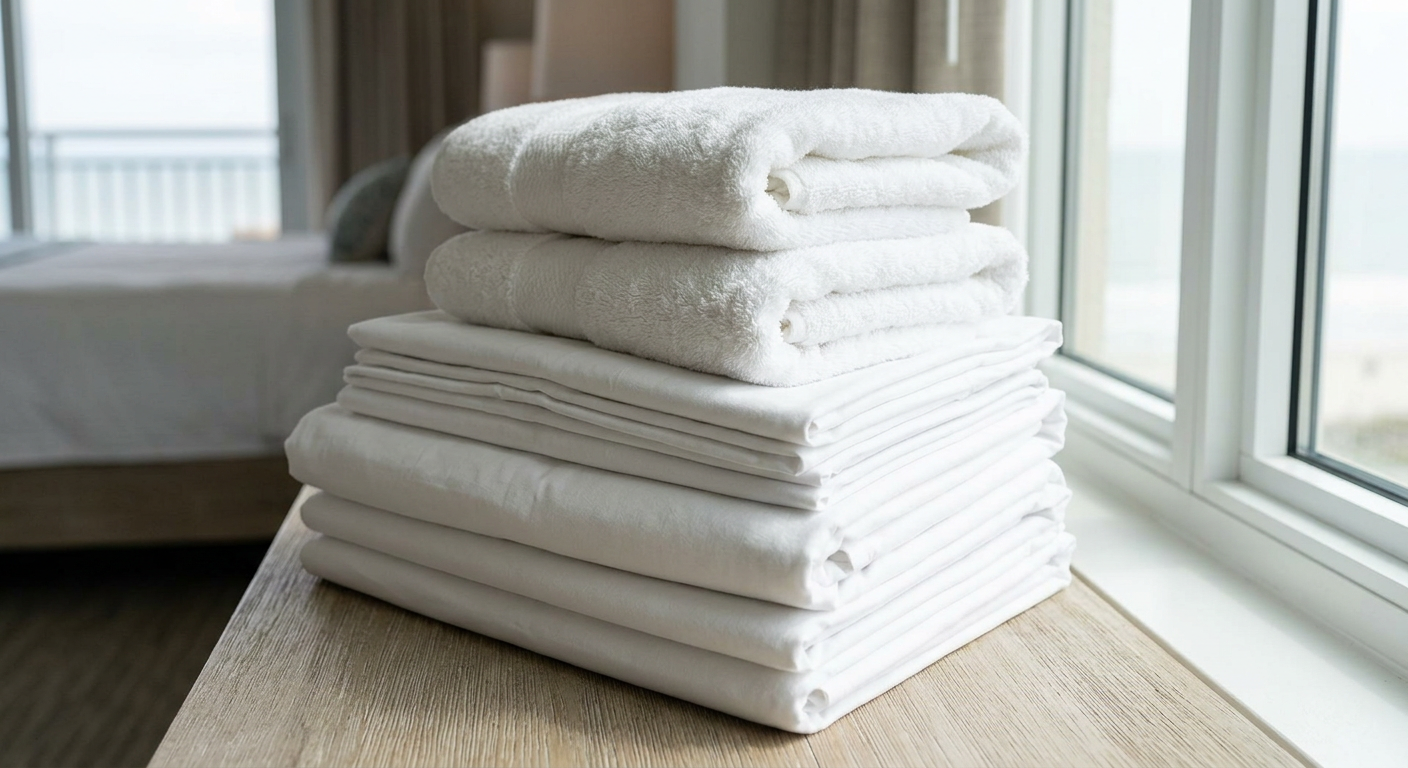
In the high-occupancy environment of Myrtle Beach and the Grand Strand, vacation rental linens endure a constant assault from sweat, natural skin sebum, and long-wear cosmetics. When these organic compounds combine with our local hard-water minerals and humid salt air, they form stubborn chemical bonds that resist standard residential wash cycles. Left unaddressed, these residues cause premature graying, yellowing, and costly linen discard rates. This technical guide outlines the professional chemistry, wash-wheel steps, and inventory strategies required to completely extract these residues and protect your linen investments.
The Chemistry of Coastal Cosmetic and Sebum Bonding
In our humid Grand Strand climate, natural skin oils—primarily squalene, wax esters, and triglycerides—are produced at elevated rates by active, vacationing guests. When guests sleep on high-thread-count cotton or poly-cotton rental sheets, these sebum molecules migrate deep into the fiber matrix. The ambient moisture in oceanfront properties prevents these oils from drying out naturally, allowing them to act as a sticky binder for airborne dust, micro-sand, and skin cells.
The problem worsens dramatically with modern cosmetics. Today’s waterproof foundations, sunscreen primers, and transfer-resistant lipsticks are formulated with synthetic silicones like dimethicone and cyclopentasiloxane. These compounds are engineered specifically to resist water and perspiration, meaning they will not dissolve in a standard domestic wash cycle. Instead, they cling to the cotton fibers, forming a hydrophobic barrier that seals in pigments and organic soils.
When these contaminated linens are stuffed into laundry bins and stored in hot, humid service closets or transport vans, a chemical curing process begins. The heat and humidity accelerate the oxidation of the sebum, turning it yellow and bonding the cosmetic silicones to the fabric. This transformation turns a superficial surface smudge into an industrial-grade cleaning challenge that requires specific, multi-stage surfactant chemistry to break down.
The Hard-Water Minerals of the Grand Strand and the Grey-Out Trap
Municipal water supplies along the Grand Strand often carry high concentrations of calcium and magnesium ions. When these minerals enter a commercial or residential washing machine without proper treatment, they react directly with standard soap molecules. This reaction creates an insoluble substance known as calcium stearate, or soap scum, which precipitates out of the water and settles directly onto the bedsheets.
This mineral precipitation acts as a microscopic magnet for dissolved sebum and microscopic cosmetic pigments. As the wash cycle runs, these suspended soils stick to the mineral-laden soap scum on the fabric, causing a phenomenon known as redeposition. Over multiple wash cycles, this redeposition turns pristine white sheets a dull, dingy gray that guest feedback loops immediately flag as dirty.
To prevent this grey-out trap, laundry operators must introduce chelating agents or liquid water conditioners during the initial phases of the wash cycle. Compounds like ethylenediaminetetraacetic acid (EDTA) or nitrilotriacetic acid (NTA) work by chemically binding to calcium and magnesium ions. This prevents the minerals from reacting with detergents, keeping the soils suspended in the water so they can be safely drained away.
The Thermal-Setting Trap: Why Hot Wash Cycles Lock Cosmetic Stains
A common mistake made by property managers and clean teams is running stained linens through an immediate high-temperature wash cycle. While hot water is essential for sanitization, introducing heat too early in the cycle will permanently set cosmetic and organic stains. High temperatures denature the proteins found in skin cells and sweat, essentially cooking them into the cotton fibers like an egg frying on a pan.
Furthermore, intense heat melts the synthetic waxes and polymer binders present in long-wear lipsticks and liquid foundations. Once melted, these liquid waxes flow into the microscopic crevices of the cotton-polyester weave. As the water cools during the rinse cycle, these waxes solidify again, trapping the cosmetic pigments inside the core of the yarn where no subsequent chemical wash can reach them.
To avoid this thermal-setting trap, a professional wash recipe must always begin with a cool or lukewarm wash phase. This initial step emulsifies and flushes away the heat-sensitive soils and surface pigments before any high temperatures are introduced. Only after these binders are safely rinsed out of the wash wheel should the temperature be increased for sanitization and deep brightening.
The Four-Stage Wash Cycle Recipe for Cosmetic and Sebum Elimination
Our professional cleaning standards rely on a highly structured, four-stage wash cycle on commercial programmable equipment. Stage one is a low-temperature flush, lasting five to seven minutes at 90°F with a high water level. This step uses mechanical action and water volume to loosen sand, salt, sweat, and surface powders, carrying them out of the drum before any chemical breakdown of deeper oils begins.
Stage two is the alkaline break and detergent wash, running for twelve to fifteen minutes at 120°F to 130°F with a low water level. Here, we introduce a high-pH alkali builder alongside non-ionic detergents to raise the water pH to roughly 10.5. This high-alkaline environment swells the cotton fibers, opening up the weave and allowing the specialized surfactants to emulsify deep-seated sebum and silicone makeup bases.
Stage three is the bleaching and sanitizing phase, executed at 140°F to 150°F with a low water level for ten minutes. An oxygen-active or chlorine-based bleaching agent is introduced to target organic pigment residues, ensuring complete sanitization of the fabric. It is crucial to monitor water temperatures during this phase, as bleach requires precise temperature thresholds to activate efficiently without degrading the cotton's tensile strength.
Stage four is the rinse and souring phase, consisting of three high-water-level rinses followed by a final souring injection. A specialized laundry sour, such as fluorosilicic acid, is added to lower the fabric's pH to a skin-neutral 5.5 to 6.5. This neutralization step dissolves any remaining alkaline detergent residues, flushes out mineral deposits, and prevents the chemical yellowing that occurs when alkaline sheets are exposed to ironer heat.
Specialized Surfactants and Solvent Builders for Silicone and Wax-Based Foundations
Standard retail laundry detergents rely heavily on anionic surfactants, which are excellent at removing clay and mud but struggle with oily, synthetic cosmetic bases. For professional rental linen processing, non-ionic surfactants—specifically alcohol ethoxylates—are required. Non-ionic surfactants carry no electrical charge, allowing them to penetrate oil-and-water interfaces and break apart hydrophobic silicone barriers.
When dealing with heavy cosmetic loading, a d-limonene or citrus-based solvent builder should be injected during the alkaline break stage. These bio-solvents work by dissolving the wax matrices of lipsticks, waterproof mascaras, and self-tanners without stripping or weakening the synthetic or natural fibers of the sheets. This targeted solvent action turns semi-solid cosmetic residues into a liquid emulsion that can be easily washed out.
Once these oils are emulsified, the wash chemistry must prevent them from settling back onto the linens. Polymeric dispersing agents are utilized to wrap around the suspended oil and silicone droplets, giving them a negative charge that repels them from the negatively charged cotton fibers. This ensures that when the drain valve opens, the suspended cosmetics exit the machine completely, leaving no gray shadow behind.
- Utilize non-ionic alcohol ethoxylate surfactants for superior emulsification of hydrophobic silicone cosmetic bases.
- Incorporate d-limonene solvent builders during the break cycle to dissolve heavy wax formulas.
- Maintain wash-wheel pH levels between 10.0 and 11.0 to swell cotton fibers and release trapped oils.
- Deploy polymeric dispersing agents to prevent soil redeposition during the rinse cycles.
- Ensure wash-wheel water levels are calibrated correctly to maximize chemical concentration during the break step.
Mitigating Self-Tanner DHA Reaction in Hospitality Linens
Dihydroxyacetone (DHA) is the active ingredient in sunless self-tanners, a product widely used by tourists visiting the Grand Strand. DHA works by reacting with the amino acids in the dead outer layers of human skin, creating a temporary browning effect. However, unreacted DHA on a guest’s skin easily transfers to white bedsheets and pillowcases during the night through friction and perspiration.
The critical danger with DHA is that it is often invisible when the sheets are stripped from the bed. If these sheets are washed using standard chlorine bleach, a chemical reaction occurs. The chlorine oxidizes the DHA, turning it a bright, stubborn yellow-orange stain that is incredibly difficult to remove. Once oxidized and set by the high heat of a commercial flatwork ironer, the stain becomes permanent, forcing the linen to be discarded.
To safely extract self-tanner, sheets suspected of DHA contamination must be treated with oxygen-based bleaching agents (like hydrogen peroxide) or reductive bleaches (such as sodium hydrosulfite) rather than chlorine. These chemicals break the molecular bonds of the DHA without the oxidizing reaction that triggers the orange discoloration. Processing these linens at controlled temperatures ensures the tanner is lifted safely and the sheet remains bright white.
Inventory Par-Level Math to Allow Stain-Recovery Soak Windows
Many vacation rental managers struggle with linen stains because their inventory is running on a thin par level. Operating with a 1-par or 2-par system forces clean teams to wash, dry, and pack linens as fast as possible to meet tight check-in windows. This rush leaves zero time for the specialized, multi-stage stain extraction and soaking processes required to salvage cosmetically damaged sheets.
To run an efficient, high-quality rental portfolio, property managers must implement a strict 3.5 to 4-par inventory standard. One par is on the beds, one par is clean in the property owner's closet ready for the next turn, one par is dirty at the laundry facility being processed, and the remaining half-par is held in a central warehouse as a buffer pool to replace damaged or heavily stained items.
This healthy par level provides the laundry team with a critical 'reclamation window.' Stained sheets do not have to be rushed through the main wash-wheel and dried. Instead, they can be routed to a dedicated salvage lane, where they can undergo a 12-to-24-hour enzyme soak to break down stubborn sebum and cosmetic oils. This luxury of time dramatically increases linen recovery rates and lowers annual replacement costs.
Quality Assurance Inspections and Post-Dryer Rejection Audits
The final defense against stained linens reaching a guest bed is a structured, multi-point quality assurance inspection. The folding table at the laundry facility must be equipped with high-intensity, color-corrected LED lighting (with a minimum Color Rendering Index of 90). This specific light spectrum mimics natural daylight, exposing subtle yellow sebum halos and pale cosmetic smears that standard yellow facility lighting hides.
Laundry technicians should be trained in the 'folded-edge inspection' protocol. As sheets are pulled from the dryer or flatwork ironer, they must be drawn across a clean, backlit inspection table. Technicians look for any shadows, dark spots, or yellowing along the center folds and pillowcase openings where face oils and makeup naturally accumulate. Any piece failing this visual audit is pulled immediately before it can be folded and packed.
Rejected linens must be categorized and routed to marked salvage bins, keeping them separate from standard wash cycles. Treating these rejected items as a separate chemical run—using extended soak times and highly concentrated enzyme formulations—allows the team to recover up to 85% of cosmetically stained linens that would otherwise be thrown away. For professional assistance with your linen care program, call the experts at A2Z Cleaning & Linen Services at 843.800.2788.
Key takeaway
Successfully managing Grand Strand rental linens requires moving away from domestic laundry habits and adopting precise, commercial-grade chemical protocols. By understanding the chemistry of waterproof cosmetics, hard-water mineral reactions, and proper wash-wheel stages, property managers can keep their sheets pristine white while extending their operational lifespan. Investing in a healthy par-level ensures your linen assets receive the careful restoration they need to consistently impress your guests.
Related services
Keep Reading
Linens & Laundry
The DHA and Bronzer Extraction Protocol: Salvaging Self-Tanner Stained Linens in Grand Strand Vacation Rentals
ReadLinens & Laundry
The 3-Par Linen Formula: Calculating Inventory Lifespans and Industrial Wash Formulas for Grand Strand Vacation Rentals
ReadLinens & Laundry
The Sunscreen Stain Solution: Protecting Myrtle Beach Rental Linens from Orange Rust Spots
ReadReady for a spotless property?
Call 843.800.2788 or request a free quote from A2Z Cleaning & Linen Services.