Coastal Living
The Cost of Restoring Coastal Luxury Vinyl Plank and Engineered Hardwood Flooring: Mitigating Sand-Grit Micro-Scratches, Salt-Damp Seam Swelling, and Residue Build-Up in Grand Strand Homes
Discover the costs, product safety standards, and technical differences between DIY and professional deep extraction for coastal LVP and engineered wood flooring in the Grand Strand.
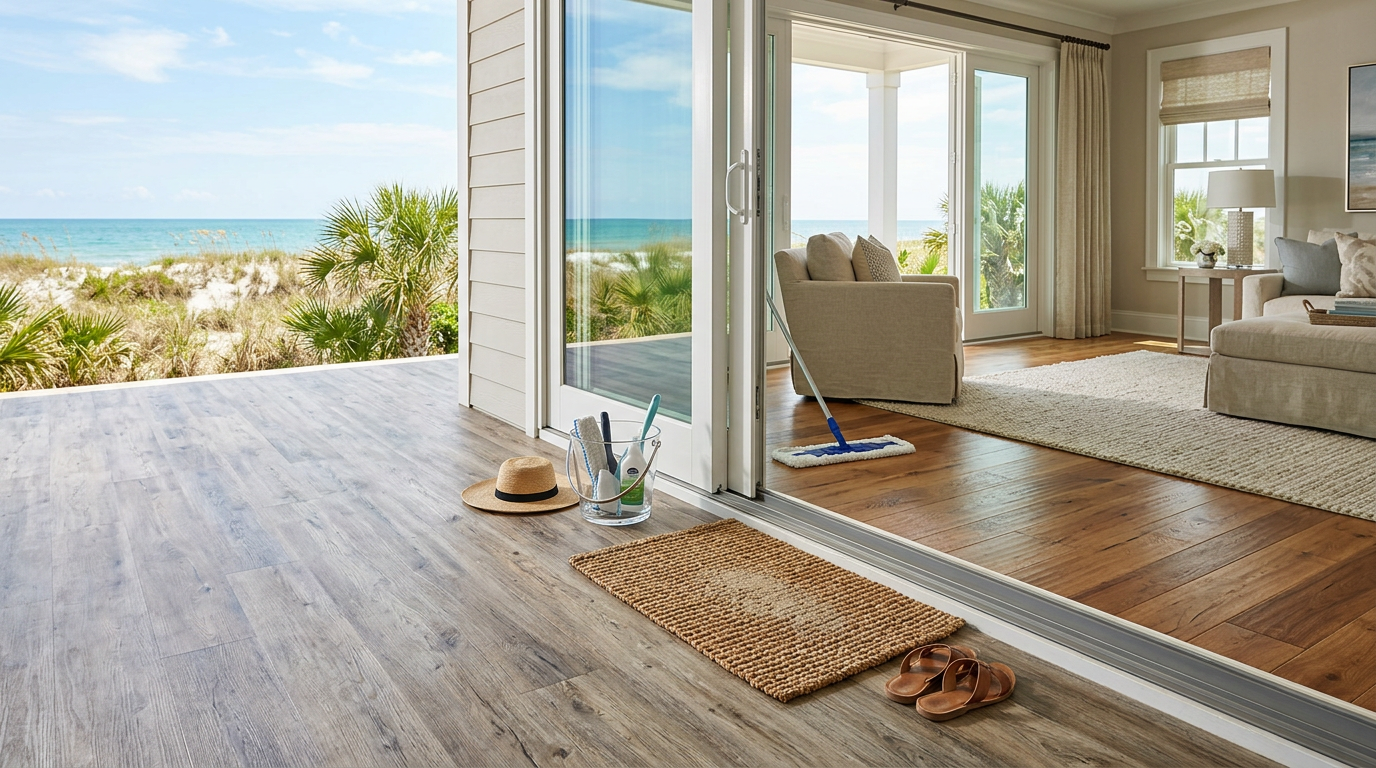
Hard flooring in Grand Strand homes faces a relentless combination of abrasive sand-grit, salt air, and high humidity that differs from any inland environment. While Luxury Vinyl Plank (LVP) and engineered hardwood are highly popular for their modern aesthetic, they require specialized care to prevent premature wear and unsightly cloudy haze. This guide explores the actual costs of professional restoration, safe chemical standards, DIY pitfalls, and how to protect your major flooring investment. For expert, high-extraction floor care tailored to our coastal climate, call A2Z Cleaning & Linen Services at 843.800.2788.
The Coastal Threat Matrix: Sand, Salt, and Moisture vs. Your Hard Flooring
Welcome to the unique flooring challenges faced by homeowners along the Grand Strand. From Cherry Grove to Murrells Inlet, our homes are subject to a constant influx of abrasive sand, salt-laden air, and oppressive humidity. While Luxury Vinyl Plank (LVP) and engineered hardwood are marketed as highly durable, the coastal environment tests their limits daily. Fine silica sand acts as an abrasive agent underfoot, while ambient salt air works its way into floor joints. Understanding how these factors interact with your home's flooring is the first step in protecting your major financial investment.
Many Grand Strand homeowners choose LVP for its water resistance, or engineered hardwood for its premium warmth. However, neither material is completely immune to the physical and chemical realities of living near the ocean. Moisture from damp swimsuits, pet paws returning from the beach, and high indoor humidity can cause engineered wood veneers to swell or delaminate. Meanwhile, micro-fine sand particles lodge in the textured grain of LVP, slowly grinding away the protective wear layer and leaving a dull, chalky appearance that standard mopping cannot fix.
Protecting these surfaces requires moving beyond standard retail cleaning methods. A simple grocery-store mop often spreads a thin layer of salty slurry across the floor, depositing fine grit deep into the seams where it accelerates structural wear. To preserve the integrity and appearance of your floors, you need a specialized approach that addresses the physical mechanics of sand friction and the chemical properties of salt-damp residue. This guide breaks down the restoration processes, realistic costs, and safety considerations for restoring your hard floors.
The Anatomy of Floor Degradation: Sand-Grit Micro-Scratches and Salt-Damp Seam Swelling
To understand why coastal floors fail, we must look at sand under a microscope. Grand Strand sand is composed largely of quartz and silica, materials with a high Mohs hardness rating. When shoes or bare feet press these sharp-edged granules into your floor, they act exactly like sandpaper. Over months of foot traffic, these micro-scratches destroy the factory-applied polyurethane wear layer of LVP or the top coat of engineered wood. Once this protective barrier is compromised, the underlying material becomes highly vulnerable to staining, moisture intrusion, and UV discoloration.
Salt-damp seam swelling is another major concern, particularly for engineered hardwood and click-lock LVP. High humidity levels, combined with microscopic salt crystals that attract and hold atmospheric moisture, can cause floor seams to remain perpetually damp. When salt-laden moisture penetrates the seams, the core material of engineered wood—often high-density fiberboard or plywood—absorbs the water and expands. This leads to cupping, peaking, or puckered seams that cannot be flattened out once structural deformation occurs, making early mitigation absolutely critical.
In LVP flooring, while the vinyl itself is waterproof, the joints are not hermetically sealed. Salty water from beach gear or frequent wet mopping can seep through the locking mechanisms, pooling on the subfloor. This trapped moisture becomes a breeding ground for mold and mildew in the warm Grand Strand climate, leading to musty odors and potential subfloor rot. Additionally, as the water evaporates, crystallizing salt expands within the locking joints, slowly weakening the physical connection between planks and causing them to separate or buckle over time.
The DIY Residue Trap: Why Popular Cleaners and Wax Polishes Ruin Coastal Floors
When homeowners notice their floors becoming dull and scratched, their natural instinct is to reach for off-the-shelf floor polishes, waxes, or shine-restoring cleaners. Many of these products contain acrylic resins, silicone emulsions, or natural oils designed to temporarily fill micro-scratches and create a reflective surface. However, in a coastal environment, these sticky coatings act as a magnet for fine sand and dust. Within days, the new grit becomes permanently embedded in the soft wax layer, creating an abrasive sandpaper film that darkens and clouds the floor's original color.
Applying layer after layer of these retail polishes creates a thick, yellowed build-up that resists standard cleaning. This residue traps salt crystals, which continuously absorb moisture from our humid Grand Strand air, leaving a streaky, hazy film that looks dirty even immediately after mopping. Stripping these stubborn acrylic and oil residues requires specialized chemical strippers. If these aggressive strippers are used incorrectly by a well-meaning DIYer, they can dissolve the factory finish of LVP or dissolve the adhesives holding engineered wood layers together.
Furthermore, many household cleaners contain harsh surfactants, high pH-alkalinity, or acidic ingredients like vinegar. While vinegar is often touted as a natural cleaning miracle, its acetic acid slowly etches the protective finish on engineered wood and can degrade the plasticizers in LVP, making them brittle over time. Steam mops are equally dangerous; the intense heat and pressure force moisture deep into floor joints, causing immediate wood delamination and warping LVP core layers. Safe restoration requires avoiding these quick-fix chemical shortcuts.
DIY Maintenance vs. Professional Deep Extraction: Choosing Your Battle
Deciding between a DIY approach and hiring a professional floor restoration service comes down to the current state of your flooring. Daily and weekly maintenance is best handled as a DIY task, provided you use the correct tools. A dry, high-density microfiber dust mop should be your primary defense, used daily to lift sand before it can scratch. For light damp mopping, a neutral-pH cleaner paired with a barely damp microfiber pad will suffice for removing light salt film without saturating the seams.
However, once sand-grit has become deeply embedded in the textured grain of LVP, or when a heavy build-up of wax residue has clouded the floor, DIY methods reach their limit. Residential mop-and-bucket systems lack the extraction power required to lift soil out of the deep pores of the flooring. Instead, they simply redistribute dirty water, leaving behind a gray residue in the textured valleys of the planks. Professional restoration utilizes specialized cylindrical counter-rotating brush (CRB) machines that physically lift and extract embedded grit from deep textures.
Professional truck-mounted or high-performance portable extraction systems also employ high-volume vacuum recovery. This ensures that cleaning solutions and dissolved salt-grit are instantly lifted from the floor rather than pooling in the seams. For engineered hardwood, professional systems use specialized low-moisture cleaning protocols that safely deep-clean the wood grain without risk of moisture saturation. If your floors have lost their luster, feel sticky, or exhibit visible dark lines in the textured grain, a professional deep-extraction and residue-removal service is necessary.
The Cost Breakdown: Estimating Professional Restoration vs. DIY Equipment Rentals
Understanding the costs of floor restoration helps Grand Strand homeowners make informed budget decisions. For a professional deep-cleaning and sand-extraction service on LVP or engineered wood, expect to pay between $0.50 and $1.25 per square foot, depending on the layout and overall square footage. This service typically includes detailed edge vacuuming, application of a specialized soil-suspending agent, counter-rotating brush mechanical agitation, and high-vacuum extraction. For a standard 1,500-square-foot home, a professional deep extraction runs between $750 and $1,875.
If your floors have a heavy accumulation of DIY wax, acrylic polish, or oily residue, a chemical strip and restoration process is required. This process is more labor-intensive and involves applying residue-dissolving chemistry, mechanical scrubbing, and multiple rinse-extraction passes to return the floor to its original factory finish. Professional residue stripping typically adds $0.75 to $1.50 per square foot to the base cleaning cost. While this is more expensive, it is significantly cheaper than replacing ruined flooring, which can cost $6.00 to $12.00 per square foot.
In contrast, a DIY attempt using rental equipment costs around $50 to $100 per day for a basic floor scrubber, plus $30 to $50 for consumer-grade chemicals. While this seems economical, rental machines are often poorly maintained and lack the high-powered vacuum lift of professional systems. This leaves excessive moisture on the floor, increasing the risk of seam damage. Additionally, if you inadvertently use the wrong stripping chemical, you risk permanently bleaching wood veneers or dissolving LVP wear layers, resulting in thousands of dollars in premature replacement costs.
Product Chemistry and Safety: Choosing Non-Toxic, pH-Neutral Agents for Family and Pet Health
Product safety is a paramount concern for families, pets, and the delicate coastal ecosystem of the Grand Strand. Many industrial stripping and cleaning products rely on volatile organic compounds (VOCs), strong solvents, or high-alkali chemicals that release harsh fumes and leave behind toxic residues. This is particularly problematic for indoor air quality in modern, tightly sealed coastal homes. When selecting or hiring a company for floor restoration, look for green-certified, low-VOC, and biodegradable formulas that prioritize family safety without sacrificing cleaning efficacy.
The safest and most effective chemical profile for daily maintenance and professional deep cleaning is a pH-neutral, surfactant-free agent. Surfactant-free cleaners use advanced colloidal or ionic technology to break the bond between the soil and the floor without leaving behind sticky soap residues that attract sand and salt. These formulas are safe for children crawling on the floor and pets who lick their paws. They also prevent the rapid re-soiling that occurs when traditional, soapy floor cleaners are used in high-dust, coastal environments.
When professional residue stripping is required to remove old acrylic waxes, insist on non-ammoniated, water-based strippers. Ammonium-based strippers release toxic, eye-watering vapors and can permanently discolor the wood fibers in engineered flooring or turn the vinyl in LVP yellow. Modern botanical-based or low-emission stripping chemistry safely breaks down synthetic polymer chains without off-gassing toxic fumes. Always ensure that any cleaning agent used is thoroughly rinsed and extracted, leaving the floor neutral, dry, and perfectly safe for immediate family use.
Key Questions to Ask a Professional Grand Strand Floor Cleaning Company
Before hiring a floor cleaning or restoration company in the Myrtle Beach area, it is crucial to ask targeted questions to verify their technical expertise. Many general cleaning companies lack the specialized training required to handle sensitive coastal floor materials. By asking specific questions, you can screen out unqualified providers who might cause irreversible damage to your flooring.
A professional flooring specialist should easily explain their machine configurations, chemical selections, and moisture-mitigation strategies. If a company hesitates or gives vague answers about their procedures, they likely rely on generic carpet-cleaning equipment or aggressive scrub pads that are inappropriate for luxury vinyl or engineered wood. Protect your home by using our practical screening checklist during your initial inquiry.
Ensure that any technician entering your home is fully certified in hard-surface restoration. Proper certification guarantees they understand substrate chemistry, dwell times, and moisture-neutralization techniques. Taking the time to ask these detailed questions will give you absolute peace of mind that your home investment is in hands that respect both the aesthetic beauty and the physical engineering limits of your coastal floors.
- What specific machinery do you use to clean LVP or engineered hardwood floors?
- How do you prevent water from penetrating the seams of engineered wood and click-lock LVP?
- Are your cleaning agents pH-neutral, and do you perform a neutralizing rinse after stripping residues?
- Can you provide safety data sheets (SDS) for all chemicals used in my home?
- Do you carry comprehensive general liability and workers' compensation insurance?
Proactive Preservation: Daily Routines and Entryway Management to Extend Floor Lifespan
Preventing future damage to your coastal flooring requires establishing proactive daily routines and strategic barrier systems. The single most effective step you can take is implementing a strict no-shoes policy inside the home. By leaving outdoor footwear at the door, you eliminate up to 80 percent of the abrasive sand and salt-grit that would otherwise scratch your floors. Provide comfortable, soft-soled indoor slippers or socks for family members and guests to ensure compliance while keeping feet comfortable on your hard surfaces.
Additionally, place high-quality walk-off mats at every entrance. An effective entryway system consists of a coarse, scrape-style mat outside the door to remove large sand granules, and a high-absorption, microfiber mat inside to trap fine silt, salt air moisture, and dampness. Ensure these mats are long enough—at least three to four steps—so that guests naturally deposit outdoor soils before stepping onto your LVP or engineered hardwood. Avoid rubber-backed or latex-backed mats, as these can permanently discolor vinyl floors through plasticizer migration.
Keep your indoor relative humidity controlled between 35 and 55 percent using your HVAC system and dehumidifiers. This limits the expansion and contraction of engineered wood joints and prevents salt crystals from drawing moisture out of the air. Vacuum your hard floors at least two to three times a week using a vacuum cleaner specifically rated for hard surfaces, making sure the brush roll is turned off to prevent plastic bristles from scratching the wear layer. If you need professional assistance to restore your floors, call A2Z Cleaning & Linen Services at 843.800.2788.
Key takeaway
Protecting your luxury vinyl plank and engineered hardwood from the unique abrasive realities of the Grand Strand requires a shift away from wet-mopping and harsh consumer polishes. Utilizing neutral, residue-free chemistry and professional low-moisture mechanical extraction is the only way to safely remove embedded sand and restore your floor's original brilliance. For expert, family-safe flooring restoration, contact the team at A2Z Cleaning & Linen Services today at 843.800.2788.
Keep Reading
Coastal Living
The Coastal Consumer Guide to Restoring Capiz, Oyster Shell, and Beaded Chandeliers: Costs, DIY vs. Professional Care, and Material Safety in Grand Strand Homes
ReadCoastal Living
The Coastal Louvered Door and Airflow Closet Decontamination Protocol: Mitigating Damp Dust Slats, Mold Spores, and Eco-Friendly Airway Protection in Grand Strand Homes
ReadCoastal Living
The Cost of Restoring Coastal Natural-Fiber Rugs: Mitigating Humidity-Driven Rot, Sand-Grit Fiber Shredding, and Water-Staining in Grand Strand Homes
ReadReady for a spotless property?
Call 843.800.2788 or request a free quote from A2Z Cleaning & Linen Services.