Home Cleaning
The Grand Strand Toddler and Pet Floor-Level Play Zone Decontamination Protocol: Mitigating Humid Sand-Grit, Dander Allergens, and Chemical-Residue Hazards in Busy Family Homes
Discover a child-safe, pet-friendly decontamination protocol designed for Grand Strand families to eliminate humid sand, sticky dander, and chemical residues from low-level play zones.
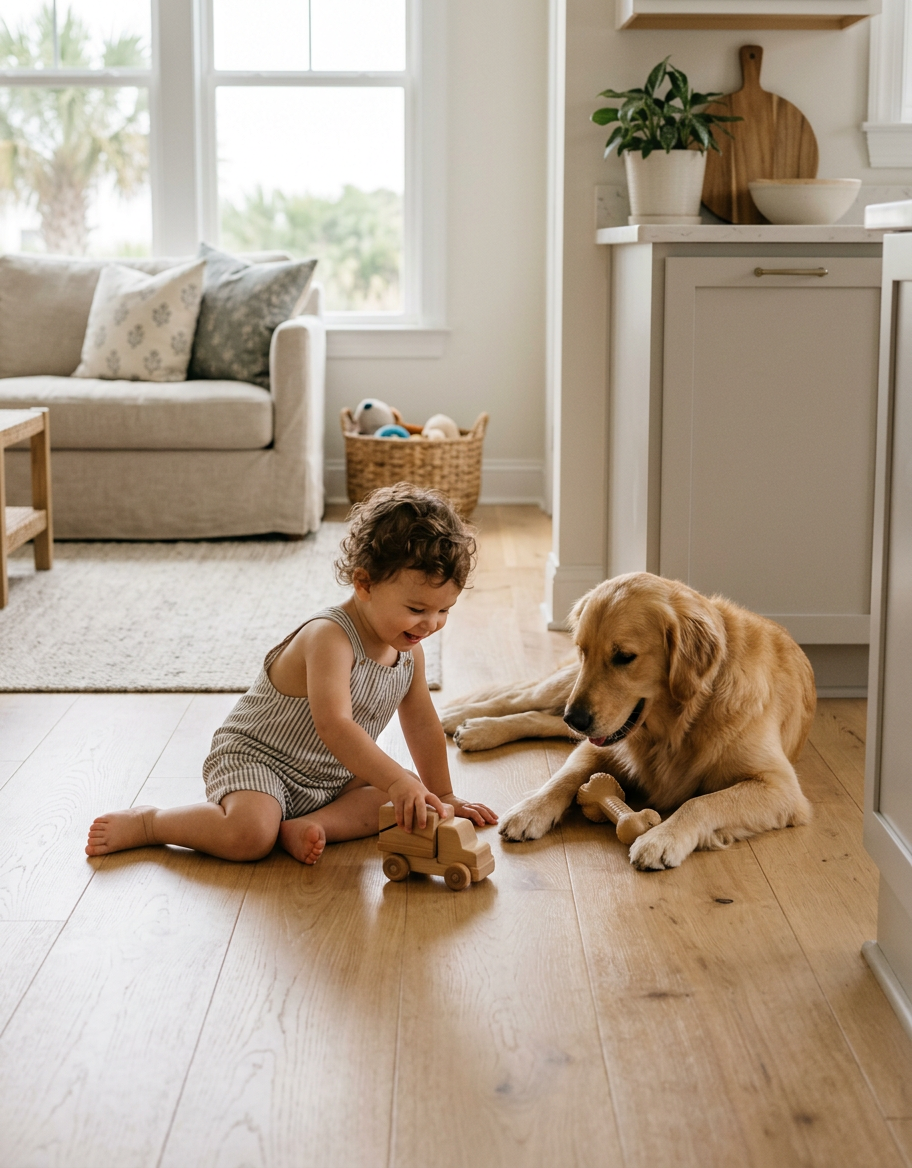
In busy Grand Strand households, the floor is much more than a design element; it is an active, low-level ecosystem where toddlers crawl, pets rest, and family life unfolds daily. The unique coastal climate of Myrtle Beach introduces high humidity and fine beach sand, which act as binding agents for airborne pet dander, outdoor allergens, and micro-particles. Conventional deep cleaning often relies on aggressive chemical agents that leave sticky, synthetic residues behind, creating an invisible hazard for sensitive young skin and curious pets. Developing a scientifically grounded, non-toxic decontamination routine is essential for maintaining a healthy, allergen-free home without compromising the safety of your family's most vulnerable members.
The Physics of the Floor-Level Zone: Why Coastal Families Face Unique Risks
In the humid coastal environment of the Grand Strand, gravity and moisture conspire to concentrate indoor pollutants in the bottom two feet of your living space. Fine quartz sand carried home from local beaches functions like sandpaper underfoot, grinding down fibers and surfaces while carving micro-grooves into hardwood, laminate, and luxury vinyl plank flooring. These microscopic abrasions act as harborages for organic debris, pet dander, and dust mites, which thrive in our naturally high humidity. Because toddlers spend the majority of their active hours crawling and playing directly on these surfaces, they are exposed to a significantly higher concentration of these settled allergens than adults.
The problem is exacerbated by the moisture-binding properties of pet sebum and saliva, which act as natural glues, binding fine dust and hair to the floor. When relative humidity levels rise, these organic protein matrices soften, capturing even more airborne particles and holding them firmly in place. Standard sweeping simply skims the surface of these sticky layers, redistributing fine particles back into the air where they can settle directly onto your child's hands and toys.
Furthermore, many off-the-shelf cleaning agents contain volatile organic compounds, synthetic fragrances, and heavy surfactants that do not fully evaporate. Instead, they leave a tacky, microscopic film that continuously traps dirt while posing a direct chemical-contact risk to children who frequently place their hands, toys, and pacifiers directly on the floor. To keep a coastal home truly clean and safe, families must pivot away from surface-masking products toward a systematic, residue-free decontamination protocol.
The Multi-Stage Mechanical De-Sanding and Hair Extraction Sequence
Before any liquid cleaning agents are introduced to a playroom or living room floor, a rigorous, multi-stage mechanical dry extraction must occur. Introducing moisture to a sandy, hair-laden floor creates a stubborn, abrasive slurry that pushes grit deeper into tile grout lines, floorboard seams, and carpet backings. To prevent this, the decontamination process must always begin with a dry-extraction phase that targets both high-mass sand particles and low-weight, electrostatic pet hair.
The sequence begins with a specialized, rubber-bristle broom or a silicone squeegee rake pulled across the floor in long, overlapping strokes. Unlike traditional nylon-bristle brooms that kick dust into the air and allow pet hair to escape via static cling, silicone and rubber create a gentle electrostatic charge that pulls hair, lint, and large sand grains into manageable piles. This initial sweep protects your vacuum cleaner's brush roll from becoming instantly bound and choked by long hair and fibers.
Following the manual sweep, a double-pass vacuuming technique using a certified HEPA-filter vacuum is required. The first pass should be executed slowly against the direction of the floor grain or carpet pile to lift embedded sand, while the second pass runs perpendicular to seal the surface clean. For busy Grand Strand households, this dry extraction must be performed at least three times per week in primary play zones to stop the physical abrasion of flooring substrates and eliminate the dry allergen load.
Selecting and Calibrating Child-Safe, Pet-Friendly Cleaning Chemistry
Transitioning to a non-toxic cleaning regime requires a clear understanding of surfactant science and pH balancing. Many commercial disinfectants rely on quaternary ammonium compounds, commonly known as quats, which have been linked to skin irritation and respiratory issues in both young children and domestic pets. To build an allergy-friendly, family-safe environment, coastal homeowners should select bio-based, biodegradable cleaning solutions that clean through enzymatic action and natural mineral chemistry rather than harsh synthetic agents.
Enzymatic cleaners formulated with plant-derived proteases and amylases are highly effective at breaking down the protein bonds found in pet saliva, urine, dander, and spilled milk. These enzymes physically digest the organic matter without leaving a chemical residue, turning complex allergen proteins into simple, water-soluble compounds that can be easily wiped away. For general sanitizing, a neutral-pH, plant-derived soap diluted in warm, distilled water offers excellent soil-lifting power without degrading wood finishes or irritating sensitive paws.
When dealing with hard-water mineral buildup or ocean salt films common to the Myrtle Beach area, a mild acid solution is highly effective. Pure distilled white vinegar diluted with warm water works naturally to dissolve salt crystals and hard-water deposits, leaving hard surfaces clean and streak-free without synthetic fragrances. However, this acidic solution must be used sparingly and only on acid-resistant surfaces, avoiding natural stone or unsealed grout where it can cause etching.
- Avoid products containing ammonia, bleach, synthetic fragrances, and quaternary ammonium compounds.
- Utilize plant-derived enzymatic cleaners to target and digest organic proteins from pet saliva and dander.
- Opt for pH-neutral, residue-free liquid solutions to prevent the formation of a sticky, allergen-attracting surface film.
- Use highly diluted distilled white vinegar on non-porous surfaces to neutralize ocean salt films and hard-water haze.
- Verify that all cleaning solutions are certified green, biodegradable, and completely free of artificial dyes and perfumes.
Hardwood and LVP Deep Decontamination: Lifting Sticky Dander Without Water Damage
Luxury Vinyl Plank (LVP) and engineered hardwood are popular choices in modern Grand Strand homes, but they require delicate moisture management to prevent structural damage. When wet-cleaning these surfaces, excess water can easily seep into the locking joints, leading to subfloor mold growth, edge cupping, and adhesive failure. To safely decontaminate these floors, a damp-mopping protocol using a highly wrung microfiber flat mop is the industry standard.
To tackle the sticky film of pet sebum and toddler food spills, spray a fine mist of your child-safe enzymatic cleaner directly onto the floor or onto the microfiber pad, rather than flooding the surface with a mop bucket. Microfiber pads feature wedge-shaped polyester and nylon fibers that are split to a fractional size of a human hair. This unique structure allows the pad to mechanically scrape up sticky, low-lying dander and grease, locking it within the fibers rather than spreading it across the floor.
Always work in small, controlled zones, moving the flat mop in a continuous figure-eight pattern to trap debris at the leading edge of the pad. If the flooring is highly textured to mimic wood grain, ensure that your final pass runs parallel to the embossing to extract any lingering residue from the deep grooves. Finish the process by running a dry, clean microfiber pad over the floor to absorb any remaining moisture, leaving the surface dry to the touch within sixty seconds.
Area Rug and Play Mat Sanitization: Neutralizing Pathogens in High-Contact Fabrics
Plush area rugs and interlocking foam play mats are comfortable spaces for babies to practice tummy time, but they also act as massive sinks for organic contaminants. Foam puzzle mats can trap spilled juices, drool, and pet accidents within their seams, creating a dark, humid breeding ground for yeast and bacteria. Woven rugs present an additional challenge, as their dense fibers trap sand particles that grind away at the backing while holding onto dander and dust mites.
For foam play mats, disassemble the tiles completely at least once a week to clean both the top and bottom surfaces, as well as the subfloor beneath them. Wash the tiles with a mild, fragrance-free dish soap and warm water solution, utilizing a soft-bristled brush to clear out the textured grip surfaces where grime accumulates. Thoroughly rinse the tiles with clean water and allow them to dry completely in a well-ventilated area before reassembling, preventing moisture from becoming trapped between the foam and the floor.
Area rugs require regular deep-extraction cleaning to remain truly allergy-safe. When using a home carpet cleaner, avoid heavy shampoo concentrates which leave a sticky, soapy residue that attracts dirt at an accelerated rate. Instead, fill the machine with warm water and a minimal amount of a low-foaming, non-toxic carpet rinse, ensuring you perform multiple dry-extraction passes with the machine to pull out as much water and dissolved organic soil as possible.
- Disassemble interlocking foam play mats weekly to clean the seams, textured surfaces, and the subfloor beneath.
- Use a soft-bristled brush with plant-derived soap to lift sticky residues from textured play mat surfaces.
- Avoid heavy soap concentrates in carpet extraction machines to prevent soapy residues that attract dirt.
- Maximize dry-vacuum cycles on carpet extractors to remove deep moisture and prevent mold growth in humid coastal weather.
- Thoroughly dry all rugs and play mats before returning them to active service to eliminate moisture pockets.
The Allergen-Barrier Maintenance Routine for Busy Grand Strand Households
Maintaining a clean, allergy-safe play zone in a busy home with pets and children requires a proactive containment strategy. The most effective way to keep your indoor play floors clean is to stop sand, dander, and outdoor pollen from crossing the threshold of your home. Establishing a dedicated entryway transition zone is the first line of defense for Grand Strand families.
Place heavy-duty, dual-zone walk-off mats at every entrance: a coarse, moisture-wicking scraper mat outside to catch heavy sand and mud, and a dense, high-pile microfiber mat inside to absorb residual moisture and fine dust. Implement a strict, household-wide shoe-free policy, providing comfortable indoor slippers or socks near the doorway to encourage compliance from both family members and guests. This simple step reduces the volume of outdoor chemical residues, lawn fertilizers, and street grime tracked onto your living room floors by up to eighty percent.
Additionally, keep a dedicated pet-wiping station stocked with pet-safe, hypoallergenic wipes and a dry microfiber towel at your primary entryways. Wiping down your dog's paws, underbelly, and coat immediately after walks removes damp sand, tree pollen, and outdoor allergens before they can be deposited onto rugs and carpets. This daily maintenance routine takes only a few minutes but dramatically reduces the allergen load in your home's central play areas.
- Install dual-zone walk-off mats at all exterior entrances to capture coarse sand and residual moisture.
- Enforce a strict shoe-free household policy to block outdoor chemical residues and street dirt.
- Set up a dedicated pet-wiping station near doorways to clean paws and coats immediately after outdoor activity.
- Execute a swift, five-minute nightly spot-clean of high-traffic play zones using a damp microfiber flat mop.
- Keep child-safe, fragrance-free surface wipes readily accessible for immediate cleanup of organic spills.
Micro-Climate Management: Controlling Indoor Humidity to Suppress Dust Mites and Pet Yeast
The coastal climate of the Grand Strand is characterized by prolonged periods of high humidity, which can easily infiltrate your home when doors are opened for children and pets. When indoor relative humidity levels rise above fifty-five percent, dust mites reproduce rapidly, and mold spores begin to colonize organic materials like pet dander and wood fibers. For a family struggling with indoor allergies or asthma, controlling the indoor micro-climate is just as critical as physical cleaning.
To suppress these biological allergens, maintain your home's indoor relative humidity between forty-five and fifty percent. This dry environment halts the reproduction of dust mites and prevents the growth of yeast on pet dander settled in carpet fibers. Ensure your HVAC system is set to the 'Auto' position rather than 'On' to allow moisture to properly drain from the cooling coils, and utilize stand-alone dehumidifiers in low-lying play areas or basements to pull excess moisture from the air.
Complement your humidity control with high-efficiency MERV 13 air filters in your heating and cooling system, replacing them every thirty to sixty days in homes with active pets. By filtering out airborne pet dander and fine sand dust before they have a chance to settle, you keep your air cleaner and reduce the physical cleaning workload on your floors. This combination of moisture control and filtration creates a healthy, stable environment for young children playing close to the ground.
Professional Floor Restorations: When to Call A2Z Cleaning & Linen Services
Even with a rigorous daily cleaning routine, the constant influx of fine beach sand, airborne pet dander, and household spills can eventually overwhelm domestic cleaning equipment. Standard household vacuums and consumer-grade carpet cleaners often lack the extraction power required to lift deeply embedded quartz sand and stubborn dander proteins from the bottom of carpet backing and tight hardwood seams. Over time, these residues accumulate, leading to persistent musty odors and scratchy, abrasive floor surfaces.
When your home's floors begin to feel dull, show signs of persistent pet odors, or trigger allergy symptoms despite regular cleaning, it is time to schedule a professional floor restoration. At A2Z Cleaning & Linen Services, we specialize in non-toxic, deep-extraction cleaning methods tailored specifically for busy Grand Strand families. Our highly trained technicians use advanced, residue-free hot-water extraction systems and neutral, pet-safe chemistry to lift deeply embedded sand-grit and neutralize organic allergens without leaving harmful chemical residues behind.
By restoring your hard floors, area rugs, and carpets to a clean, residue-free baseline, we make it much easier for you to maintain a safe, healthy environment for your children and pets. For professional assistance in keeping your Grand Strand home fresh, clean, and allergy-friendly, contact A2Z Cleaning & Linen Services today at 843.800.2788 to schedule a deep-cleaning consultation tailored to your family's unique needs.
Key takeaway
Maintaining a healthy, low-level play zone in a coastal environment requires a systematic approach that balances deep mechanical extraction with gentle, non-toxic chemistry. By controlling indoor humidity, establishing protective entryways, and avoiding sticky chemical residues, families can create an allergy-friendly home where children and pets thrive. When daily routines are not enough to combat Grand Strand sand and dander, professional extraction provides the deep, safe restoration your household deserves.
Keep Reading
Home Cleaning
The Coastal Pet-Crate and Indoor Dog-Bed Restoration Protocol: Mitigating Humid Yeast Biofilms, Dander Reservoirs, and Urine-Ammonia Interactions in Grand Strand Homes
ReadHome Cleaning
The Coastal Modular Foam Play-Couch Decontamination Protocol: Managing Sand-Grit, Pet Dander, and Humidity-Trapped Spills in Grand Strand Homes
ReadHome Cleaning
The Sticky Floor Syndrome: Managing Pet Hair, Child-Safe Products, and Coastal Residues in Grand Strand Homes
ReadReady for a spotless property?
Call 843.800.2788 or request a free quote from A2Z Cleaning & Linen Services.